Kospi cycles longer term swing count remains bullish


Kospi Cycles Longer Term Swing Count Remains Bullish
The KOSPI Index in the long term has been trending higher with other world indices since inception in 1983. The index began with a base value set at 100 and trended higher until it ended that cycle in 1994. The index then corrected that cycle with the dip into 1998 lows during the Asian Financial Crisis. That is where the monthly chart pictured below begins. From the 1998 lows the index did three bullish swings higher into the November 2007 highs. The pullback from there until October 2008 was strong enough to suggest it was correcting the whole cycle up from the June 1998 lows.
Secondly I would like to mention this is a swing count. It is not an Elliott Wave count. As per the rules an impulse travels in the direction of the trend in 5-9 or 13 swings. When the bullish trend renewed to the April 2011 highs it reached the .618-.764 Fibonacci extension of the June 1998 to November 2007 cycle. This is a usual area for a 5th swing of a cycle. The 6th swing dip to the September 2011 lows corrected that cycle up from the October 2008 lows. The analysis continues below the chart.
Kospi Monthly Chart
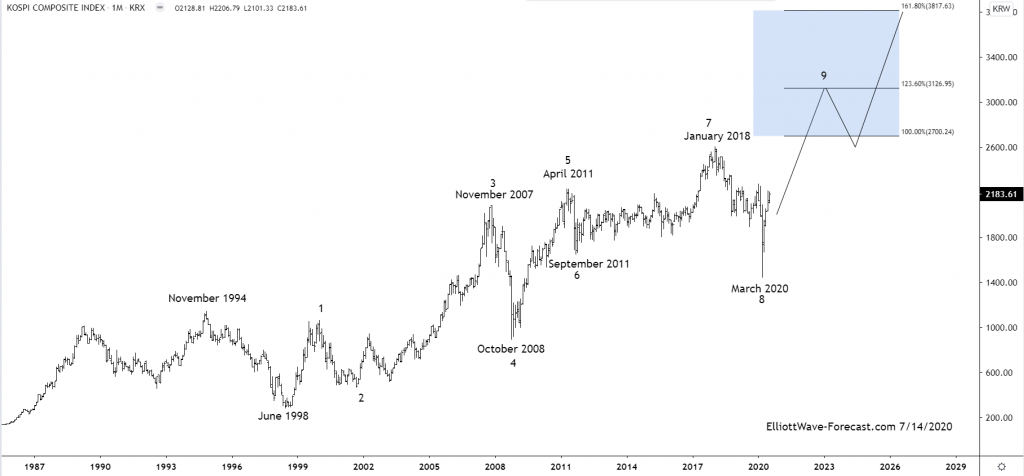
Thirdly, how these extension areas are measured. Take the Fibonacci extension tool on a charting platform. On this chart, point 1 will be at the beginning of the cycle at the 1998 lows. From there on up to the 2007 highs, marked with a 3, will be point 2. The point 3 will be down at the 2008 lows. This point is marked with a 4. The extension areas shown are the same as long as price remains above the 2008 lows. As previously mentioned from the 2008 lows the index has bounced in a 5th swing higher as well as correcting that bounce with the 2011 lows.
Lastly in conclusion the bounce from the 2011 lows ended a cycle on January 2018 and the dip to the March 2020 lows corrected that cycle. It should in the near term remain above there. Until it gets back above the January 2018 highs another swing lower can not be ruled out. However the trend is up and the index should trade higher into the target area at 2700-3126+ area before it sees another larger pullback to correct the cycle up from the March 2020 lows.
Author
Elliott Wave Forecast Team
ElliottWave-Forecast.com