Kevin Warsh as Fed Chair

Summary
We know from our many client discussions that there appears to be at least some degree of comfort with a Warsh led Fed vs. the other choices. But, we all should be mindful that there is also some degree of uncertainty associated with this pick if for no other reason than his public remarks on the economic outlook and the appropriate path for the federal funds rate have been fewer and farther between than the other finalists.
We generally expect Chair Warsh to support a more dovish stance on monetary policy driven in part by his optimism over productivity growth as well as his view of the need for lower rates to support "Main Street." And of course, a dovish slant is what President Trump wanted. That said, Warsh has historically been among the most hawkish of the four finalists on President Trump's shortlist. Warsh's reputation as a hawk stems from his time as a Fed Governor and during his post-Fed career.
Although Warsh's comments on the fed funds rate have been infrequent in recent months, he has maintained a belief that the Fed's balance sheet is too large—a belief he has long held and another factor that has contributed to his hawkish reputation.
We think it is highly unlikely that the Fed will shrink its balance sheet materially under Chair Warsh given how entrenched the "ample reserve" operating framework is in the financial system. Stated differently, there are no reasonably plausible scenarios where the financial system would comfortably absorb a sharp change to this stance, no matter what the leaning of the new Fed chair may be. There is a high hurdle to altering this framework.
Where we think Chair Warsh could affect more change is by de-emphasizing short-term data dependence in favor of "trend dependence", which we believe would lead to fewer, but more seismic, inflection points in U.S. monetary policy. We can also see him making a case for diminishing or even completely doing away with the Summary of Economic Projections and the Dots. We would not be surprised if he makes a case for less "Fed-speak".
When it comes to Fed independence, Warsh has been outspoken about the need for the Fed to revisit some of its current governance policies and processes, but he has publicly maintained a belief in the importance of central bank monetary policy independence.
It is also important to remember that monetary policy decisions are a Committee decision. Seven governors vote at each meeting in addition to five of the 12 regional Fed presidents. This ensures some continuity in the makeup of the FOMC as it transitions. Accordingly, we do not anticipate making any changes to our fed funds forecast, although as we have stressed elsewhere, we continue to see risks to our call.
We would give you just two more things to consider. Warsh has some challenges that start almost right away. First, does he act as a shadow Fed chair? If he is going to second guess Powell at every turn or forcibly disagree with him, he may appease his new boss, but he runs the risk of alienating himself to the rest of the Committee. We think Warsh knows this and will tread carefully around that, but it’s a risk. And second, what kind of consensus builder will he be? Criticize Powell as much as you like (and yes, we have been critical of him at times), but he is one heck of a consensus builder, carefully crafting and selling his message to members ahead of meetings. This will be critical for Warsh. The expectation is he wants to cut, perhaps even more aggressively than market pricing. If that is indeed the case, he has his work cut out for him in building a consensus toward that when the expectation of the Committee at large is just for one more cut per the dots (where we think the hurdle is growing higher even for that).
For those that want to read on, below you’ll find more detail about his background and our analysis of his direct quotes over the years…
Warsh's Windy Path Back to the FOMC
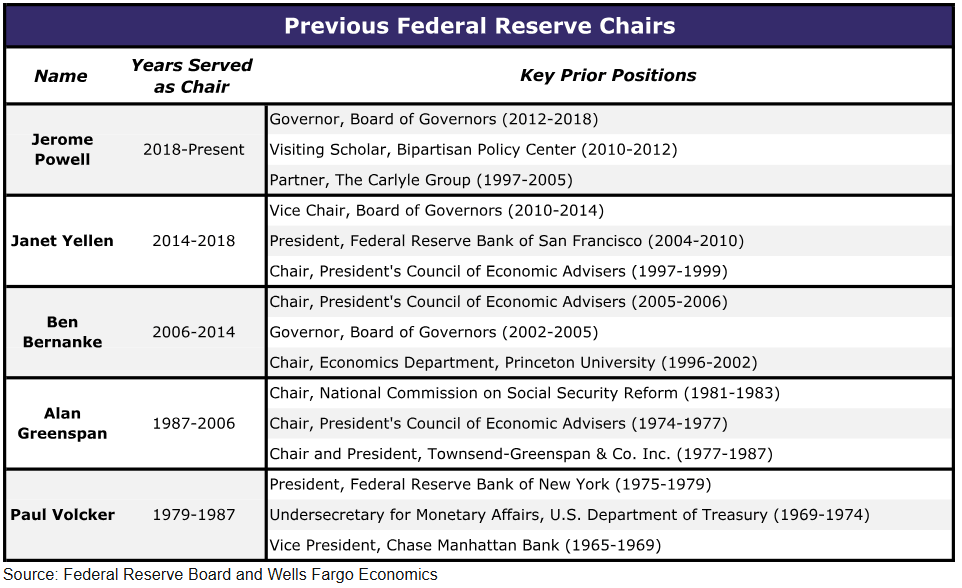
Like current Fed Chair Jerome Powell, Kevin Warsh does not hold a PhD in economics but has prior experience in the financial industry and public policy. After obtaining a law degree from Harvard in the mid-1990s, Warsh went on to work on Wall Street before holding several positions in the George W. Bush administration, including executive secretary to the National Economic Council. From 2006 to 2011, he served on the Federal Reserve Board of Governors. Although Ben Bernanke, Janet Yellen and Jerome Powell also served on the Board prior to their appointments as Fed Chair, Warsh's tenure is not as recent as his predecessors' was when they assumed the Chair (Figure 1). Warsh has not served in government since his time at the Fed, although he has remained active in public policy circles. He currently serves as a distinguished visiting fellow at the Hoover Institution.
Author
Wells Fargo Research Team
Wells Fargo

















