July CPI: Broad heat in the core

Summary
Consumer prices rose roughly in line with expectations in July. Headline CPI moderated to a 0.20% gain, keeping the year-over-year rate steady at 2.7%. Excluding food and energy, the core CPI was hotter, rising 0.32% over the month and pushing the year-over-year rate up to 3.1%—its highest year-ago reading since February. The details show tariff-related price increases continuing to seep into the economy, with core goods prices rising 0.2% in July amid additional increases for heavily imported items, such as household furnishings and recreational goods. Core services inflation picked up a stronger-than-expected 0.4% as a rebound in airfares and a strengthening in medical care services prices overtook the gradual moderation in primary shelter cost growth. Yet, with medical care and airfares not serving as source data for the PCE deflator, we currently estimate the core PCE index rose a softer 0.22% in July.
Today's CPI report illustrates the challenges the Fed faces in its efforts to balance its price stability and maximum employment dual mandate. The labor market is showing signs of lost momentum, but inflation is 1) still above the 2% target and 2) drifting in the wrong direction. We are skeptical of rate cuts much deeper than our current forecast of 25 bps cuts at the FOMC's next three meetings given the prospects for above target inflation over the next year. Unless the labor market deteriorates more markedly, it is hard to make the case that monetary policy should be accommodative at present, in our view.
Core inflation heats up in July
Consumer prices rose mostly in line with expectations in July. Headline CPI moderated to a 0.20% gain over the month, keeping the year-over-year rate steady at 2.7%. Excluding food and energy, price growth was hotter. The core index rose 0.32% in July, which marked the strongest gain since January. On a year-over-year basis, the core CPI increased 3.1%, the highest reading since February.
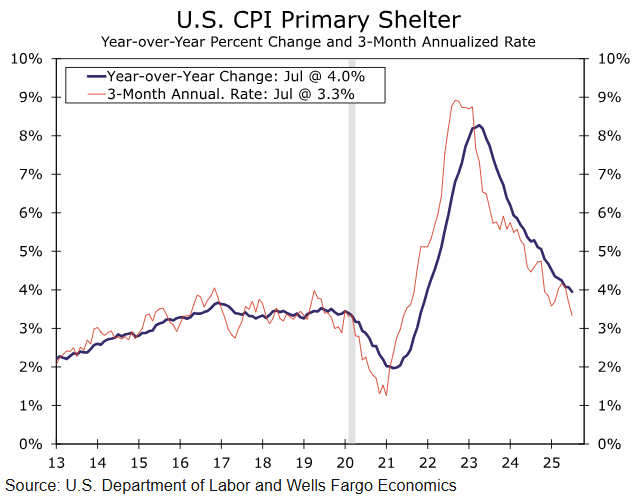
For all the consternation over the impact of tariffs on goods prices, it was mostly service-related categories that accounted for the firmer core reading in July. Medical care services (+0.8%) and airfares (+4.0%) posted monthly readings that were stronger than we were expecting and above their recent trends. Rent of primary shelter and owners' equivalent rents were spot on, matching expectations at 0.3% month-over-month. Primary shelter inflation continues to moderate on trend and is starting to approach its pre-pandemic pace (chart). Core goods inflation was 0.2%, below the 0.3% we were expecting but above the 0.05% that this category averaged in the 12 months ending in June. Tariff-related price increases continued to seep slowly into the data, with prices for household furnishings, apparel and recreational goods once again climbing higher. Prices for used autos rose 0.5% in the month, while new vehicle prices were roughly flat in July.
With medical care and airfares not serving as source data for the PCE deflator, the Fed's preferred measure of inflation looks likely to be somewhat softer in July. We currently estimate the core PCE index rose 0.22% last month. We will update our estimate following Thursday's PPI report.
Author

Wells Fargo Research Team
Wells Fargo