JPY: Intervention fears clash with carry trade attractiveness


Key points:
-
USDJPY reversed from near-158 levels that sparked intervention fears
-
Yen strength is still likely to be temporary as Fed sticks with high-for-longer
-
Low volatility summer months can fuel more carry trades, and yen remains a preferred funding currency
-
The expectations of BOJ rate hike are rising again, but this hardly erodes the carry advantage
Overview of current USD/JPY trends
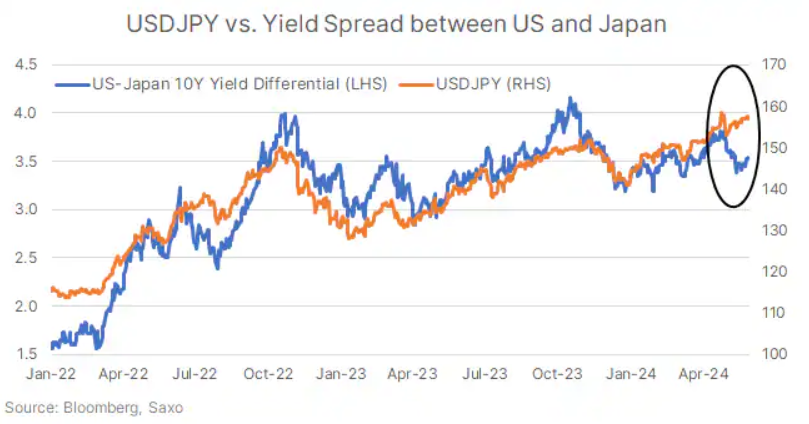
The USD/JPY pair remains a key focus for investors as Treasury yields have surged this week due to weak auctions and the Federal Reserve's consistent message of a prolonged higher interest rate environment. The pair touched a high of 157.70 overnight, nearing the intervention level speculated to be around 158. Japanese authorities intervened near this level on May 1, and the market now views 158 as a critical point for potential intervention.
The Bank of Japan (BOJ) has been relatively restrained in verbal interventions, possibly waiting for weaker U.S. economic data and a shift in Fed policy to support the yen. To gauge the risk of intervention, consider the following metrics:
-
A 10 yen/USD move within one month.
-
A 4% depreciation in the yen over two weeks.
Neither of these conditions has been met, which explains the lack of strong verbal interventions. However, caution has increased as the USD/JPY approaches the key 158 level, causing the pair to retreat below 157.
Japanese yields and Yen weakness
Recently, Japanese Government Bond (JGB) yields have climbed to their highest levels in over a decade, with the 10-year yield surpassing 1%. This rise is driven by speculation that the BOJ might raise rates again as early as July, if not June. The next BOJ announcements are scheduled for June 14 and July 31. BOJ member Adachi has noted that yen weakness is contributing to price pressures, which might prompt an earlier-than-expected rate hike.
Despite rising Japanese yields, the yen has not shown significant strength.
Implications
We anticipate that any yen strength will be temporary, primarily due to ongoing fears of intervention by Japanese authorities. The low-volatility summer months are likely to fuel carry trading, and the yen remains a preferred funding currency. Even if the BOJ raises rates in June or July, the increase is expected to be minimal and unlikely to significantly close the gap with US interest rates. Consequently, movements in USDJPY towards the 155 level could attract more carry trade interest, as investors take advantage of the interest rate differentials.
Despite rising Japanese yields, the yen has continued to weaken, highlighting the persistent yield advantage of the USD and the influence of higher US interest rates. This trend underscores the attractiveness of the yen as a funding currency for carry trades, where investors borrow in low-yielding currencies to invest in higher-yielding assets. As such, the yen’s weakness is expected to continue unless there is a significant shift in US economic data or Fed policy that would lead to a re-evaluation of current market dynamics.
How to trade the Yen
-
Long USD/JPY on dips: This strategy can be used if you believe that Fed rate cuts are unlikely in the near term and BOJ rate hikes will be minimal. Be mindful of intervention risks around 157.50+ levels.
-
Short Yen in other pairs: Shorting the yen could be considered against currencies where easing cycles are expected to be delayed, such as AUDJPY or NZDJPY. EURJPY and GBPJPY could also benefit given higher inflation is likely to mean delayed and slow rate cut cycles even if the ECB rate cuts begin next week.
-
Expectations of Yen strength: If you expect the U.S. economy to weaken faster than anticipated, leading to Fed rate cuts, this could trigger a carry trade unwinding and result in significant yen strength. Additionally, any expectations of BOJ tightening could support the yen, making short USDJPY positions attractive.
-
Minimal negative carry pairs: When bullish on the yen, pairs with minimal negative carry could be considered, such as CNHJPY or CHFJPY.
Read the original analysis: JPY: Intervention fears clash with carry trade attractiveness
Author
Saxo Research Team
Saxo Bank
Saxo is an award-winning investment firm trusted by 1,200,000+ clients worldwide. Saxo provides the leading online trading platform connecting investors and traders to global financial markets.