It’s another short week for just about everybody


Outlook
It’s another short week for just about everybody. Markets will close at noon on Wednesday and plenty of traders will be absent on Friday, including us.
Last week we asked how traders want to be positioned at the year-end. The consensus view is that they want to be long equities and precious metals and short the dollar and crypto, but we are seeing a +retreat in all of those. We suspect or perhaps wish it’s just year-end profit-taking. About Silver, a Bloomberg analysts has this:
“While there was no clear driver for the Silver pullback, the low levels of liquidity and silver’s parabolic rise means that it is vulnerable to a snap back. Macro drivers and liquidity remain light, meaning that such erratic price action in the metals space could be a feature of trade for what is left of 2025.”
Given the thin market and sentiment switching to fear, we can only expect more of the same today and tomorrow.
We do get data this week. Today it’s US goods trade and the Dallas Fed. Tomorrow it’s Case Shiller home prices and the Chicago PMI. Wednesday it’s the Fed minutes and jobless claims. On Friday it’s PMI’s for the US, eurozone and US.
The PMI’s have become the key indicator in recent years, so there is some chance that Friday’s data will shift gears, especially in the UK. There the twin deficits are a drag on the pound offset only by a slow-motion Bank of England delivering nice yields. If you read the Economist, the public mood is sour, letting the political situation get really bad. But the S&P version of manufacturing PMI was surprising healthy and another verification would presumably support sterling, which in any case has fallen back less than the Europeans.
Absent any big surprises, the rest of the week will deliver results based on positioning by the big players with small players either out or sheep.
Forecast
The EUR/USD just missed putting in an engulfing bear candlestick on Friday. We are very unhappy about the USD/CHF delivering an engulfing bull candlestick on Friday. It’s one of the more reliable candlestick indicators in FX. It could be due to squaring up positions, or some game-playing to scare the dollar shorts going into year-end (Monday being the last useful day to do a spot trade).
We can’t stop the ride. Our worst-case scenario for today to Wednesday noon is the previous low, 1.1705 from Dec 19.
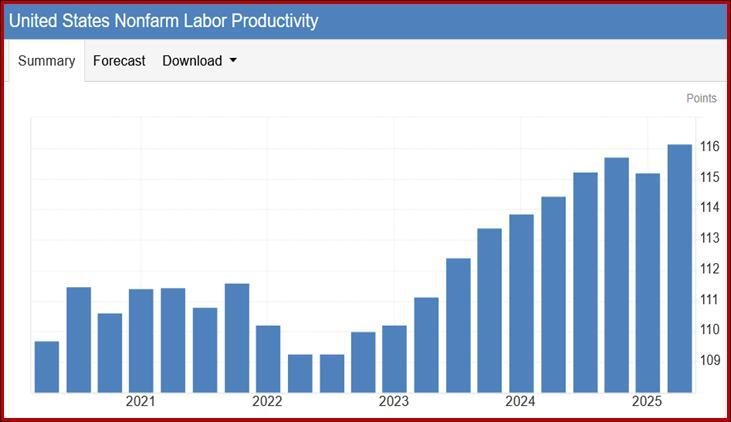
Food for thought: The loss of jobs and rising unemployment at the same time the economy is booming is inherently contradictory. Doubts about the data are few. How can this be? The Econ 101 answer is a rise in productivity. That’s a problem. Productivity data is hard to get a grip on. We will go with Trading Economics (yes, we hate the “points,” too). See the chart. Here is the text:
Productivity in the United States increased to 116.14 points in the second quarter of 2025 from 115.21 points in the first quarter of 2025. Productivity in the United States averaged 60.70 points from 1947 until 2025, reaching an all time high of 116.14 points in the second quarter of 2025 and a record low of 22.07 points in the third quarter of 1947.
The critical sentence is “all time high in Q2 2025.” So yes, you can have your cake and eat it, too.
The WSJ has a story on jobs that is pretty grim. A Yale School symposium showed 66% of CEO’s and other top big-company managers leaders said they will not be hiring next year. Only a third will be hiring.
“You’re going to see a lot of wait and see,” said Chris Layden, chief executive of staffing company Kelly Services. “Some of the looming uncertainty will mean that we’re going to continue to see an investment in capital over people.”
Companies haven’t been in the hiring mood for months. The unemployment rate rose to 4.6% in November, its highest in four years. While the U.S. added jobs in fields such as healthcare and education in 2025, signs are growing that the white-collar labor market is now seizing up. A range of prominent employers such as Amazon.com, Verizon, Target and United Parcel Service have cut white-collar roles in recent months, adding to the unease among workers.
“The reluctance to add staff reflects concerns about the economy, along with the belief that artificial intelligence could handle more work inside major companies. Other employers hired too many people after the pandemic and are still correcting for that.
Fed Gov Waller notes “’We’re close to zero job growth. That’s not a healthy labor market. When I go around and talk to CEOs around the country, everybody’s telling me, ‘Look, we’re not hiring because we’re waiting to try to figure out what happens with AI. What jobs can we replace? What jobs do we don’t?’”
This is an excerpt from “The Rockefeller Morning Briefing,” which is far larger (about 10 pages). The Briefing has been published every day for over 25 years and represents experienced analysis and insight. The report offers deep background and is not intended to guide FX trading. Rockefeller produces other reports (in spot and futures) for trading purposes.
To get a two-week trial of the full reports plus traders advice for only $3.95. Click here!
Author
Barbara Rockefeller
Rockefeller Treasury Services, Inc.
Experience Before founding Rockefeller Treasury, Barbara worked at Citibank and other banks as a risk manager, new product developer (Cititrend), FX trader, advisor and loan officer. Miss Rockefeller is engaged to perform FX-relat