|

Is the NZD/USD bearish or bullish?

The Reserve Bank of New Zealand (RBNZ), showing concern about inflation, made another 50bsp hike during May taking its Official Cash Rate to 2.0%. The hawkish tone and actions of the RBNZ paired with fears the US economy could tip into a recession by the end of the year have helped the NZD regain some composure over the past couple of weeks.

The NZDUSD made a significant bounce at around 0.62000 after its descent during the first few weeks of the month. Now, the NZD is showing some sign of weakness as it again attempts to breach the 0.63100 resistance level.

During last week, we saw mixed data for the Kiwi dollar. The Business NZ Services Index showed a significant increase of 55.2 versus the previous data of 52.2, which indicates a stronger expansion in the services area. But on the other hand, Westpac Consumer Sentiment recorded the lowest reading ever of 78.7 since the survey began in 1988 which shows pessimism towards economic growth and low consumer confidence.
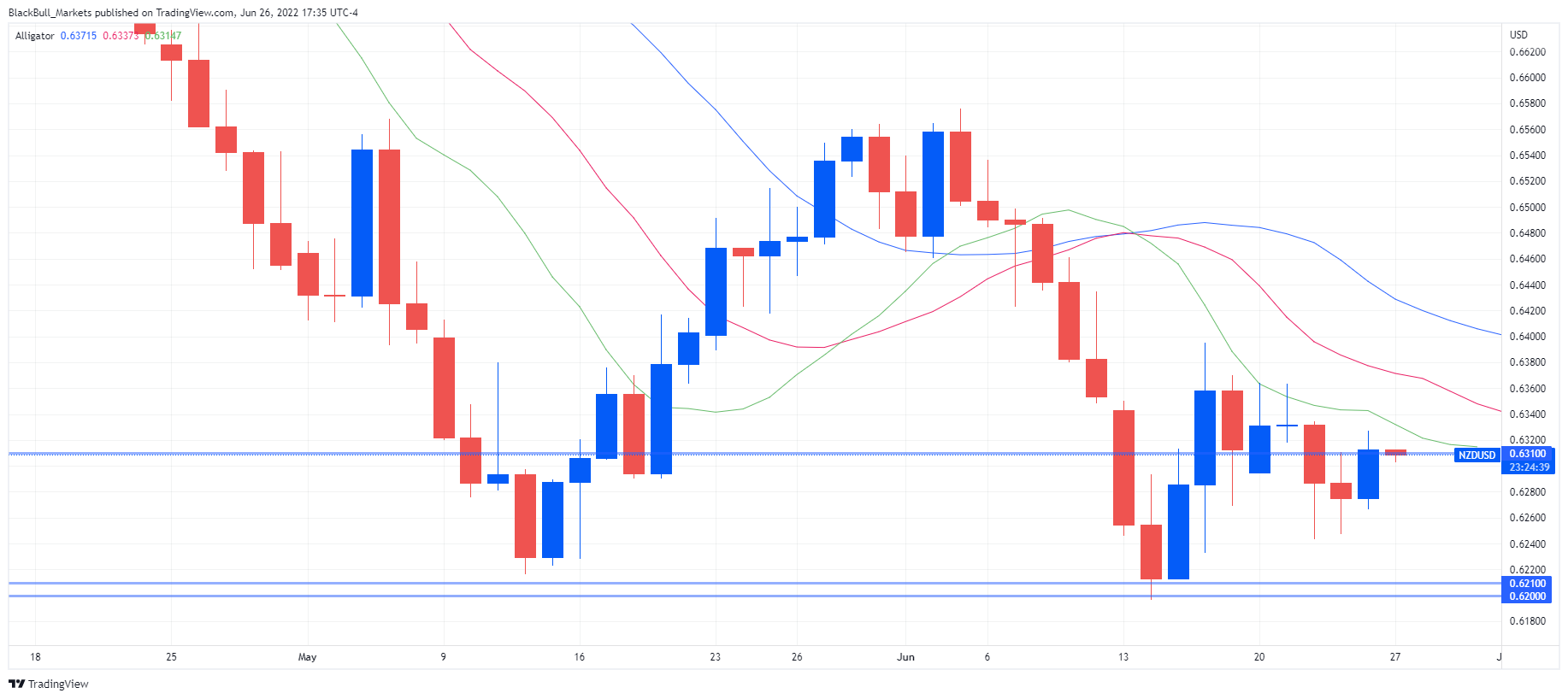
NZD/USD 1D

On the daily chart, the Williams Alligator Indicator is showing a strong downtrend signal as the price stays below the green 5-period moving average (alligator’s lips). While the other moving averages, the red 8-period moving

average (alligator’s teeth) and the blue 13-period moving average (alligator’s jaw) are separated by a large distance giving us another strong bearish trend signal.
However, a staunch support level might appear at the 0.62100 area. Given the fundamental analysis and a strong downtrend signal from the alligator indicator, a possible break out to the downside below the strong support zone may push the pair to the 0.60000 psychological price area.

Author

Mark O’Donnell

Mark O’Donnell

Blackbull Markets Limited

Mark O’Donnell is a Research Analyst with BlackBull Markets in Auckland, New Zealand.

More from Mark O’Donnell
Share:

Editor's Picks

EUR/USD weakens to near 1.1900 as traders eye US data

EUR/USD eases to near 1.1900 in Tuesday's European trading hours, snapping the two-day winning streak. Markets turn cautious, lifting the haven demand for the US Dollar ahead of the release of key US economic data, including Retail Sales and ADP Employment Change 4-week average.

GBP/USD stays in the red below 1.3700 on renewed USD demand

GBP/USD trades on a weaker note below 1.3700 in the European session on Tuesday. The pair faces challenges due to renewed US Dollar demand, UK political risks and rising expectations of a March Bank of England rate cut. The immediate focus is now on the US Retail Sales data. 

Gold sticks to modest losses above $5,000 ahead of US data

Gold sticks to modest intraday losses through the first half of the European session, though it holds comfortably above the $5,000 psychological mark and the daily swing low. The outcome of Japan's snap election on Sunday removes political uncertainty, which along with signs of easing tensions in the Middle East, remains supportive of the upbeat market mood. This turns out to be a key factor exerting downward pressure on the safe-haven precious metal.

Bitcoin Cash trades lower, risks dead-cat bounce amid bearish signals

Bitcoin Cash trades in the red below $522 at the time of writing on Tuesday, after multiple rejections at key resistance. BCH’s derivatives and on-chain indicators point to growing bearish sentiment and raise the risk of a dead-cat bounce toward lower support levels.

Follow the money, what USD/JPY in Tokyo is really telling you

Over the past two Tokyo sessions, this has not been a rate story. Not even close. Interest rate differentials have been spectators, not drivers. What has moved USD/JPY in local hours has been flow and flow alone.

Bitcoin Cash trades lower, risks dead-cat bounce amid bearish signals

Bitcoin Cash (BCH) trades in the red below $522 at the time of writing on Tuesday, after multiple rejections at key resistance. BCH’s derivatives and on-chain indicators point to growing bearish sentiment and raise the risk of a dead-cat bounce toward lower support levels.