|

Is the dollar trading against the euro independently of interest rates?

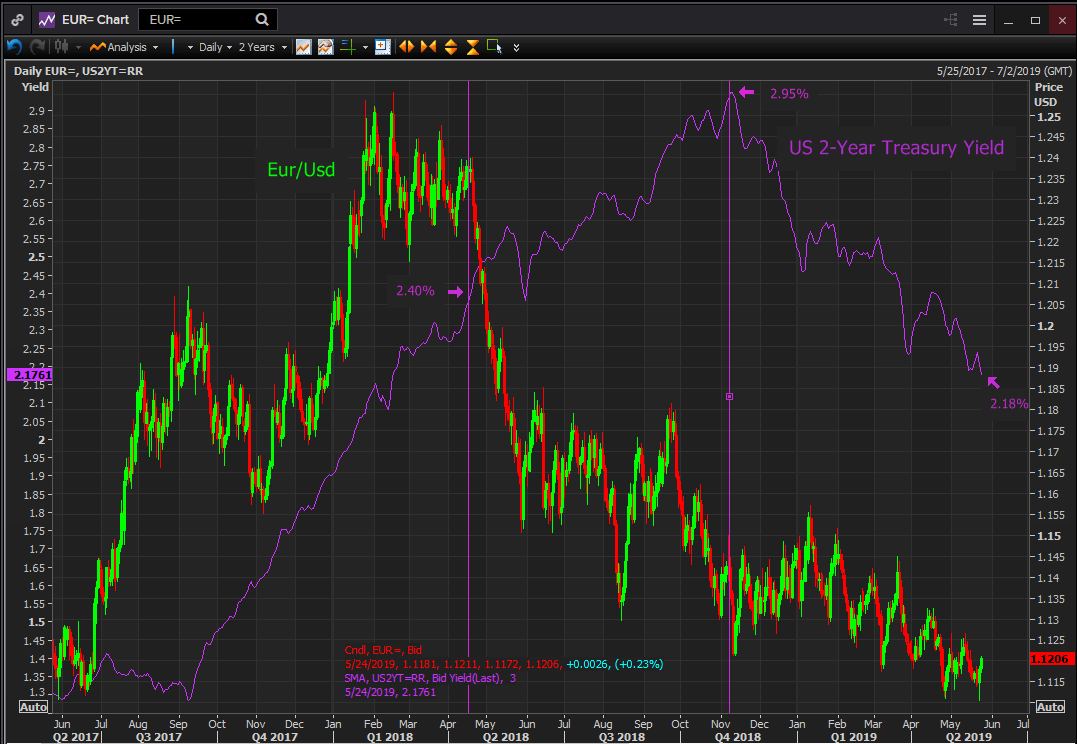
The US dollar has been gaining ground against the euro for just over a year. From a 1.2372 close on April 18th last year to the 1.1180 finish on May 23rd the united currency has lost 9.6% versus the greenback.  For roughly half of that period April to November 2018 US interest rates were rising, for the second half they were falling. 

The interest rate on the 2-year Treasury, the government security with the closest tie to currency movements rose from 2.40% on April 18th 2018 to 2.95% on November 8th, from then it fell to 2.18% by May 24th. 
Reuters

For the first period of rising US rates (4/18/18-11/8/18) the euro lost 8.2%.  In the second period (11/9/18-5/24/19) the euro lost the balance 1.6%, given the percentage difference in the original rate.

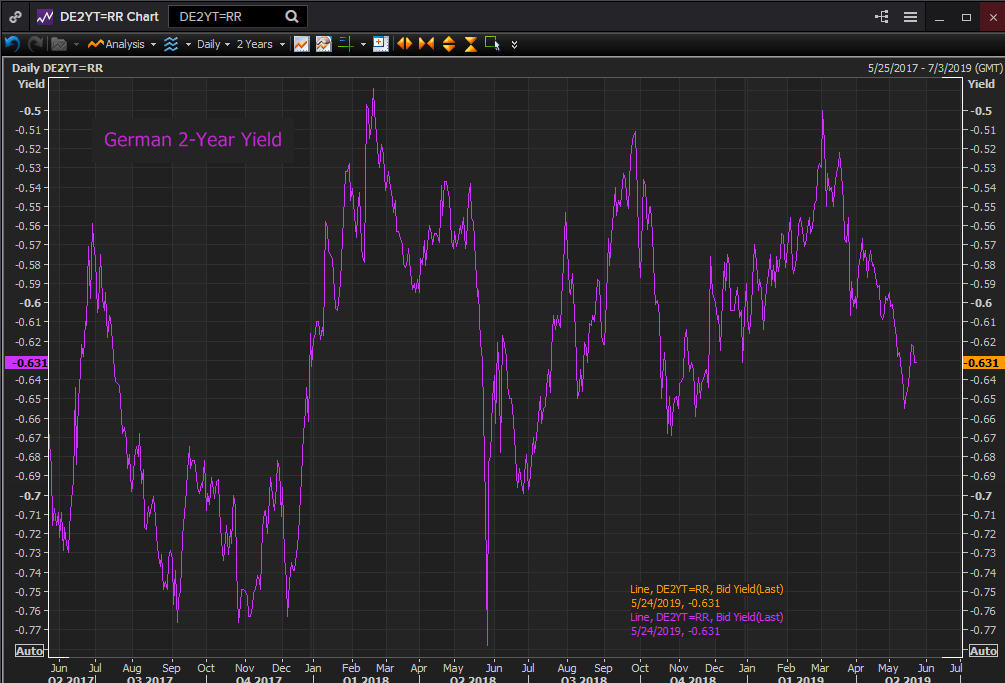
If we look at the German 2-year yield for a European comparison it has moved from -0.57% on April 18th last year to -0.61% on November 8th and then to -0.63% on May 24th.  
Reuters

Comparatively the US range of 55 basis points on the upside and 77 on the downside dwarf the German change of 6 points. Clearly the euro level is not being driven by interest rate differentials.

 In effect the fall in US rates has blunted the dollar advantage but it has not taken over the relationship between the currencies. The macro-economic effects of the European economic slowdown and the potential damage from yet unsettled British departure continue to weigh heavily on the euro despite the shrinking rate advantage for the dollar.

Author

Joseph Trevisani

Joseph Trevisani began his thirty-year career in the financial markets at Credit Suisse in New York and Singapore where he worked for 12 years as an interbank currency trader and trading desk manager.


More from Joseph Trevisani
Share:

Editor's Picks

EUR/USD sticks to positive bias above 1.1800 as trade jitters undermine USD

The EUR/USD pair builds on the previous day's modest gains and attracts some buyers for the second straight day on Thursday amid a softer US Dollar. Spot prices, however, lack bullish conviction and trade around the 1.1815-1.1820 area during the Asian session, up 0.10% for the day.

GBP/USD bounces as soft CPI boosts BoE cut bets

GBP/USD rose 0.42% on Wednesday, recovering toward 1.3600 in a session shaped by softer-than-expected UK inflation data and broad US Dollar weakness. The pair had been consolidating in a tight range between about 1.3450 and 1.3520 for the past few days following the sharp pullback from the late-January high near 1.3870, and Wednesday's move pushed price action back onto the high side of key moving averages.

Gold struggle with $5,200 extends ahead of more US-Iran talks

Gold is replicating the recovery moves seen in Wednesday’s Asian trading early Thursday, as buyers continue to flirt with the $5,200 level. Sustained US Dollar weakness and looming US-Iran talks aid the bright metal’s rebound.  

Michael Saylor unveils Bitcoin-backed "Digital Credit" vision at Strategy World

Strategy CEO Michael Saylor delivered a keynote titled "Digital Credit" on Tuesday at Strategy World, positioning Bitcoin as the foundation of a new financial system built on what he described as "digital capital."

Nvidia delivers another monster earnings report, and forecasts big things to come

It was another monster earnings report from Nvidia for fiscal Q4. Revenues were $68.1bn, smashing estimates of $65bn. Gross profit margin was a healthy 75%, up from 73.5% in the prior quarter, and the outlook for this quarter was monstrous.

Cosmos Hub Price Forecast: ATOM rebounds slightly, bearish outlook remains intact

Cosmos Hub (ATOM) price rebounds, trading above $2.05 at the time of writing on Wednesday, after undergoing a sharp correction since last week. Weakening on-chain and derivatives data support a bearish outlook, while technical analysis remains unfavorable.