|

Gold trades sideways amid tarrif uncertainty, geopolitical tension

Gold prices have remained range bound as markets continue to monitor events that could spark further price movement. Earlier this week, the precious metal  received influx of buyers after the US President Donald Trump imposed a 15% tariff on certain countries. This came after a Supreme court ruled against Trump administration’s tariff, citing that he did not have the authority to issue such levies. In addition to that, the ongoing discussion between the US and Iran will proceed today February 26, 2026 at Geneva, sending caution to the market. The 2 nations will try to avoid conflict by negotiating a deal as regards Iran’s nuclear enrichment programme.

Technical outlook

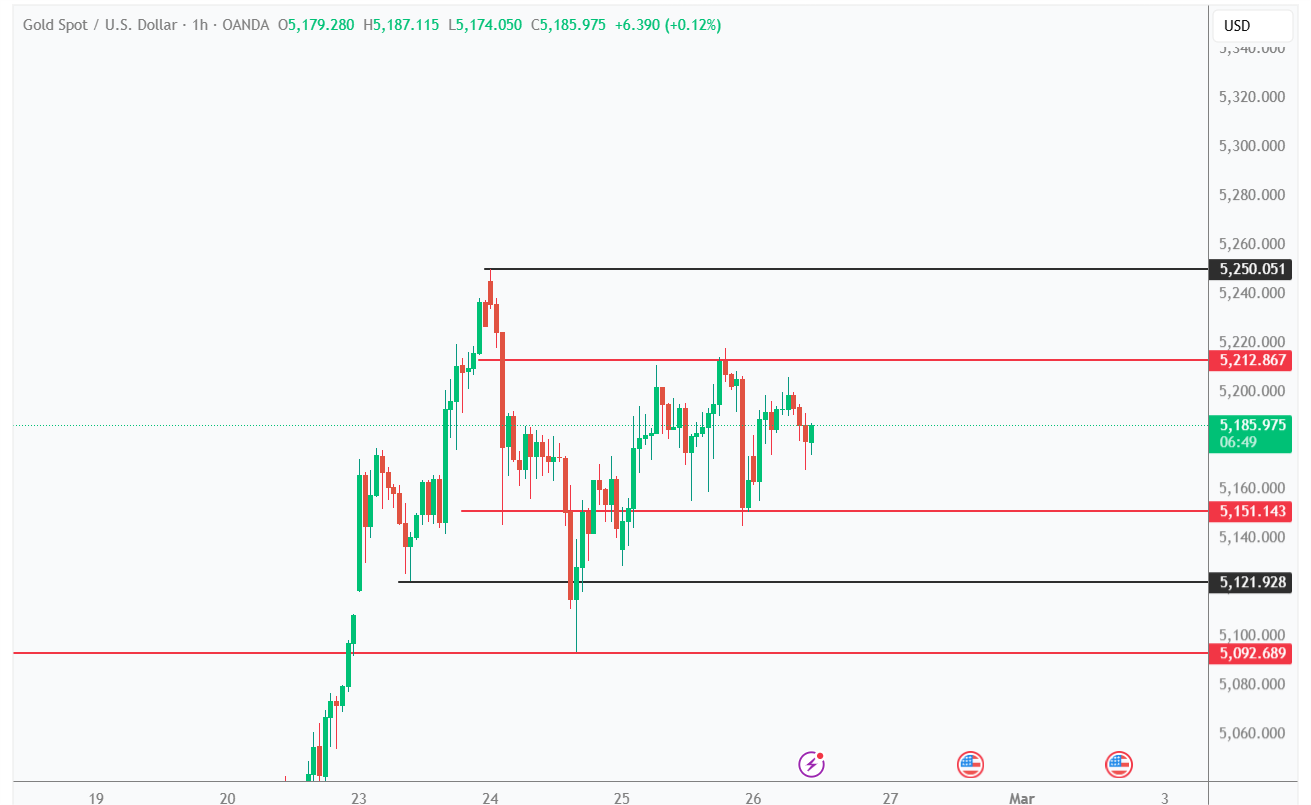
Gold prices still remains bullish following its reconfirmation of the $5000 price handle. In what looks like a range bound market after hitting $5250 earlier this week, the price has struggled to gain traction with an attempt towards a downward move after testing the $5121.92 support.

The price is currently experiencing a slight pullback with the near-term support around $5151.14 set to sustain further price appreciation after holding up recently. Failure to keep the price from dropping further could see the price make a move towards the $5121.92 support which has kept the price in the current range. Any rebound from any of the levels could see the price aim for the near-term resistance at $5212.86, with the next resistance level at $5250. A clear breakout to the upside  will expose the $5500 handle.

On the flip side a clear break to the downside from the current price range could see the price test the turncoat support at $5092.6 with the $5000 price handle once again exposed. Resistance levels that could sustain the price pressure are  at $5212.86 and $5250.
Gold

Author

Erastus Adegbotolu

Forex market analyst and educator with a strong focus on technical analysis and trader psychology.


More from Erastus Adegbotolu
Share:

Editor's Picks

AUD/USD stabilizes above two-week low/0.6950 as traders await US election results

AUD/USD edges higher in the Asian session on Wednesday, recovering slightly from a two-week low touched on a less hawkish RBA reaction the previous day. Hopes for Iran diplomacy undermine the safe-haven US Dollar and support the currency pair, though the upside remains capped as traders await US midterm election results.

USD/JPY retreats from three-week top, slips below 158.50 amid intervention risks and softer USD

USD/JPY slides below 158.50 in the Asian session on Wednesday, snapping a two-day winning streak to hit a near three-week high the previous day, as intervention risks support the Japanese Yen. Meanwhile, the US Dollar remains on the back foot amid hopes for Iran diplomacy, further weighing on the currency pair as traders brace for some volatility surrounding US midterm election results.


Gold consolidates below $3,950 as Fed hike bets counter softer USD ahead of US election results

Gold struggles to capitalize on the previous day's bounce from sub-$3,900 levels, oscillating in a range during the Asian session on Wednesday as traders brace for short-term market volatility surrounding US midterm election results. Meanwhile, hopes for Iran diplomacy weigh on the safe-haven US Dollar and support bullion, though upside remains capped amid Fed rate hike bets.

Ethereum: US-led selling keeps ETH below $2,309 realized price
Ethereum (ETH) faces pressure near $2,300 on Tuesday as it struggles to recover its realized price. The top altcoin fell below its realized price, or investors' average on-chain cost basis, at $2,309 following the $6.3 billion Binance hack last Thursday.
US Midterms: Can Wall Street rally despite AI debt and credit risks?
Political uncertainty may be coming to an end, but the real question for investors is whether the technology sector can sustain its enormous spending commitments. The US midterm elections are arriving at an interesting moment for financial markets.
The 2% inflation target came from a throwaway remark. It now moves trillions
The Federal Reserve's 2% inflation goal grew out of an off-the-cuff remark by a New Zealand politician in 1988. Bond investors still price long-term US debt as if 2% holds, so a change in how the Fed measures inflation would move markets.