How Japan became the World's Banker and why that era may be ending

Japan's ultra-low interest rates helped finance trillions of dollars in global investments for more than a decade, making the Japanese Yen (JPY) one of the world’s cheapest sources of funding. With the Bank of Japan (BoJ) expected to tighten policy again this week, that advantage may be entering a new phase.
While most major economies raised interest rates, Japan remained the world's outlier. The BoJ kept borrowing costs close to zero through years of extraordinary monetary easing, allowing investors to borrow cheaply in Yen and invest in higher-yielding assets elsewhere.
That cheap money strategy became known as the Yen carry trade, and its scale turned Japan’s monetary policy into a global market force.
Now, with another BoJ rate hike widely expected, investors are asking whether Japan's role as the world's preferred source of cheap funding is slowly coming to an end and what that could mean for currencies, stocks, bonds and global capital flows.
How the world's favourite trade works
For all its reputation, the carry trade is remarkably simple:
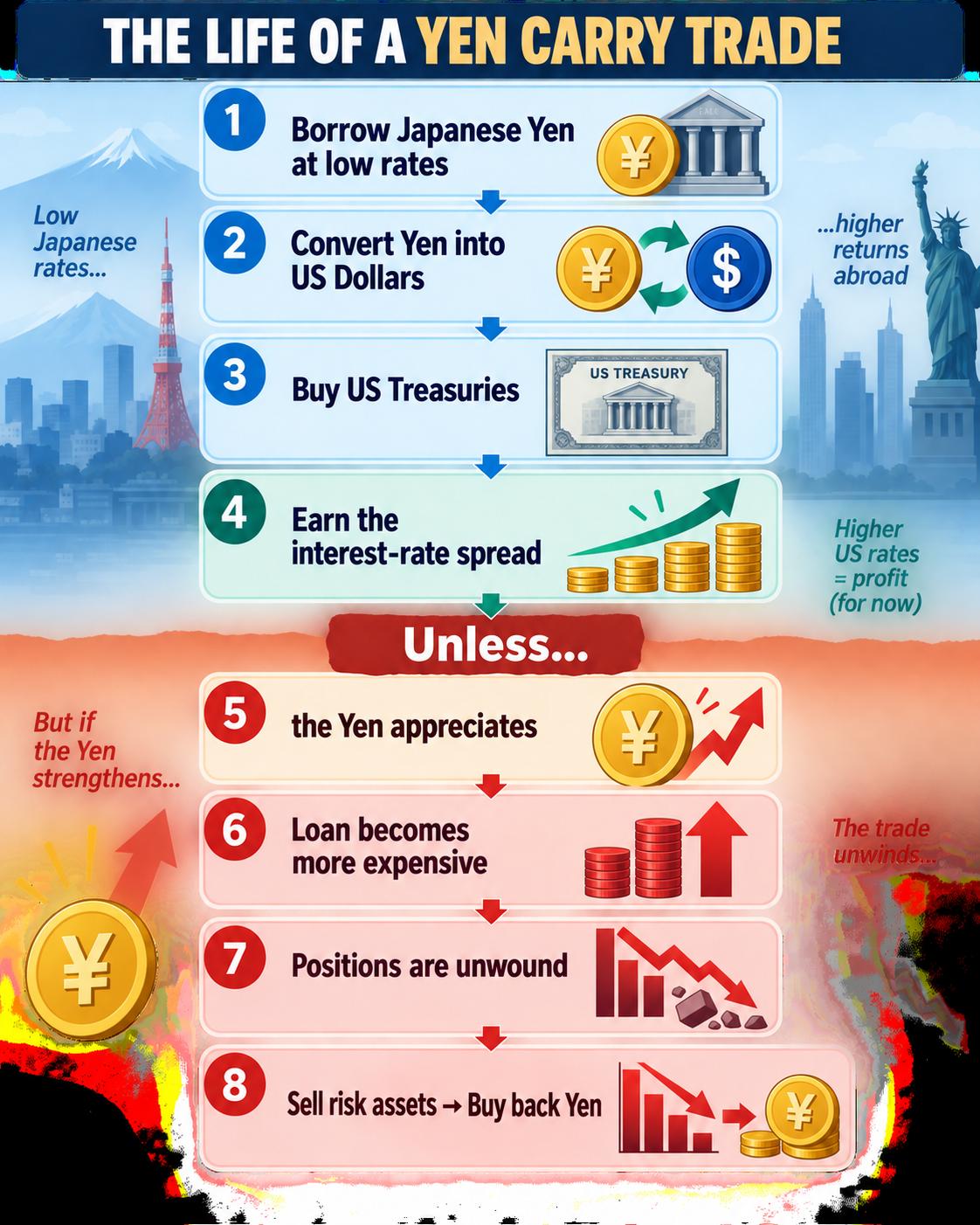
Investors borrow money in a country where interest rates are exceptionally low, convert those funds into another currency offering higher yields, and invest the proceeds in bonds or other financial assets. As long as exchange rates remain relatively stable, they collect the difference between borrowing costs and investment returns.
Japan became the ideal funding source because borrowing in Yen remained extraordinarily cheap for years, even as interest rates climbed sharply elsewhere.
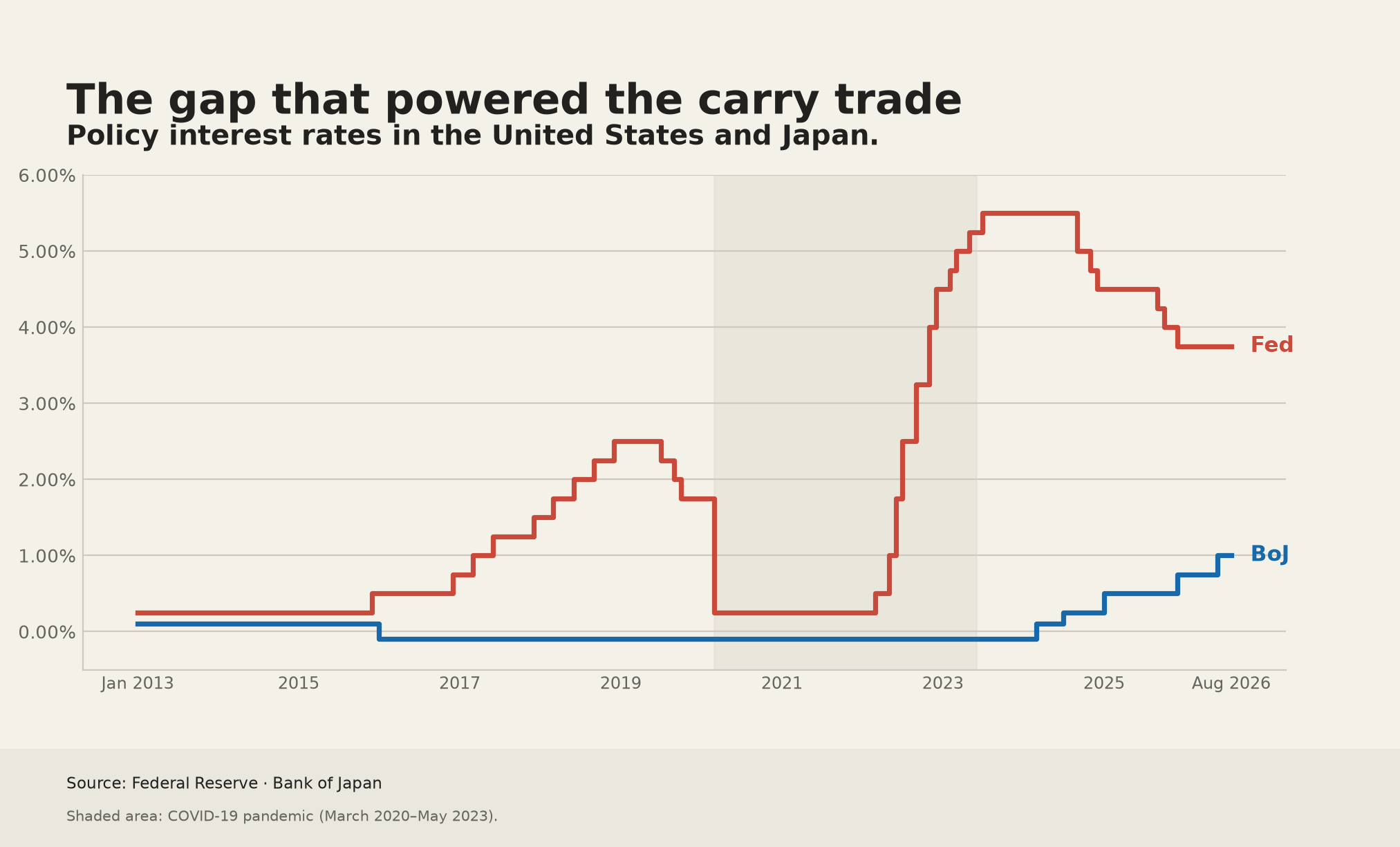
During the Federal Reserve’s (Fed) aggressive tightening cycle after the COVID pandemic, the gap between US and Japanese interest rates reached levels not seen in decades. Borrowing Yen to buy higher-yielding US assets became one of the defining macro trades of the post-pandemic era.
From Japanese policy to global markets
The carry trade is often described as a foreign-exchange strategy.
In reality, it reaches much further.
Borrowed money has helped finance purchases of US Treasuries, corporate debt, emerging-market bonds, equities and higher-yielding currencies. As long as funding remained cheap and the Yen stayed relatively weak, investors could comfortably employ leverage to amplify returns.
That helps explain why changes in Japanese monetary policy can reverberate far beyond Tokyo.
According to data from the Bank for International Settlements (BIS), cross-border borrowing in Japanese Yen was approximately ¥360 trillion (about $2.3 trillion) earlier this year, illustrating the global nature of Yen-funded financing.
Those figures have been on the rise over the past decade, especially following the wider US-Japan interest rate spread since 2022. Indeed, investors have been increasingly relying on cheap Yen funding to finance investments worldwide in response to the Fed’s aggressive tightening versus the BoJ’s exceptionally accommodative monetary policy.
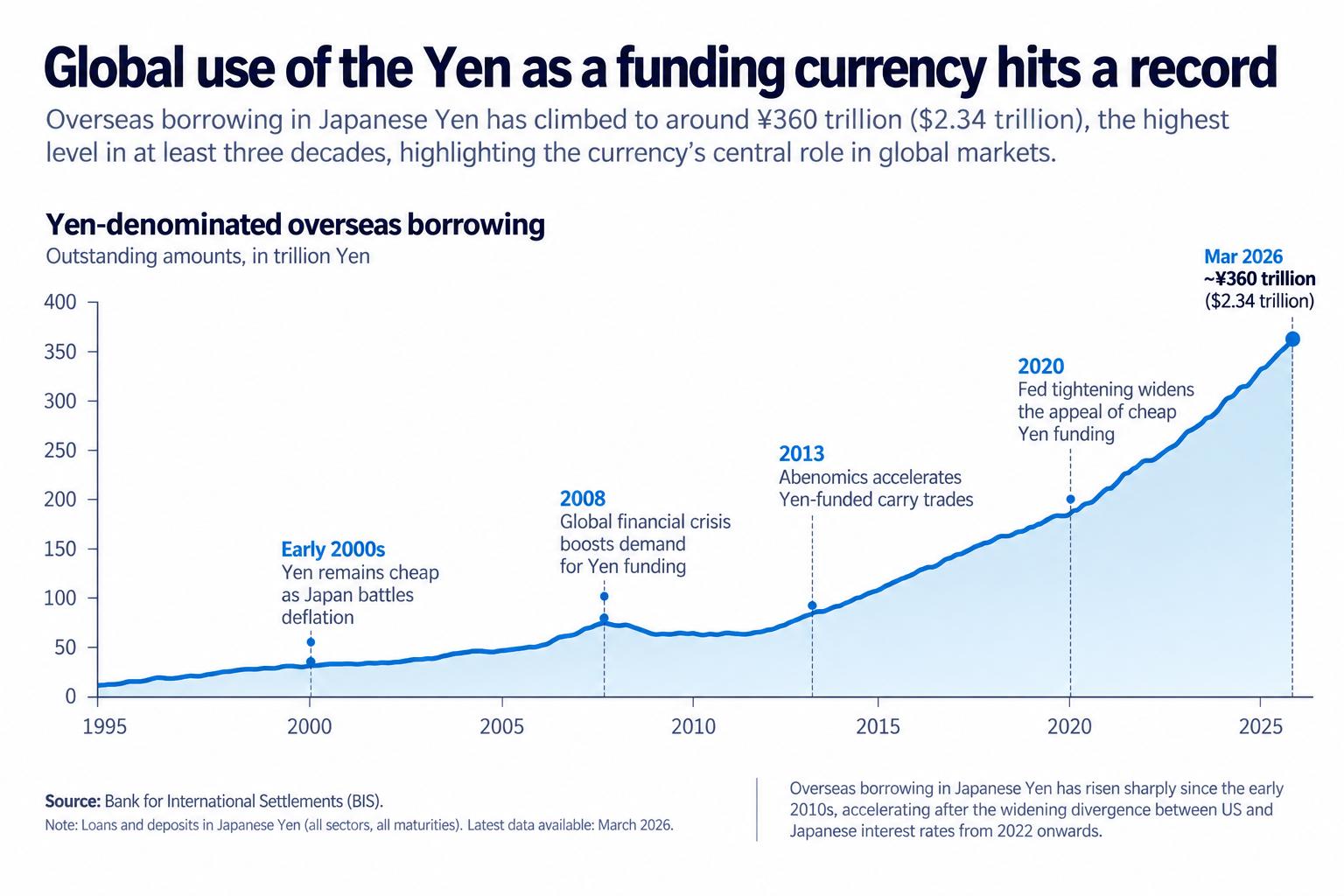
That data do not represent the carry trade itself. They nevertheless provide one of the clearest indicators of how deeply the Japanese currency has become embedded in global funding markets.
Why next week matters
Financial markets expect both the Federal Reserve and the Bank of Japan to raise interest rates at this week's policy meetings.
The key question for the BoJ is how quickly it can continue normalising policy. With inflation proving more durable and wage growth improving, policymakers are expected to maintain a gradual tightening path after years of extraordinary accommodation.
Even a modest rate increase would continue narrowing the interest-rate gap that has supported the traditional Yen carry trade, particularly if Japanese rates continue rising while the Fed’s tightening cicle approaches its peak.
For investors, the issue is not simply whether borrowing in Yen becomes more expensive. It is whether the assumptions that underpinned more than a decade of cheap Japanese financing are gradually disappearing.
Why this isn't another 2024
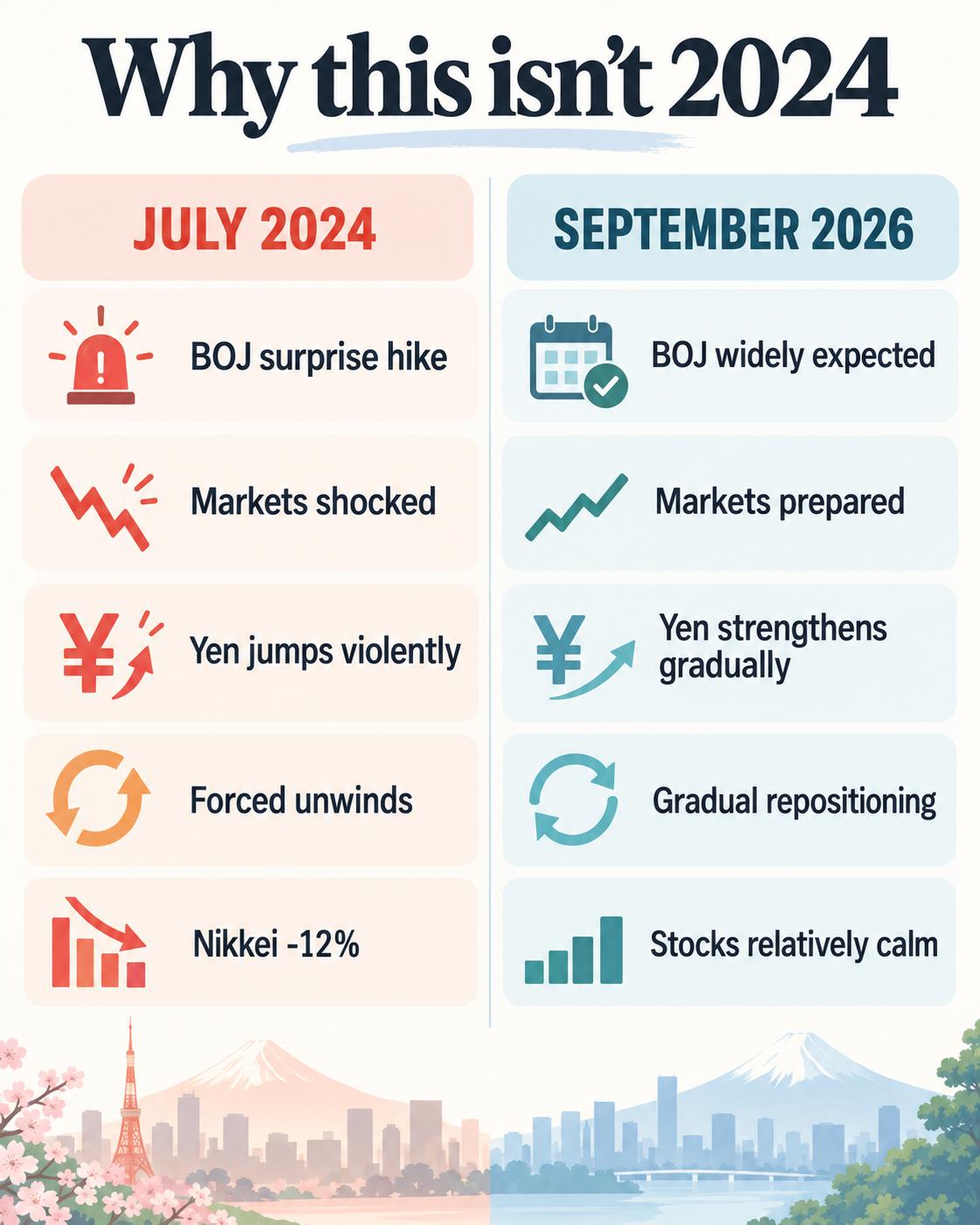
The prospect of another BoJ rate increase inevitably brings back memories of the market turbulence seen in 2024.
When the central bank unexpectedly tightened policy, the Yen strengthened rapidly, forcing many leveraged investors to unwind positions simultaneously. Japanese equities suffered one of their sharpest one-day declines in decades as markets scrambled to adjust.
Today's environment looks very different.
BoJ officials have spent weeks preparing markets for the possibility of another rate increase. Investors have had time to reassess portfolios, reduce leverage and hedge currency exposure.
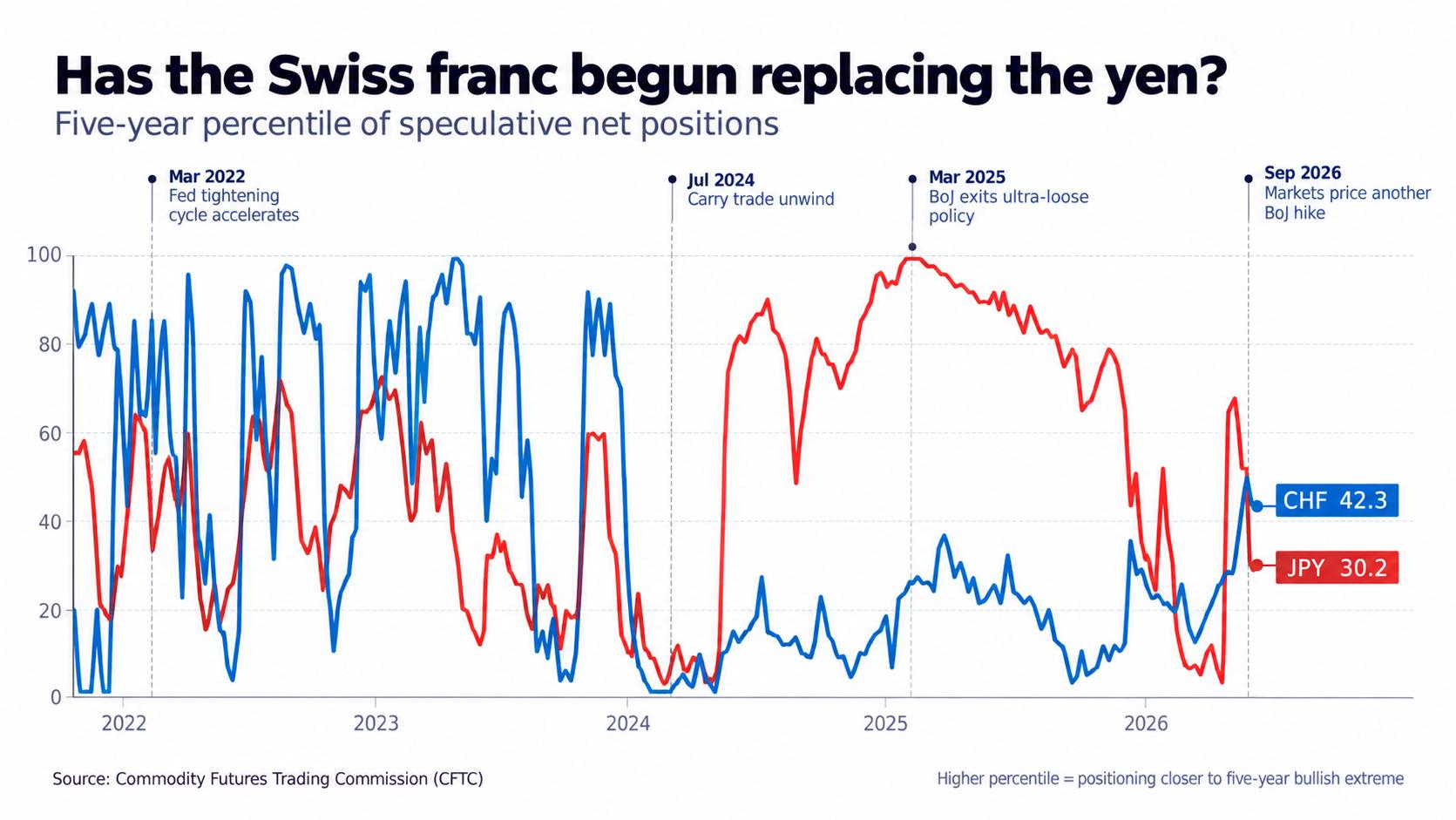
Positioning data suggest speculative bets against the Yen have already moderated from the extreme levels seen earlier this year, pointing to a more orderly adjustment rather than a sudden scramble for the exits.
Is the Swiss franc becoming the next funding currency?
As borrowing in Yen gradually becomes more expensive, investors are increasingly exploring alternative funding currencies, with the Swiss Franc often mentioned as a potential successor thanks to Switzerland's relatively low interest rates, deep financial markets and reputation as a safe-haven currency.
The idea is intuitive. If Japan is slowly moving away from the ultra-loose monetary policies that defined the past decade, investors will naturally look for other sources of inexpensive funding.
The evidence, however, remains mixed.
While market participants have pointed to growing interest in franc-funded carry trades, speculative positioning data do not yet point to a broad migration from the Yen to the Swiss Franc. Instead, they suggest investors have been reducing extreme bearish bets against the Yen without simultaneously building unusually large speculative positions in the Franc.
That distinction matters. Rather than signalling a wholesale change in the world's preferred funding currency, current positioning is more consistent with investors reassessing leverage and adapting to a changing interest-rate environment.
Japan built its dominance as a funding currency over more than a decade of ultra-loose monetary policy, deep liquidity and well-established financing markets. Replacing that ecosystem would require far more than a modest change in interest-rate differentials.
Whether the Swiss Franc ultimately assumes a larger funding role will become clearer over time. For now, the data suggest the carry trade is being repriced before it is being relocated.
The bigger shift
The biggest question facing investors is no longer whether the Yen carry trade can survive, but how it will evolve. Cross-border Yen borrowing remains near record highs, speculative positioning shows little evidence of a decisive shift toward the Swiss Franc, and the Bank of Japan is gradually removing the ultra-loose policies that made the strategy so attractive in the first place.
The era of virtually free Japanese funding is slowly fading. Whether another currency eventually fills that role remains uncertain. What seems increasingly clear is that investors are entering a world where leverage is becoming more expensive and Japan is no longer the almost unlimited source of cheap money it once was.
What comes next may not be the end of the carry trade… but the beginning of a new one.
Author

Pablo Piovano
FXStreet
Born and bred in Argentina, Pablo has been carrying on with his passion for FX markets and trading since his first college years.