US yields near 5%: Is the long-term bull cycle entering its final stage? [Video]
![US yields near 5%: Is the long-term bull cycle entering its final stage? [Video]](https://editorial.fxsstatic.com/images/i/Discover-f-38.jpg)
If you have been following our analysis for a while, you may remember that we were already looking for higher US yields back in December 2025, when we prepared our special market outlook for the year ahead. Since then, US yields have moved nicely higher, and the US 10-year yield has now reached the important 5% area.
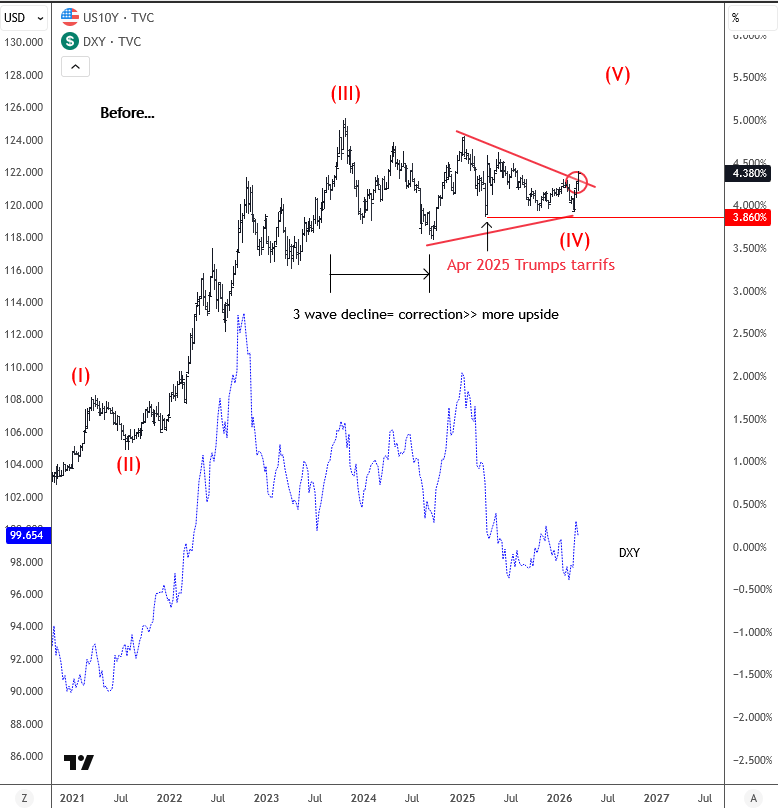
The move has been supported by persistent inflation, strong economic data and, more recently, the sharp rise in crude oil. Markets have also become much more confident that the Fed will raise rates, with a rate hike now almost fully priced in for Wednesday.
But could yields be getting close to a top?
This is where things become interesting.
Markets usually move on expectations of what central banks will do next, rather than simply reacting to what they are doing today. For months, investors have been repricing the possibility of higher Fed rates, and this has helped push the 10-year yield towards 5%.
But once the Fed actually starts hiking, the focus will quickly shift to the next question: how many more hikes can they deliver?
In other words, more tightening now could mean less upside for yields later.
This is especially interesting because the Fed has waited for months before taking action. If Wednesday finally brings a hike, it does not necessarily mean that we are at the beginning of a long and aggressive hiking cycle. It could still turn out to be a limited tightening cycle, particularly if higher rates eventually start slowing the economy.
That’s why I would not rule out some kind of “buy the rumor, sell the news” reaction in yields once the Fed finally acts. At the moment, markets are pricing a very high probability of a hike this week and are also expecting additional tightening ahead, so a lot of the hawkish story may already be reflected in prices.
Elliott Wave structure also points to a mature trend
From an Elliott Wave perspective, this possibility makes a lot of sense.
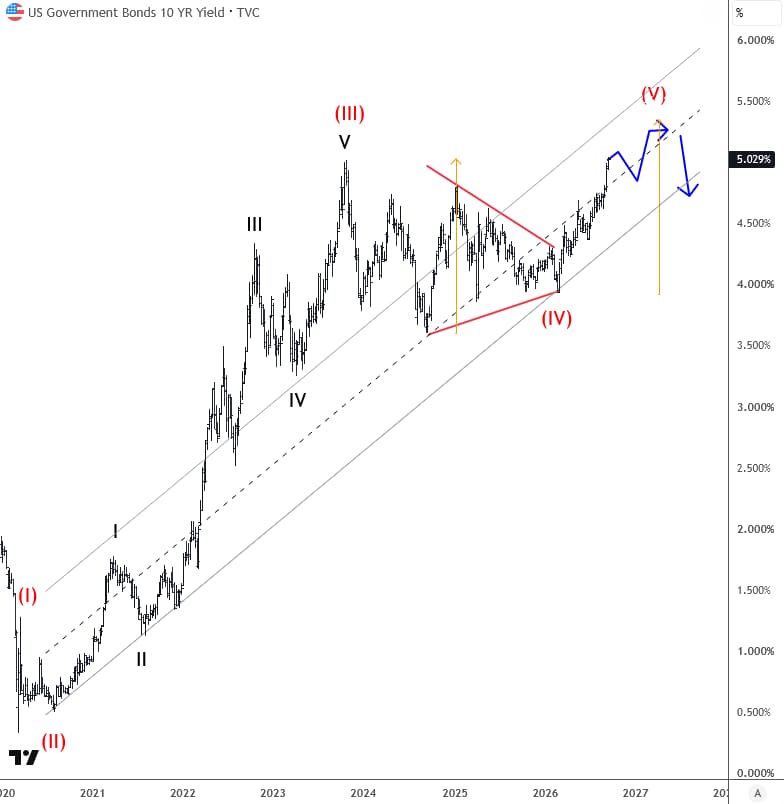
Looking at the bigger picture, US yields have been advancing within a five-wave bullish cycle. We appear to be in the final higher-degree wave five, but the structure does not look fully complete yet.
So I am not saying that yields have topped at 5%.
There could still be another push higher, and the final wave can take several weeks or even months to complete. Turning points on these higher time frames are usually a process rather than a one-day event.
However, we should now be aware that we may be entering the late stages of this major bullish cycle in yields.
When everyone sees higher yields, Be careful
This is also where market psychology becomes important.
Elliott Wave teaches us that markets move between extremes of pessimism and optimism. Very often, when a trend becomes obvious to almost everyone, that is when we need to start watching for signs that the cycle is becoming mature.
US 10-year yields have now crossed 5%, the highest level since 2007, while inflation and higher oil prices have made the higher-for-longer story increasingly obvious to investors.
That doesn’t mean yields have to reverse tomorrow. But it does mean that this is probably not the time to become aggressively bullish on yields after such a large move.
For now, I still think there can be some upside left as wave five completes. But later this year, I will be watching very closely for signs of a larger slowdown and potentially an important reversal in US yields.
And if yields finally turn lower, that could become a very important development not only for bonds, but also for the US dollar, stocks, metals and the broader financial markets.
Get Full Access To Our Premium Elliott Wave Analysis For 14 Days. Click here.
Author

Gregor Horvat
Wavetraders
Experience Grega is based in Slovenia and has been in the Forex market since 2003.