Higher Mortgage Rates, Lower Housing Affordability

Mortgage rates have continued to march higher following the U.S. presidential election. While yields remain near historic lows, the rise may prove unsettling for the housing market as affordability is set to wane.
What Goes Down...Must Come Back Up
Mortgage rates have continued to follow U.S. Treasury yields higher in the wake of the U.S. presidential election, eliciting questions about the future course of interest rates in the year ahead and, if sustained, the subsequent effect on housing affordability.
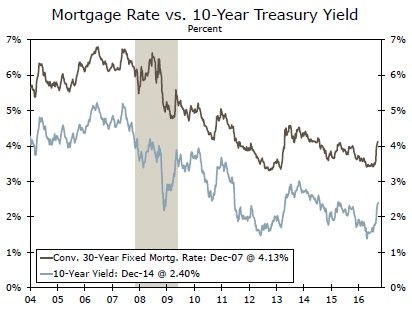
According to Freddie Mac, the 30-year conventional fixed mortgage rate rose to an average of 4.13 percent during the week ended December 7, marking a 56-basis point jump relative to the average rate before the election. The pickup is notable as rates have largely declined over the past two years (top chart). While it remains to be seen whether these levels will be sustained, against the backdrop of continued Fed tightening and anticipated fiscal stimulus, we suspect a slightly higher interest rate environment over the next two years. We look for the 30-year conventional mortgage rate to maintain its recent gains and average 4.16 percent for 2017, which is a 45-basis point increase from our anticipated average of 3.71 percent in 2016.
How Will Higher Rates Affect Homebuyers?
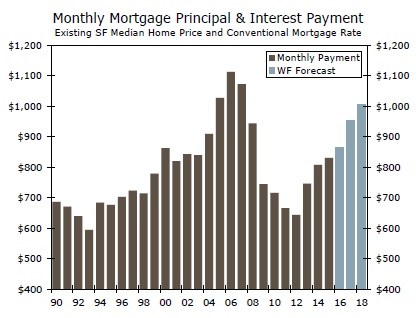
Based on our calculations, a homebuyer's monthly mortgage payment would increase roughly 5.6 percent due to a 45-basis point increase in mortgage rates if home prices held steady. However, when coupled with a 4.3 percent year-over-year increase in median existing home prices, which we forecast for 2017, the monthly mortgage payment would rise roughly 10 percent, or about $90 (middle chart).* That increase would be quite a lot for many households to absorb, as personal income is expected to rise a lesser 4.1 percent over the same period.
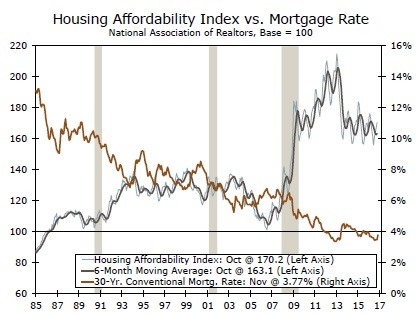
While low mortgage rates have allowed housing to remain affordable relative to long-run norms (bottom chart), affordability has fallen in recent years as home prices have risen faster than incomes. Housing affordability will likely continue to edge lower in 2017 as the effects of steeper borrowing costs settle in and tight supplies continue to fuel price gains.
Rising Mortgage Rates Are the Latest Headwind for Housing
While we note that mortgage rates remain low relative to historical standards (bottom chart), the higher interest rate environment that we now anticipate likely will create roadblocks for the still-slowly recovering housing market. We do not expect home sales to falter as a result of rising mortgage rates; however, the greater cost burden will likely squeeze some potential first-time homebuyers out of the market. This is notable, as homeownership is already trending near all-time lows as more people choose to rent. We now look for the pace of new and existing home sales to slow modestly in 2017, with sales rising roughly 6 percent and 2.5 percent year over year, respectively.
Author
Wells Fargo Research Team
Wells Fargo