Gulf States: Falling Oil prices should not pose a threat to economic diversification

A new Oil landscape
The fall in global oil prices is one of the most dramatic effects of the uncertainty generated by the tightening of US trade policy. The price of Brent crude is now expected to average USD 65 in 2025-2026, compared with USD 80 in 2024, and the risks of a further fall are high. For the Gulf States where hydrocarbons account for 60% of budget revenues and 70% of exports, the consequences will be manifold.
Fiscal breakeven Oil prices
Seemingly greater budgetary vulnerability
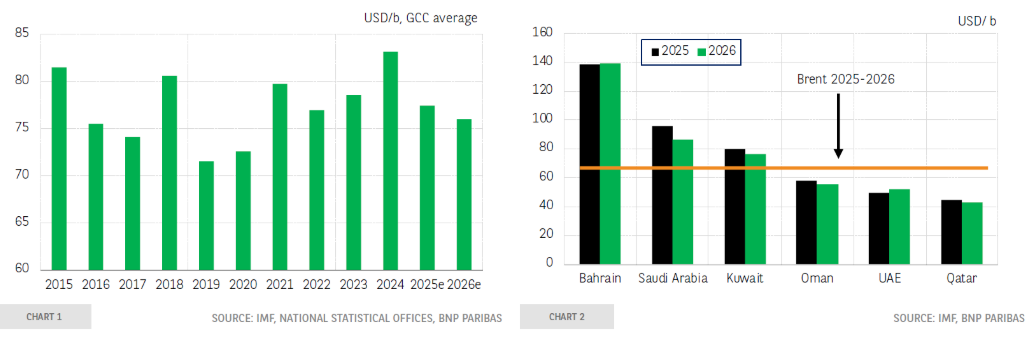
The average fiscal breakeven oil price for countries in the region (the oil price that balances the budgets) has risen steadily in recent years. In 2024, it hit USD 83.2, an increase of USD 10 from 2020. The fiscal breakeven oil price is expected to fall in 2025-2026 as oil production rises, but it will remain higher than the price of Brent crude. From a situation of near-balance in 2023-2024, the aggregate budget balance of the Gulf States will therefore tip over into the red, with a deficit expected to exceed 3% of GDP in 2025-2026.
Different situations
Of the six countries in the region, three (Oman, Qatar and United Arab Emirates) still have comfortable budgetary margins to absorb the shock of a fall in oil prices. To this must be added Kuwait, whose public accounts are bolstered by income from its sovereign wealth fund (excluded from the budget). A small oil producer, Bahrain is the most vulnerable, but the situation remains sustainable thanks to the support of the other Gulf States. With a fiscal breakeven oil price of USD 94, Saudi Arabia is facing the most difficult economic situation.
Levers for adapting
The magnitude of the shock remains uncertain, and the ability of countries to adapt to a persistently unfavourable oil environment is questionable. In general, non-oil activity in the Gulf slows down when oil revenues fall sharply, mainly through cuts in public spending.
However, the situation of public finances is far from alarming, including for Saudi Arabia. Its budget deficit is expected to exceed 5% of GDP in 2025-2026, but government debt remains moderate (26% of GDP). In addition, the authorities have more levers at their disposal than they did during the 2015 oil crisis, thanks to the structural reforms undertaken. Non-oil revenues have increased by 4 points of GDP over the past decade (due to the near-universal use of VAT, etc.).
Even though this progress is still not enough, it could allow the Gulf countries to avoid trade-offs between the sustainability of public finances and support for the economic diversification programme. All the more so as the strength of their external accounts will also enable these countries to pursue their foreign investment strategy. Despite the drop in exports, the region is expected to generate current account surpluses of about USD 40 to 50 billion annually in 2025-2026 (compared with USD 133 billion in 2024), plus almost USD 4,000 billion in external assets.
Author

BNP Paribas Team
BNP Paribas
BNP Paribas Economic Research Department is a worldwide function, part of Corporate and Investment Banking, at the service of both the Bank and its customers.