Gold Weekly Forecast: XAU/USD loses bullish momentum ahead of next week's key events
- Gold struggled to preserve its bullish momentum this week.
- Brexit and US stimulus uncertainty balanced out coronavirus vaccine optimism.
- A daily close below $1,810 could open the door for more losses.

The XAU/USD pair built on previous week’s gains and touched its highest level in two weeks at $1,875.79 on Tuesday. In addition to the technical buying pressure that gathered momentum after the pair closed above the 20- day SMA back in early December, the USD’s poor performance fueled the rally. However, XAU/USD lost its traction in the second half of the week and erased the majority of its weekly gains before settling below $1,850.
What happened last week
At the start of the week, the data from China showed that the country’s exports in November surged by 21.1% on a yearly basis. With this reading surpassing the market expectation for an increase of 12% by a wide margin, risk flows remained in control of financial markets. Furthermore, heightened hopes for an EU-UK trade deal and additional stimulus in the US allowed the mood to remain upbeat throughout the day on Monday.
On Tuesday, the ZEW Survey showed that the Economic Situation Index both in Germany and the euro area rose sharply in December to reflect the positive impact of coronavirus vaccine optimism on sentiment. "The announcement of imminent vaccine approvals makes financial market experts more confident about the future," ZEW noted in its publication. The risk-on market environment made it difficult for the greenback to attract investors and XAU/USD continued to push higher before reversing its direction.
On Wednesday, the lack of progress in Brexit talks forced investors to adopt a cautious and stance and triggered a decisive rebound in the US Dollar Index in the late American session. Dragged by the renewed USD strength, XAU/USD lost 1.6% on the day and dropped all the way to $1,825.
On Thursday, the data from the US showed that the weekly Initial Jobless Claims increased by 137,000 to 853,000 in the week ending December 5th and reminded investors of the weight that the second coronavirus wave is putting on the economy. Furthermore, Senate Majority Leader Mitch McConnell voiced his opposition against the bipartisan coronavirus relief bill offered by the Treasury Secretary Steven Mnuchin and revived concerns over US lawmakers failing to reach an agreement on the much-needed aid. These developments helped USD stay resilient and forced XAU/USD to remain in the lower bound of its weekly range. Although the US Food and Drug Administration (FDA) announced that it has approved Pfizer-BioNTech COVID-19 vaccine for emergency use, the market reaction remained muted.
Meanwhile, the European Central Bank (ECB) left its policy rate unchanged and expanded the Pandemic Emergency Purchase Programme (PEPP) by €500 billion to a total of €1,850 billion until at least the end of March 2022. However, these policy decisions were largely in line with analysts’ expectations and already priced in the markets.
Next week
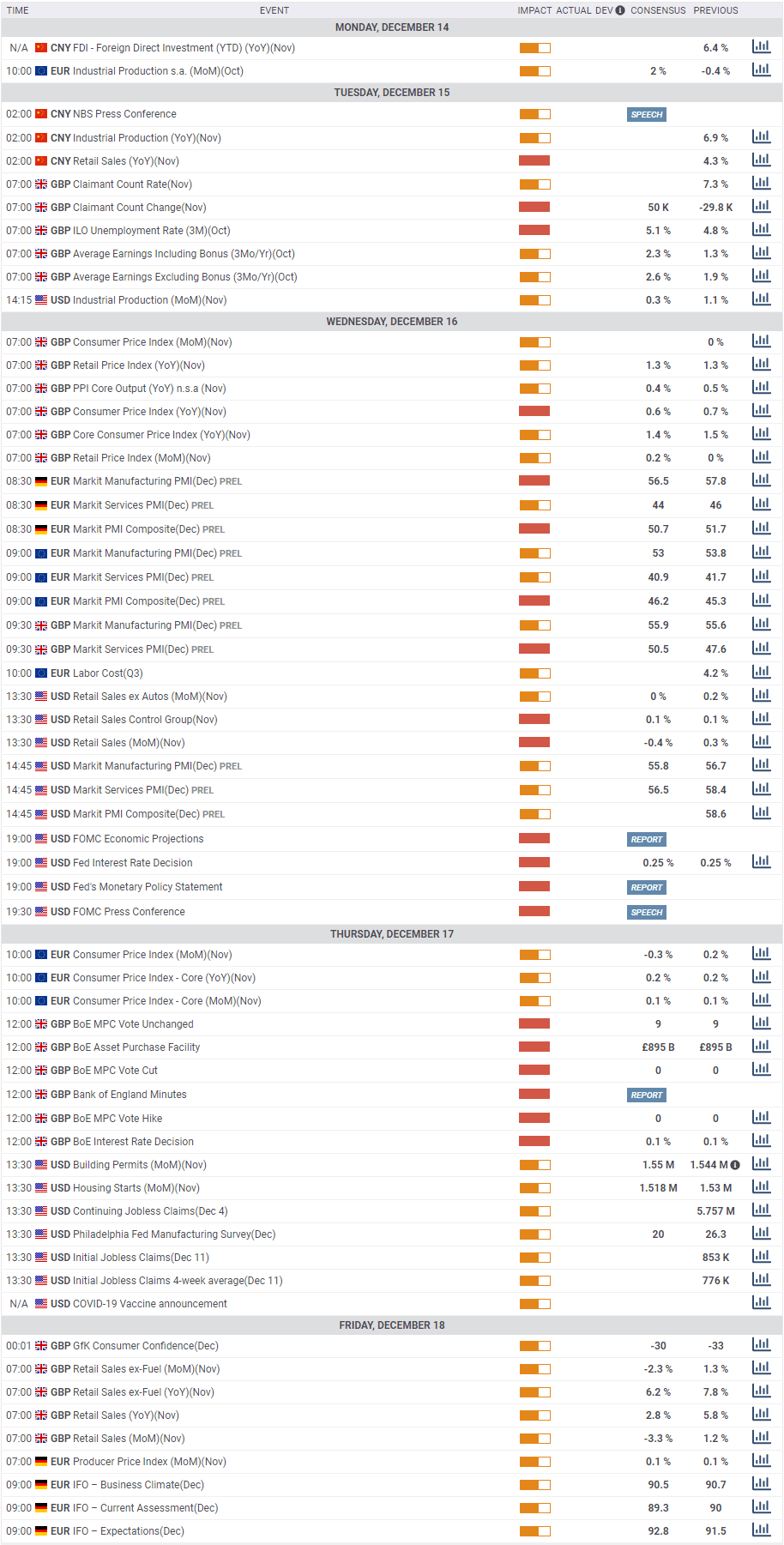
Negotiations between the EU and the UK will reportedly continue over the weekend and developments on that front could cause a significant change in market sentiment at the start of the week. A positive outcome is likely to weigh on the USD and lift XAU/USD and vice versa.
On Tuesday, Industrial Production and Retail Sales data from China will be watched closely by the market participants. Later in the day, Industrial Production from the US will be released as well.
On Wednesday, the IHS Markit will publish the Manufacturing PMI reports for Germany, the euro area, the UK and the US. More importantly, the FOMC will announce its policy decisions alongside updated economic projections. Investors don’t expect any changes in the current policy stance but any convincing hints toward adjustments in the asset purchase program could impact the performance of Wall Street’s main indexes. An upsurge in US stocks could be expected to hurt the buck more than it does the precious metal.
The weekly Initial Jobless Claims report from the US on Thursday and the IFO Current Assessment data from Germany on Friday will be looked upon for fresh impetus in the second half of the week. However, with the holiday season approaching, the trading action is likely to turn subdued after the FOMC event.
Gold technical outlook
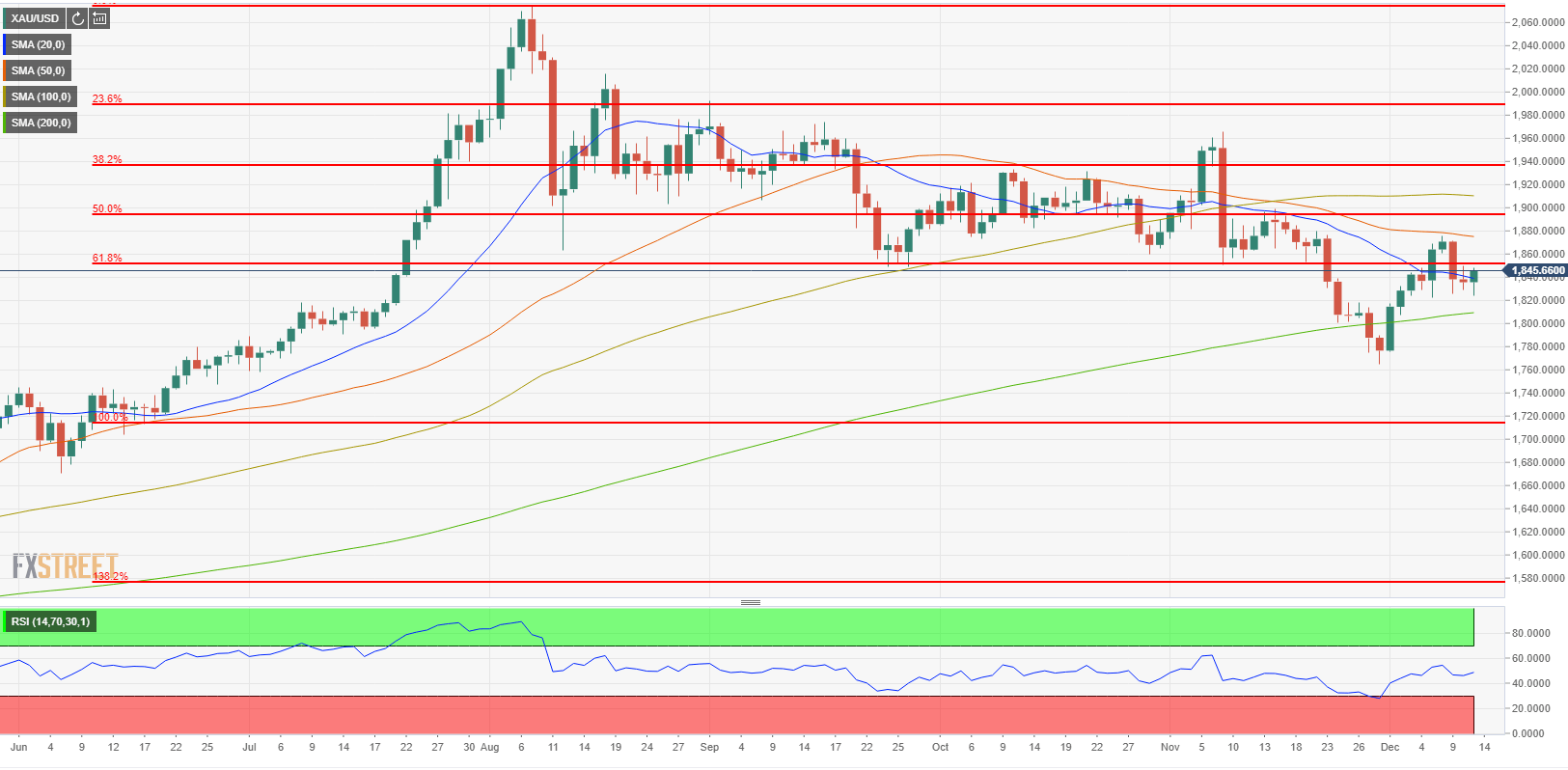
On the daily chart, the Relative Strength Index (RSI) indicator is staying close to 50, suggesting XAU/USD is struggling to make a decisive move in either direction. However, as long as the price remains above the 200-day SMA, which is currently located at $1,810, buyers could look to remain in control of the pair's movements.
On the upside, the initial resistance is located at $1,850, the Fibonacci 61.8% retracement of the June-August rally. When the price broke above that level earlier in the week, it failed to reach the next Fibo resistance, 50% retracement, at $1,900 and created an interim hurdle at $1,875, which is enforced by the 50-day SMA.
Supports, on the other hand, are located at $1,810 (200-day SMA), $1,800 (psychological level) and $1,774 (Nov. 11 low).
Gold sentiment poll
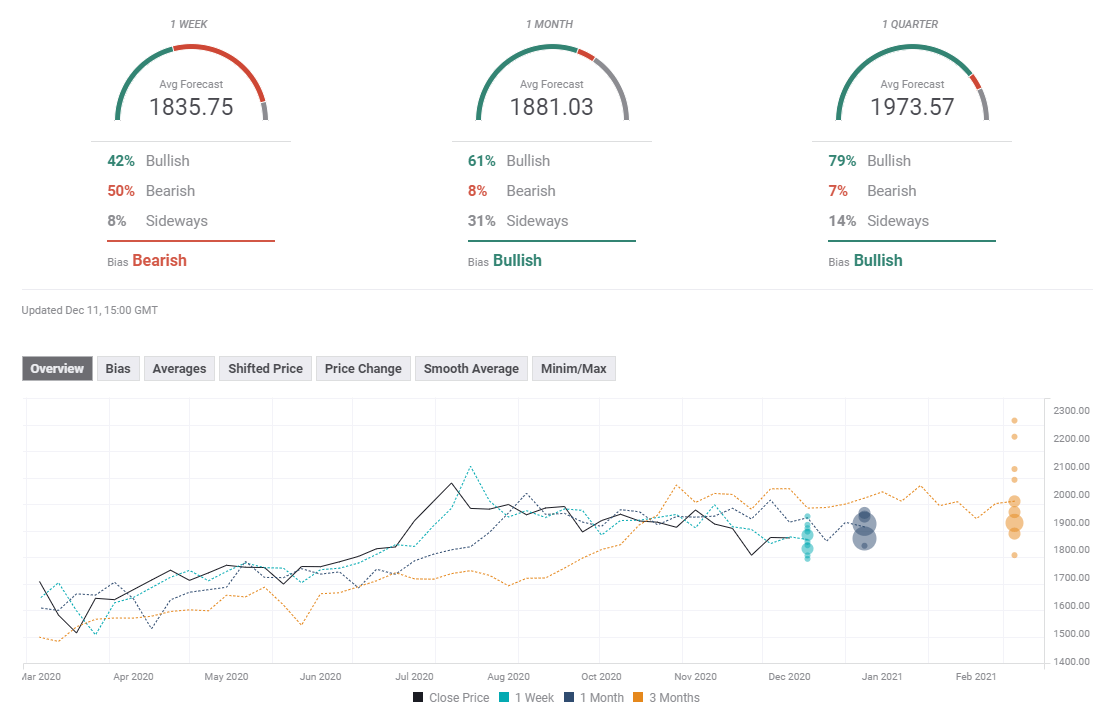
According to the FXStreet Forecast Poll, experts expect gold to stay in a consolidation phase below $1,850 next week. Although the one-month outlook remains bullish, the average target seems to have retreated to $1,881 from $1,897 last week. Additionally, 61% of forecasts are now bullish, compared to 75% last week. Finally, the quarterly outlook remains strongly bullish with an average target of $1,973.
Author

Eren Sengezer
FXStreet
As an economist at heart, Eren Sengezer specializes in the assessment of the short-term and long-term impacts of macroeconomic data, central bank policies and political developments on financial assets.