Gold Weekly Forecast: Will sellers continue to ignore oversold conditions?
- Gold fell sharply on Friday and closed second straight week in negative territory.
- The near-term technical outlook points to oversold conditions.
- US PCE inflation data and Fedspeak will be watched closely by market participants next week.


Gold managed to stay resilient for the majority of the week amidst the volatile market action but suffered heavy losses on Friday, ending up losing nearly 2% on a weekly basis. The economic docket won't be offering any high-tier data releases in the first half of next week and traders could look for signs pointing to the beginning of a technical correction.
What happened last week
Ahead of the highly-anticipated central bank announcements, gold started the new week in a relatively calm manner and consolidated the previous week’s losses. XAU/USD closed flat near $1,680 on Monday and registered modest losses on Tuesday.
On Wednesday, Russian President Vladimir Putin announced a partial military mobilization and threatened nuclear retaliation, saying the West wants to destroy Russia. Russia's defense ministry explained that 300,000 reserves will be called up and that they will receive military training before being deployed. Escalating geopolitical tensions allowed the precious metal to find demand as a safe haven and XAU/USD climbed above $1,680 before losing its bullish momentum in the second half of the day.
The US Federal Reserve announced that it hiked its policy by 75 basis points (bps) to the range of 3-3.25% as expected. The Summary of Economic Projections (SEP), the so-called dot plot, showed that policymakers’ median view of the policy rate at the end of 2023 stood at 4.6%, compared to 3.8% in June's dot plot. Furthermore, the median view of the fed funds rate at the end-2024 rose to 3.9% from 3.4%. The hawkish tilt seen in the SEP provided a boost to the US Treasury bond yields and forced gold lower. During the press conference, FOMC Chairman Jerome Powell acknowledged that there was no “painless way” of taming inflation. "Delay in getting inflation down would only lead to more pain,” Powell added.
The greenback came under selling pressure and the US Dollar Index (DXY) erased a large portion of the post-Fed gains on Thursday, helping XAU/USD stretch higher. After the Bank of Japan (BoJ) left its monetary policy settings unchanged on Thursday, the Japanese yen weakened significantly against its major rivals, triggering an intervention in the foreign exchange market. The BoJ possibly sold dollars to buy back JPY with an aim to limit the currency’s depreciation. In a press conference following that action, Japanese Finance Minister Shunichi Suzuki explained that they were concerned about excessive fx moves but refrained from commenting on the size of the intervention. Meanwhile, the Bank of England and the Swiss National Bank raised their policy rates by 50 bps and 75 bps, respectively. Following wild fluctuations during the European trading hours on central bank announcements, markets settled down during the American session and the 10-year US Treasury bond yield extended its rally, not allowing XAU/USD to stretch higher.
On Friday, the disappointing PMI data from the euro area and the UK caused the euro and the British pound to lose interest. Hence, the dollar regathered its strength and the DXY reached its highest level in two decades above 112.00. Pressured by the renewed dollar strength, gold broke below $1,650 and touched its lowest level since April 2020. The data from the US revealed that the S&P Global Services PMI and Composite PMI both rose sharply in early September, fueling another leg higher in the DXY and forcing gold to stay on the backfoot ahead of the weekend.
Next week
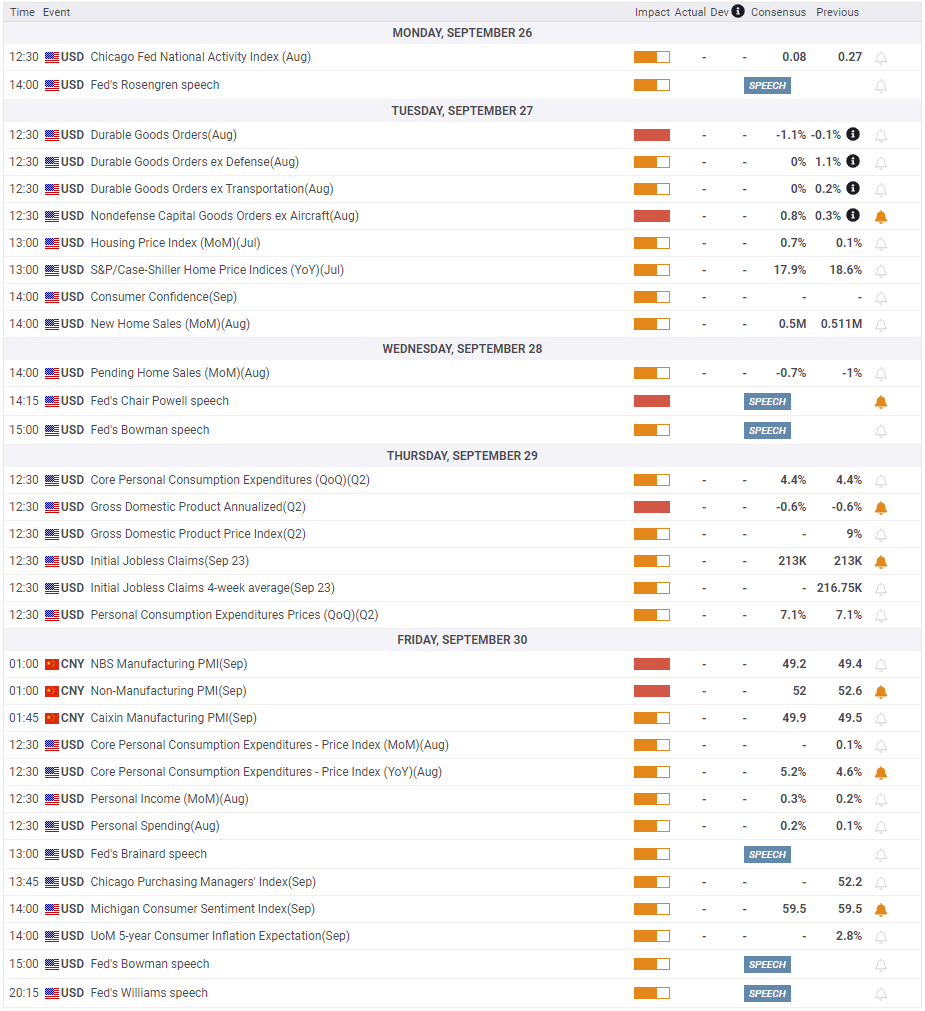
The Conference Board (CB) will release the US Consumer Confidence data on Tuesday. The S&P 500 lost over 3% last week and an upbeat sentiment report could open the door for a rebound in US stocks and cause the DXY to correct lower. In that scenario, gold could stage a rebound. Nevertheless, this data by itself shouldn’t impact the market pricing of the US central bank’s rate outlook in a significant way. According to the CME Group FedWatch Tool, there is a 70% probability of one more 75 bps Fed rate hike in November.
On Wednesday, the US Bureau of Economic Analysis will publish its final reading of the annualized Gross Domestic Product (GDP) growth for the second quarter. Investors expect the Q2 GDP to contract by 0.6%, matching the previous estimate. Since this data will be a revision, it’s unlikely to trigger a noticeable market reaction.
During the Asian trading hours on Friday, the NBS Manufacturing PMI and Non-Manufacturing PMI data from China will be watched closely by market participants. In case there is a meaningful recovery in those PMI readings, gold bulls could see that as an opportunity to bet on a steady rebound. Ahead of the weekend, the Personal Consumption Expenditures (PCE) Price Index, the Fed’s preferred gauge of inflation, will be featured in the US economic docket.
The stronger-than-expected Consumer Price Index (CPI) data earlier in the month convinced investors of a 75 bps Fed rate hike in September. Since PCE inflation is a lagging indicator, its impact on the dollar’s valuation could remain short-lived. Regardless, a retreat in the annual Core PCE figure could weigh on the dollar and vice versa.
Investors will also keep a close eye on Fedspeak next week. The greenback’s extremely overbought conditions suggest that any optimistic remarks on inflation outlook or comments that could be taken as less hawkish than Powell’s statement could pave the way for a deep dollar correction and help gold erase some of its losses.
Gold technical outlook
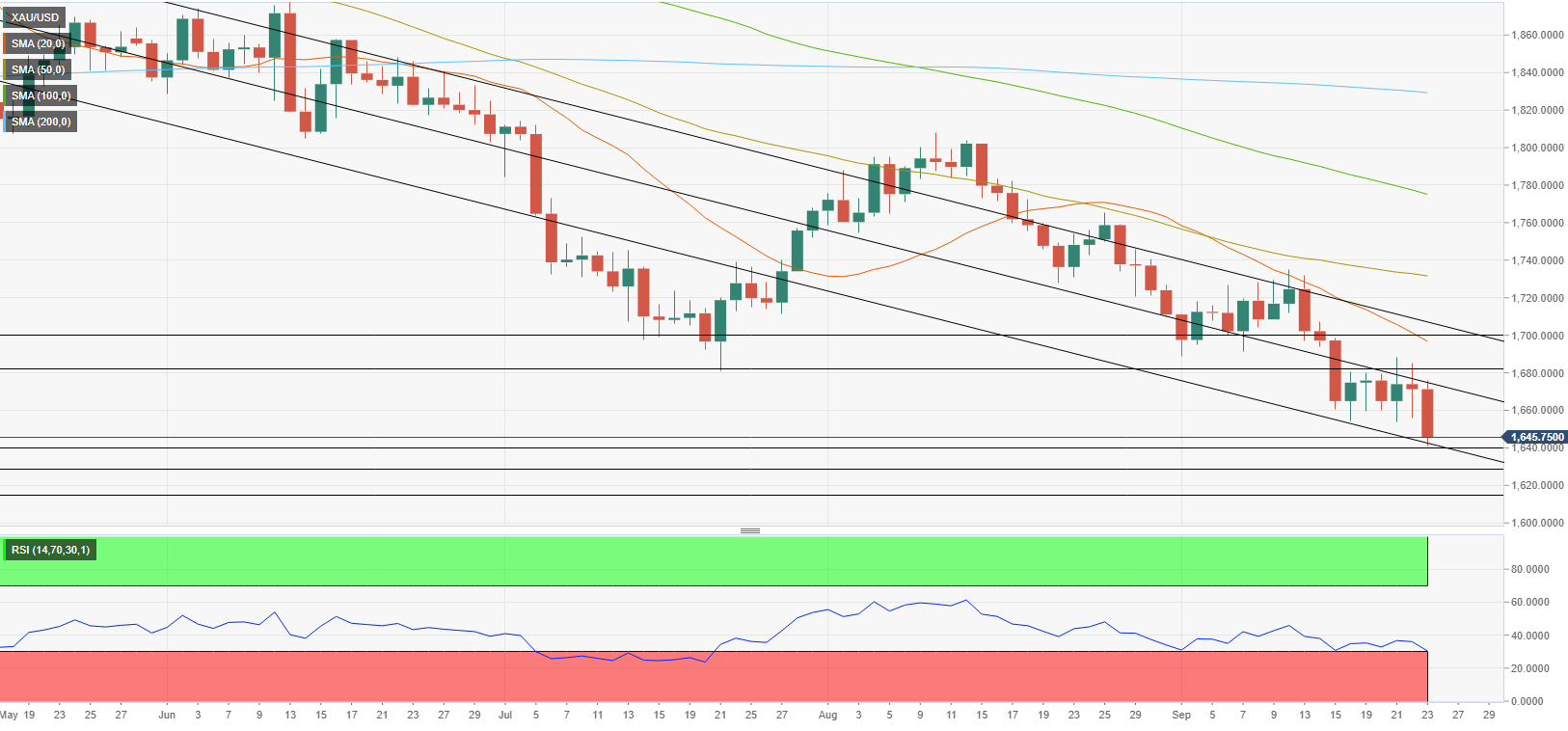
Gold is trading near the lower limit of the descending regression channel coming from March. Additionally, the Relative Strength Index is about to drop below 30, pointing to oversold conditions. In case XAU/USD starts correcting, $1,660 (mid-point of the descending channel) could be seen as the first recovery target ahead of $1,680 (static level) and $1,700 (20-day SMA).
On the downside, a daily close below $1,640 (static level from April 2020) could bring in additional sellers and cause gold to extend its slide toward $1,630 (static level from April 2020) and $1,615 (static level from April 2020).
Gold forecast poll
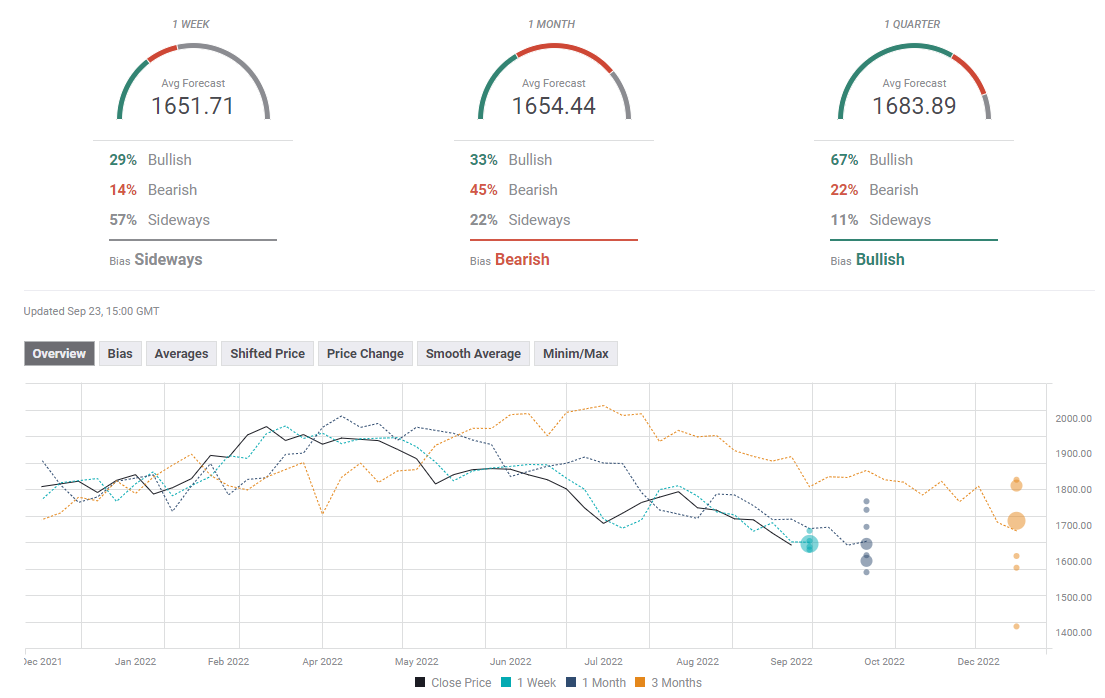
The FXStreet Forecast poll shows that experts expect gold to go into a consolidation phase next week and the average target sits at $1,651. The one-month outlook paints a mixed picture with less than 50% of experts holding a bearish view against 33% bullish.
Premium
You have reached your limit of 3 free articles for this month.
Start your subscription and get access to all our original articles.
Author
Eren Sengezer
FXStreet
As an economist at heart, Eren Sengezer specializes in the assessment of the short-term and long-term impacts of macroeconomic data, central bank policies and political developments on financial assets.