Gold Weekly Forecast: Sellers to retain control unless XAU/USD reclaims $1,670
- Gold snapped a two-week winning streak after $1,700 support failed.
- XAU/USD needs to stabilize above $1,670 to shake off the bearish pressure.
- Chinese growth data, action in US bond market will be watched closely next week.

This week’s price action proved once again how important of a pivot point $1,700 is for gold. After dropping below that level at the beginning of the week, the yellow metal extended its slide and touched its weakest level in two weeks near $1,630 before erasing a portion of its losses in the second half of the week. Nevertheless, XAU/USD ended up snapping a two-week winning streak, losing over 2% on a weekly basis.
What happened last week?
The negative shift witnessed in risk sentiment amid escalating geopolitical tensions provided a boost to the dollar early Monday and forced XAU/USD to stay under strong bearish pressure. The decisive drop below $1,700 attracted technical sellers and the pair ended up losing 1.6% on a daily basis. Russian President Vladimir Putin called the attack on the bridge over the Kerch Strait in Crimea ‘an act of terrorism’ by Ukraine. In the following hours, reports of explosions in Kyiv caused by Russian missile strikes triggered a flight to safety in markets. Meanwhile, Chinese authorities’ decision to partially shut down Changning and Putuo districts in Shanghai reminded investors of the precious metal’s fragile demand outlook.
With US bond markets re-opening following a three-day weekend on Tuesday, the benchmark 10-year US Treasury bond yield edged lower below 4% and helped XAU/USD limit its losses. The Bank of England’s decision to launch a temporary expanded collateral repo facility to support market functioning allowed global yields to retreat.
In the absence of high-impact data releases on Wednesday, the 10-year US yield continued to push lower and gold managed to post small daily gains.
The US Bureau of Labor Statistics reported on Thursday that inflation in the US, as measured by the Consumer Price Index (CPI), declined to 8.2% on a yearly basis in September from 8.3% in August. The Core CPI, however, climbed to 6.6% in the same period, compared to the market expectation of 6.5%, from 6.3%. With the initial reaction to these figures, the 10-year US yield surged to its highest level since 2008 near 4.1% and gold slumped to a fresh two-week low of $1,642. Despite the hot inflation report, investors refrained from betting on a 100 basis points Fed rate hike in November and the greenback lost its strength, opening the door to a decisive rebound in XAU/USD. Additionally, Wall Street’s main indexes registered impressive gains after having opened deep in negative territory, putting additional weight on the USD.
The dollar benefited from the cautious market mood amid the ongoing political drama in the UK early Friday and made it difficult for gold to preserve its recovery momentum. In the second half of the day, the data from the US revealed that Retail Sales stayed virtually unchanged at $684 billion in September. Finally, the 5-year Consumer Inflation Expectation component of the University of Michigan's Consumer Sentiment Survey rose to 2.9% in early October from 2.7% in September, allowing the US Dollar Index to stretch higher ahead of the weekend.
Next week
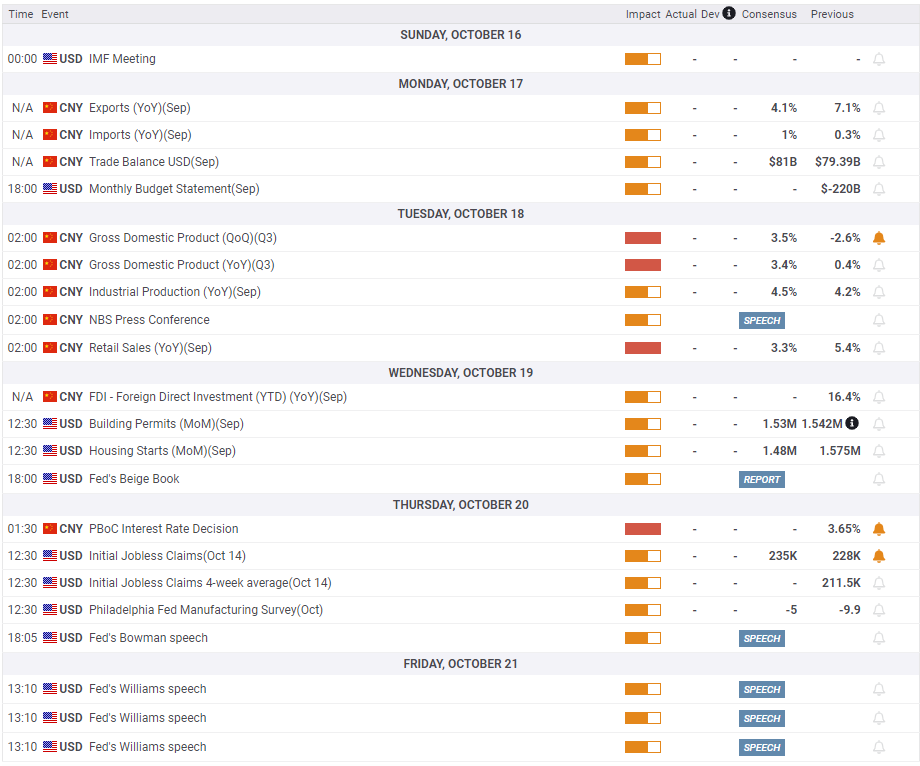
China is a major market for gold and on Tuesday, third-quarter Gross Domestic Product (GDP) data for the country will be released. The Chinese economy is forecast to expand at an annualized rate of 3.4% in the third quarter following the dismal 0.2% growth recorded in the second quarter. In case the GDP data comes in below the market expectation, gold could have a hard time finding demand and vice versa.
From the dollar’s perspective, Wednesday may be important as September Housing Starts will be featured in the US economic docket. The housing market has been suffering from rising rates and FOMC policymakers have been voicing their concerns over a “correction.” A significant decline in this data could cause the dollar to lose strength, helping gold higher. September Existing Home Sales on Thursday could also have a similar impact on the greenback’s market valuation.
There won’t be any other high-impact data releases from the US and gold is likely to remain sensitive to fluctuations in US bond yields. Since markets are already fully pricing in another 75 bps Fed rate hike in November, US yields might not have a lot of room on the upside. Hence, XAU/USD could see that as an opportunity to make a technical rebound/correction.
Gold technical outlook
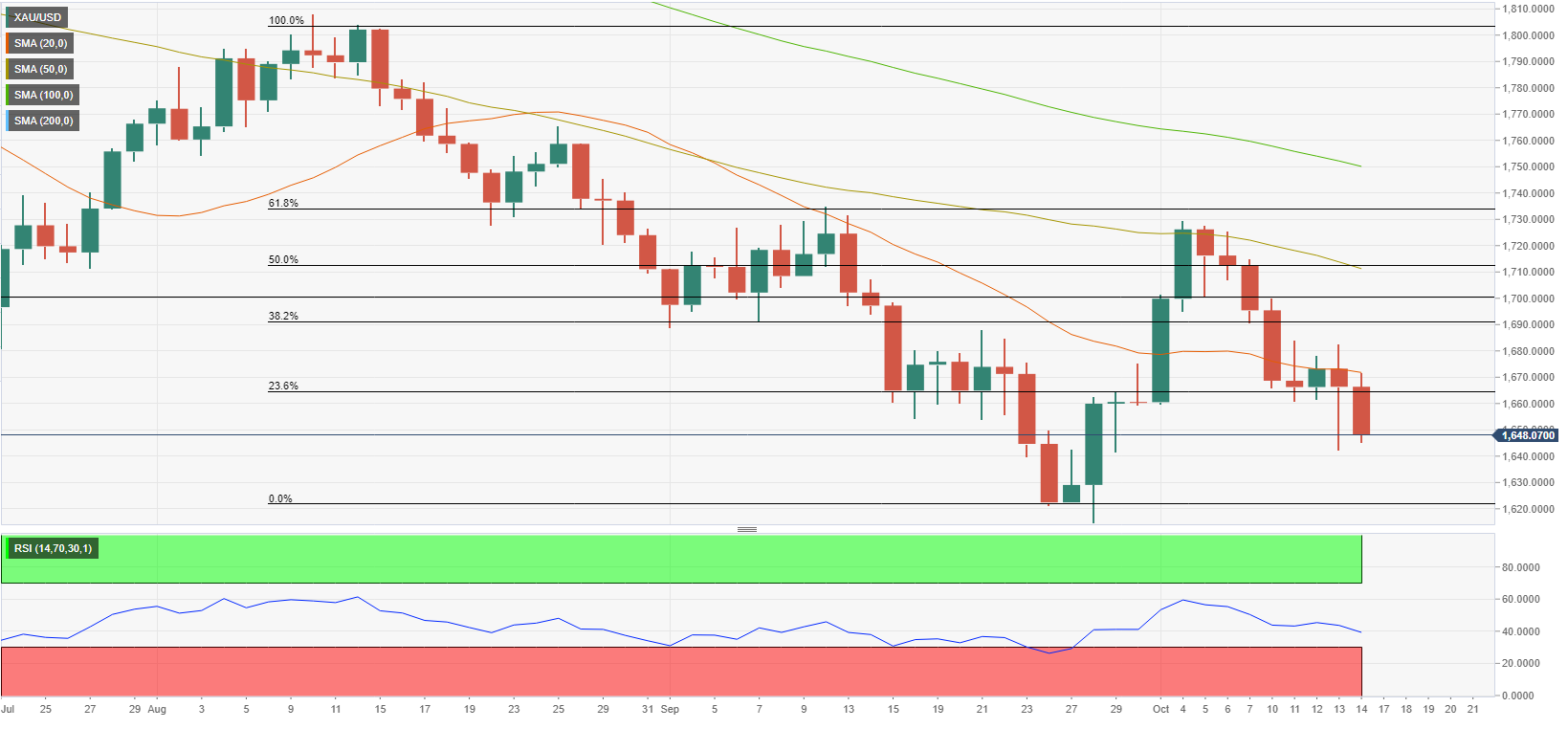
The Relative Strength Index (RSI) indicator on the daily chart dropped below 50 and XAU/USD failed to make a daily close above the 20-day SMA despite having tested that level twice in the second half of the week, pointing to a bearish tilt.
On the downside, $1,640 (two-week low) aligns as initial support ahead of $1,620 (end-point of the latest downtrend) and $1,600 (psychological level).
In case the pair rises above $1,665 (Fibonacci 23.6% retracement), it is likely to face immediate resistance at $1,670, where the 20-day SMA is located. A daily close above that level could attract buyers and open the door for an extended recovery toward $1,690 (Fibonacci 38.2% retracement).
Gold sentiment poll
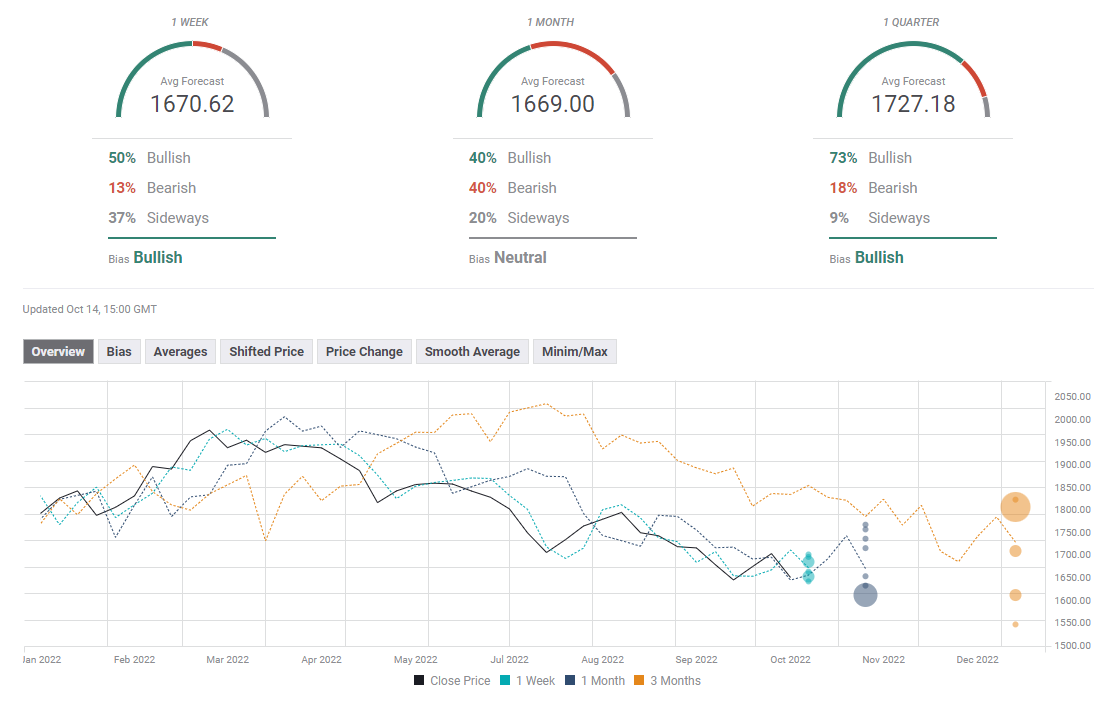
Half of the experts polled by FXStreet expect gold to stage a rebound next week with the average one-week target aligning at $1,670. The one-month view paints a mixed picture but the one-quarter outlook shows that a majority of experts project the yellow metal to be above $1,700 by the end of the year.
Author

Eren Sengezer
FXStreet
As an economist at heart, Eren Sengezer specializes in the assessment of the short-term and long-term impacts of macroeconomic data, central bank policies and political developments on financial assets.