Gold Weekly Forecast: Bearish momentum wanes as markets reassess Fed rate outlook
- Gold dropped to a new monthly low below $3,300 but then rebounded sharply after weak US NFP data.
- The near-term technical outlook suggests that the bearish bias is fading.
- Comments from Fed officials and mid-tier US data will be scrutinized by investors.

Gold (XAU/USD) stood under pressure for a large portion of the week before staging a decisive rebound on Friday. The disappointing employment data from the US forced the US Dollar (USD) to erase the gains it posted on the Federal Reserve’s (Fed) cautious tone on policy easing, allowing XAU/USD to reverse its direction. In the absence of high-impact data releases, investors will pay close attention to comments from Fed officials to assess whether the US central bank will opt for a rate cut in September.
Gold dropped below $3,300 in Fed aftermath
After closing the last three trading days of the previous week in negative territory, Gold struggled to find demand as a safe-haven on Monday and declined toward $3,300 as markets cheered the news of a trade deal between the United States (US) and the European Union (EU).
Both sides agreed on a framework that sets a blanket 15% tariff on goods traded between them, while the EU committed not to impose retaliatory tariffs and pledged $600 billion in investment in the US. Furthermore, officials from the US and China reportedly held constructive talks in Stockholm on Monday with an aim to extend the tariff truce for another three months.
On Tuesday, mixed US economic data limited the US Dollar’s (USD) gains and allowed Gold to erase Monday’s losses. The Bureau of Labor Statistics (BLS) reported that JOLTS Job Openings declined to 7.43 million in June from 7.77 million in May. On a positive note, the Conference Board’s Consumer Confidence Index improved to 97.2 in July from 95.2 in June.
Gold came under renewed bearish pressure on Wednesday, dropping to a fresh monthly low below $3,270 during the American trading hours, pressured by broad-based USD strength and rising Treasury bond yields on upbeat data and the Federal Reserve’s (Fed) cautious tone on policy-easing.
The US Bureau of Economic Analysis' first estimate showed that the US’ Gross Domestic Product (GDP) expanded at an annual rate of 3% in the second quarter. This reading followed the 0.5% contraction reported in the first quarter and beat the market expectation for an expansion of 2.4%. Additionally, the Automatic Data Processing (ADP) announced that employment in the private sector rose by 104,000 in July, surpassing analysts' estimate of 78,000.
Later in the day, the Fed left the policy rate unchanged at the range of 4.25%-4.5%, with Governor Christopher Waller and Governor Michelle Bowman both dissenting in favor of a 25 bps rate cut, in line with earlier speculation.
In the post-meeting press conference, Fed Chairman Jerome Powell refrained from confirming a rate cut at the next meeting in September, citing healthy conditions in the labor market and calling the current policy stance “appropriate” to guard against inflation risks. Moreover, Powell said that the policy was not holding back the economy despite remaining modestly restrictive.
Although Gold staged a rebound on Thursday, it failed to gather bullish momentum and stabilized near $3,300, with investors moving to the sidelines ahead of the July employment report from the US.
The BLS reported on Friday that Nonfarm Payrolls (NFP) rose by 73,000 in July, missing the market expectation of 110,000. On a more concerning note, the BLS downwardly revised NFP increases for May and June by 125,000 and 133,000, respectively. "With these revisions, employment in May and June combined is 258,000 lower than previously reported," the BLS said in its press release. The Unemployment Rate edged higher to 4.2% from 4.1% in June.
The CME FedWatch Tool’s probability of a 25 basis point Fed rate cut in September rose to nearly 70% from about 30% after the dismal employment data. In turn, the USD came under heavy selling pressure and the benchmark 10-year US Treasury bond yield fell nearly 3%, opening the door for a decisive Gold rebound to beyond $3,350.
Gold investors reassess Fed rate outlook
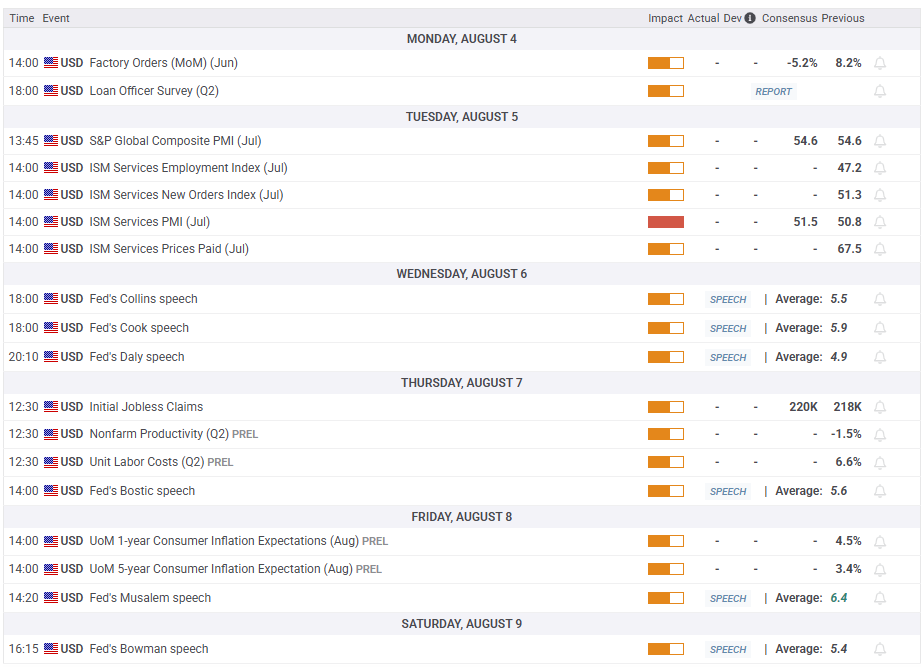
The Institute for Supply Management (ISM) will publish Services Purchasing Managers Index (PMI) data for July on Tuesday. In case the headline PMI comes in below 50 and points to a contraction in the service sector’s business activity, the USD could have a hard time outperforming its rivals, allowing XAU/USD to hold its ground. On the other hand, a reading above 50, combined with an improvement in the Employment Index of the survey, could boost the USD with the immediate reaction.
The US economic calendar will not feature any high-impact data releases in the remainder of the week. With the Fed’s blackout period coming to an end, policymakers will be delivering remarks throughout the week.
If Fed officials suggest that a rate cut will be on the table at the next meeting, citing cooling conditions in the labor market, US Treasury bond yields could turn south and allow Gold to continue to push higher. Conversely, XAU/USD could struggle to gather bullish momentum if Fed policymakers downplay the weak NFP reading for July, cling to a cautious tone on inflation outlook and reiterate the need for patience while waiting for the next batch of inflation and employment data.
Gold technical analysis
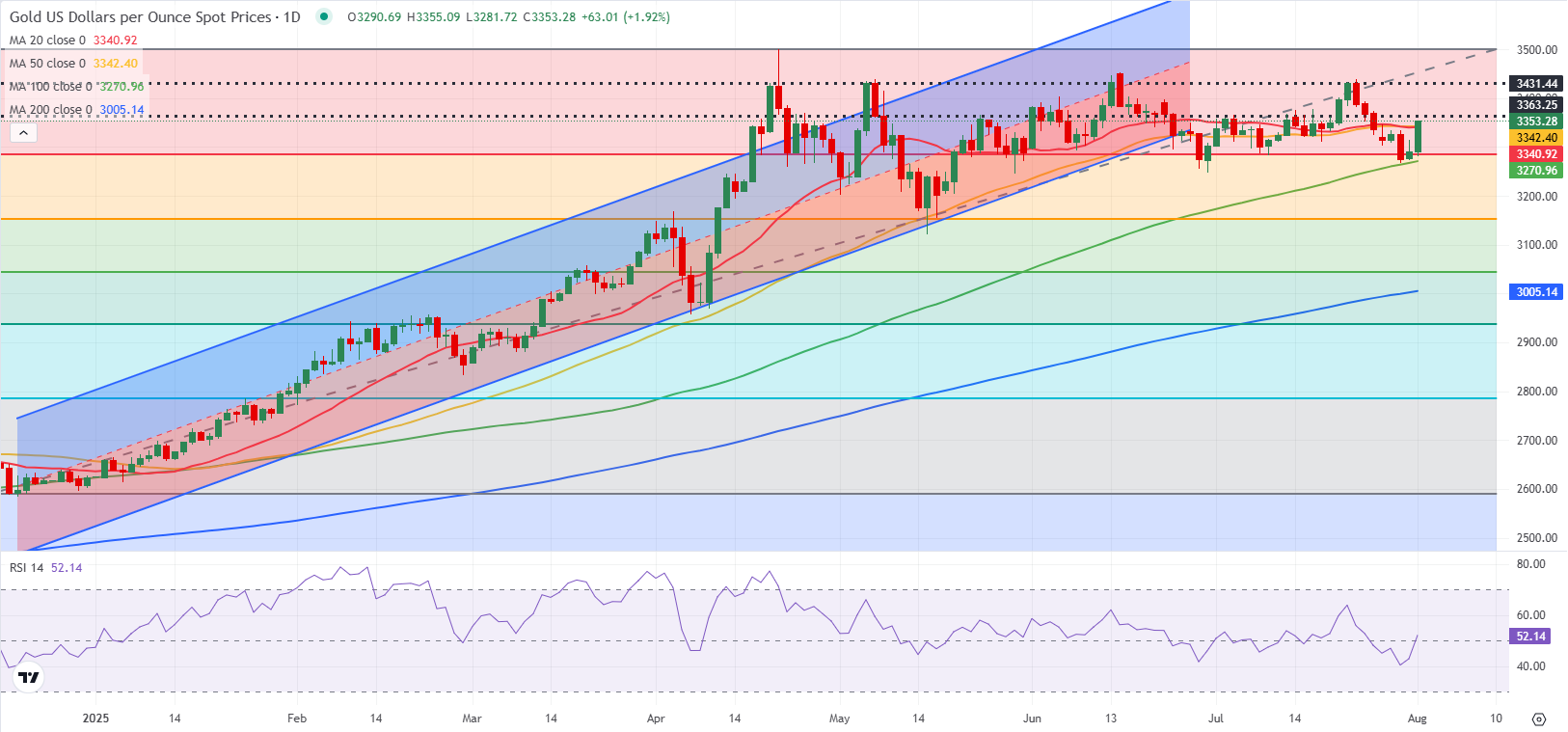
The Relative Strength Index (RSI) indicator on the daily chart recovered above 50 after the NFP data on Friday and Gold rose above $3,340, where the 20-day and the 50-day Simple Moving Averages (SMAs) align, highlighting sellers’ hesitancy.
In case Gold holds above $3,340 (20-day SMA, 50-day SMA) and confirms that level as support, $3,400 (static level) could be seen as the next resistance level before $3,430 (static level) and $3,500 (all-time high set on April 22).
On the downside, the 100-day SMA at $3,270 emerges as the immediate support level. A daily close below this level could attract technical sellers and open the door for another leg lower toward $3,200 (static level, round level) and $3,150 (Fibonacci 38.2% retracement of the January-June uptrend).
Gold FAQs
Gold has played a key role in human’s history as it has been widely used as a store of value and medium of exchange. Currently, apart from its shine and usage for jewelry, the precious metal is widely seen as a safe-haven asset, meaning that it is considered a good investment during turbulent times. Gold is also widely seen as a hedge against inflation and against depreciating currencies as it doesn’t rely on any specific issuer or government.
Central banks are the biggest Gold holders. In their aim to support their currencies in turbulent times, central banks tend to diversify their reserves and buy Gold to improve the perceived strength of the economy and the currency. High Gold reserves can be a source of trust for a country’s solvency. Central banks added 1,136 tonnes of Gold worth around $70 billion to their reserves in 2022, according to data from the World Gold Council. This is the highest yearly purchase since records began. Central banks from emerging economies such as China, India and Turkey are quickly increasing their Gold reserves.
Gold has an inverse correlation with the US Dollar and US Treasuries, which are both major reserve and safe-haven assets. When the Dollar depreciates, Gold tends to rise, enabling investors and central banks to diversify their assets in turbulent times. Gold is also inversely correlated with risk assets. A rally in the stock market tends to weaken Gold price, while sell-offs in riskier markets tend to favor the precious metal.
The price can move due to a wide range of factors. Geopolitical instability or fears of a deep recession can quickly make Gold price escalate due to its safe-haven status. As a yield-less asset, Gold tends to rise with lower interest rates, while higher cost of money usually weighs down on the yellow metal. Still, most moves depend on how the US Dollar (USD) behaves as the asset is priced in dollars (XAU/USD). A strong Dollar tends to keep the price of Gold controlled, whereas a weaker Dollar is likely to push Gold prices up.
Author

Eren Sengezer
FXStreet
As an economist at heart, Eren Sengezer specializes in the assessment of the short-term and long-term impacts of macroeconomic data, central bank policies and political developments on financial assets.


![How Wall Street rigs the game [Video]](https://editorial.fxsstatic.com/images/i/market-chaos-01.jpg)