Gold Weekly Forecast: Gold remains attractive as Russia doesn't give in
- Gold continues to find demand amid the ongoing Russia-Ukraine crisis.
- $1,975 aligns as the next bullish target for the yellow metal.
- US inflation data and geopolitical headlines should drive next week's action.

Gold reacted sharply to changes in risk sentiment throughout the week and ended up registering its highest weekly close since November 2020, near $1,950, with Russia showing no intention of de-escalating the conflict with Ukraine.
What happened last week?
Gold started the new week on a firm footing after the US, the EU, the UK, along with other western nations, decided to exclude some Russian financial institutions from the global payment system, SWIFT. Following Monday’s talks, delegations from Russia and Ukraine announced that they agreed to meet again later in the week for the second round of “peace talks” and allowed investors to breathe a sigh of relief.
Nonetheless, reports revealed early Tuesday that Russia continued to ramp up its military presence in Ukraine with an attempt to take over Kyiv, leading to safe-haven flows, once again, to take over the financial markets.
On Wednesday, FOMC Chairman Jerome Powell’s hawkish remarks triggered a sharp upsurge in the US Treasury bond yields, despite the risk-averse market environment, and forced gold to close the day in negative territory.
On the first day of his semi-annual testimony before the House Committee on Financial Services, Powell confirmed a 25 basis points rate hike would be appropriate in March. Additionally, Powell noted that they could consider the option of a 50 basis points rate hike later in the year if the first series of rate increases failed to help ease price pressures. The chairman also said that there wouldn't be any direct effects on the US economy from Russian sanctions but acknowledged that it was causing uncertainty on the growth outlook.
Gold stayed relatively quiet on Thursday and managed to erase a portion of Wednesday’s losses before regathering bullish momentum on Friday. On the second day of his testimony, this time before the US Senate Banking Committee, Powell virtually repeated his comments on the policy outlook, inflation and the economy.
During the Asian trading hours on the last day of the week, reports of Russia attacking the Zaporizhzhia nuclear power plant triggered another bout of flight to safety and provided another boost to the yellow metal.
Earlier in the week, the data from the US revealed that the economic activity in the service sector expanded at a softer pace in February than it did in January, with the ISM Services PMI retreating to 56.5 from 59.9. This print fell short of the market expectation of 61.
On Friday, the US Bureau of Labor Statistics reported that Nonfarm Payrolls increased by 678,000 in February. This print surpassed the market expectation of 400,000 by a wide margin. Investors largely ignored the upbeat jobs report and gold surged beyond $1,950 with the benchmark 10-year US Treasury bond yield losing more than 6% on a daily basis.
Next week
There won’t be any high-tier macroeconomic data releases coming from the US on Monday and Tuesday. Investors will remain focused on the Russia-Ukraine crisis, and the risk perception is likely to continue to impact gold’s market valuation.
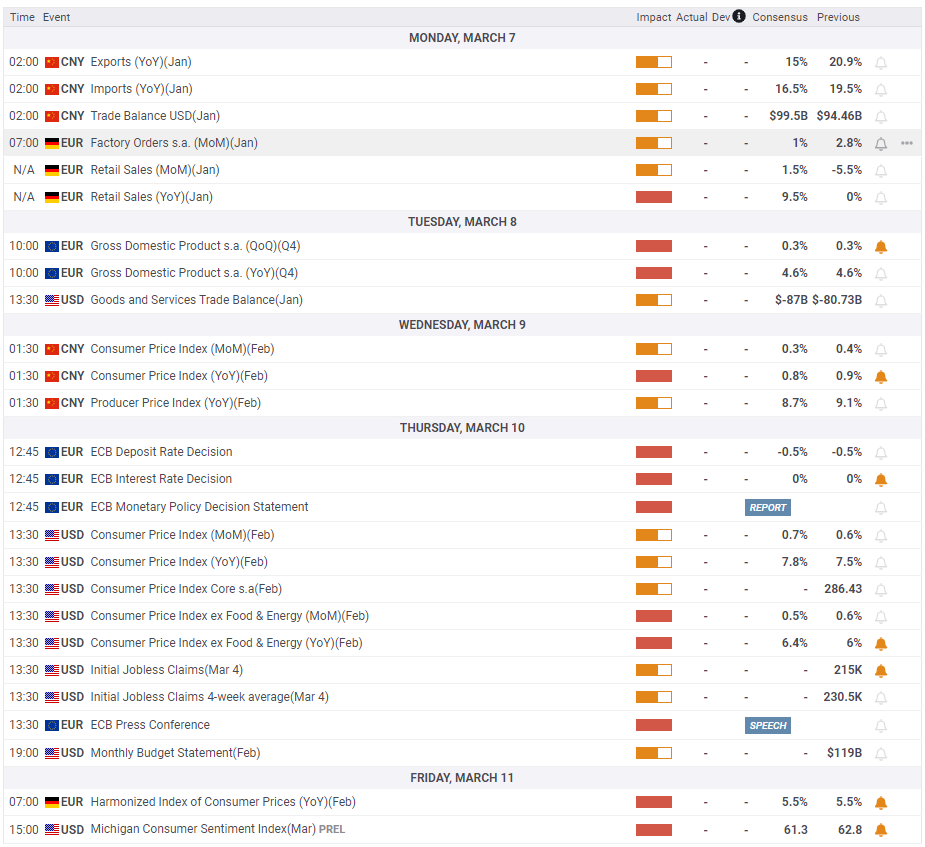
On Wednesday, the US Bureau of Labor Statistics will release the February Consumer Price Index (CPI) data. On a yearly basis, CPI is expected to rise to 6.4% from 6% in January. Unless there is a negative surprise in the inflation reading, investors should continue to price in a hawkish Fed policy outlook. Another leg higher in the US T-bond yields on a strong CPI print could limit the yellow metal’s gains.
The European Central Bank (ECB) will announce its policy decisions on Wednesday as well. Markets have already dialled back ECB rate hike bets. The bank could adopt a dovish stance amid heightened concerns over the potential negative impact of the Russia-Ukraine war on the eurozone’s economic outlook. In that case, gold is likely to remain attractive.
In short, the yellow metal should continue to find demand as a traditional safe-haven next week unless investors see convincing signs of a de-escalation of the Russia–Ukraine conflict. If participants shift their focus to the Fed’s policy outlook after the inflation data, gold's inverse correlation with the US T-bond yields could cap XAU/USD’s upside.
Gold technical outlook
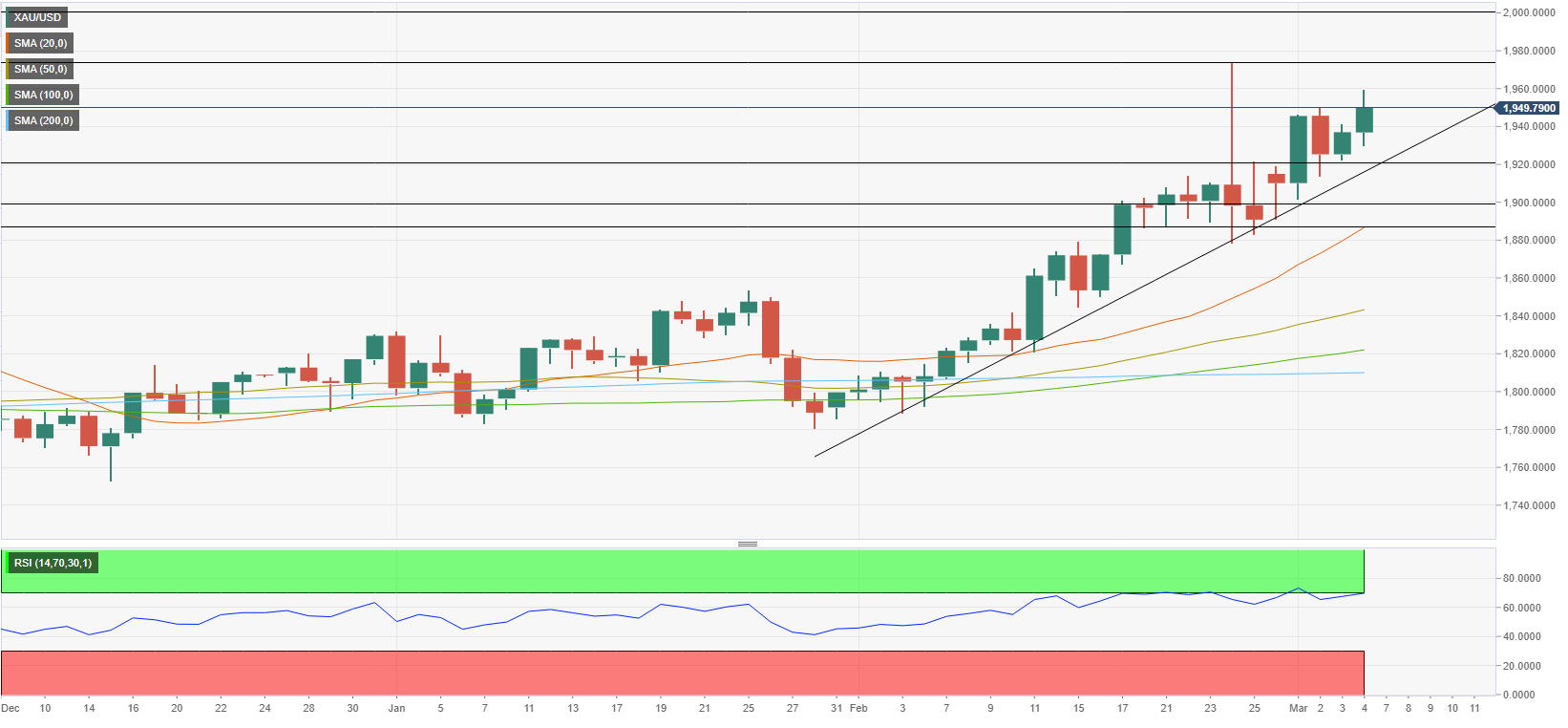
The technical picture suggests that gold remains bullish in the near term with the ascending trend line coming from early February staying intact. On the upside, $1,975 (static level, February 24 high) aligns as the first hurdle before the precious metal could target the all-important $2,000 level.
Meanwhile, the Relative Strength Index (RSI) indicator on the daily chart is about to rise above 70, suggesting that the pair might need to make a downward correction before the next leg higher. Nevertheless, as long as $1,920 support (static level, ascending trend line) holds, sellers are likely to remain on the sidelines.
Below $1,920, next support is located at $1,900 (psychological level) before $1,885 (20-day SMA).
Gold sentiment poll
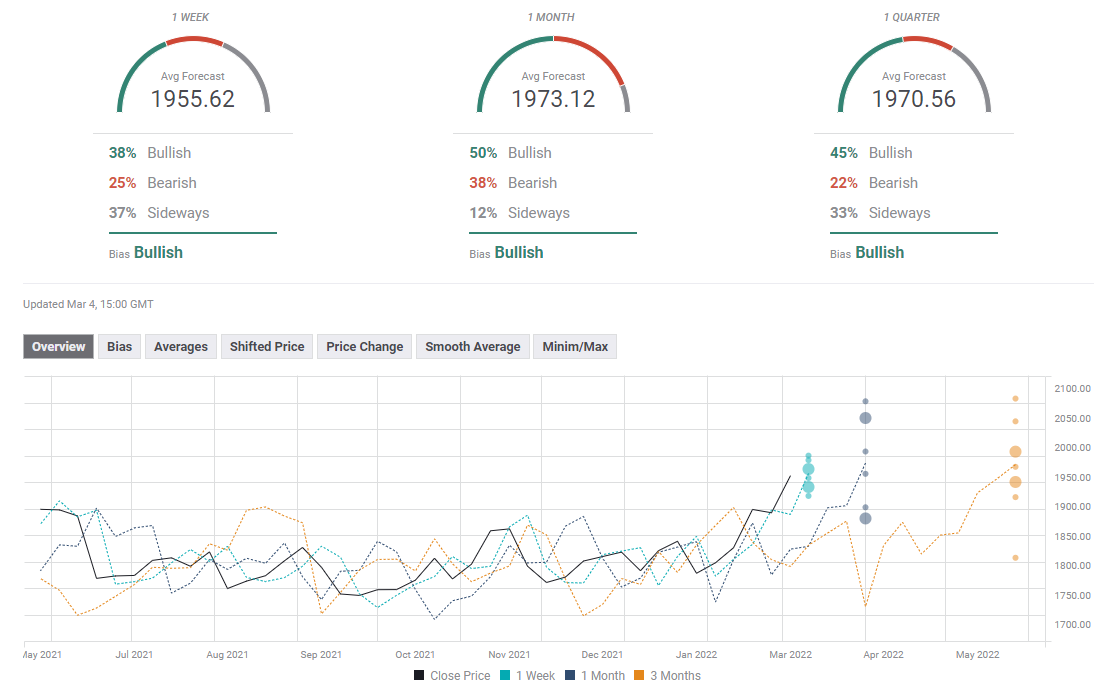
The FXStreet Forecast Poll shows that gold could stay in a consolidation phase in the short term with the one-week average sitting slightly above $1,950. The one-month outlook and the one-quarter outlook both point to additional gains with average targets of $1,973 and $1,970, respectively.
Premium
You have reached your limit of 3 free articles for this month.
Start your subscription and get access to all our original articles.
Author

Eren Sengezer
FXStreet
As an economist at heart, Eren Sengezer specializes in the assessment of the short-term and long-term impacts of macroeconomic data, central bank policies and political developments on financial assets.