Gold Weekly Forecast: Fed uncertainty caps the upside
- Gold managed to rebound following the bearish action seen in the first half of the week.
- US August inflation data could help markets decide whether the Fed will raise rates.
- The near-term technical outlook highlights a slightly bullish stance that lacks momentum.

After declining sharply in the first half of the week, Gold (XAU/USD) managed to erase its losses, reflecting the changes in the market pricing of the Federal Reserve’s (Fed) possible interest rate decision at the next meeting. Investors will scrutinize August inflation data from the United States (US), while the precious metal’s near-term technical outlook suggests that sellers remain hesitant.
Gold recovers as investors struggle to decide on the Fed’s next move
Gold remained under bearish pressure in the first half of the week as Fed Chair Kevin Warsh’s hawkish comments at the Jackson Hole Symposium revived expectations for a September Fed rate hike. Meanwhile, the deepening crisis in the Middle East further weighed on the yellow metal and dragged it to its lowest level since early August, below $4,300 by early Wednesday.
The US and Iran exchanged military strikes for the first time in weeks over the weekend. The US forces attacked two rocket launchers on Iran's Larak Island, and Iran has targeted US bases in Jordan and the United Arab Emirates (UAE) in response. During the American trading hours on Tuesday, news of the US military carrying out strikes that Tehran claimed killed civilians pointed to a further escalation of the military conflict. Following the attack, US President Donald Trump wrote on Truth Social that Iran “will be hit again at a much harder and higher level, but it will not be the biggest attack of them all, that is waiting in the wings.” In response, the Islamic Revolutionary Guard Corps said it attacked two US military bases in the United Arab Emirates (UAE).
In the second half of the day on Wednesday, XAU/USD gathered recovery momentum and closed the day in positive territory. The weaker-than-expected private sector employment data from the US weighed on the US Dollar (USD), while a sharp decline seen in the USD/JPY pair hinted at a possible currency market intervention.
The USD came under renewed selling pressure on Thursday and allowed XAU/USD to extend its rebound into a second consecutive day.
Fed Governor Christopher Waller adopted a cautious stance on policy tightening and caused the USD to lose interest. The key remark that Waller is inclined to support holding the policy rate steady in September if August inflation shows continued progress, but would consider a hike if the data come in hot, underscored a finely balanced, data-dependent reaction function that suggests a rate hike at the next meeting is not a done deal. His acknowledgment of “finally” seeing disinflation alongside still-elevated inflation, and a low tolerance for renewed price pressures, further reaffirmed his reluctance on a possible rate hike. Following Waller’s speech, the CME FedWatch Tool’s probability of a 25 basis points rate hike at the upcoming meeting declined to 50% from about 63% earlier in the week. In turn, Gold climbed above $4,500 late Thursday, erasing its weekly losses in the process.
Commenting on Gold’s price action, analysts at OCBC noted that Gold “rose more than 2% towards $4,510 intra-session high as Waller’s comments prompted markets to pare September Fed hike expectations, pulling UST yields and the USD lower.” They note that this latest move “partly reverses the sharp sell-off earlier in the week, when Warsh’s Jackson Hole remarks and the rise in global yields had weighed on precious metals.” OCBC adds that “geopolitical tensions remain supportive at the margin, though higher Oil prices are a two-sided risk if they feed back into inflation expectations and yields.”
The data from the US showed on Friday that Nonfarm Payrolls increased by 162K in August. This print surpassed the market expectation for an increase of 56K by a wide margin and boosted the USD with the immediate reaction. Other details of the report showed that the total Nonfarm Payroll employment for June and July was revised up by 11K and 44K, respectively, while the Unemployment Rate remained unchanged at 4.1%. Following the impressive labor market report, Gold failed to build on its recovery heading into the weekend.
Gold investors await critical US inflation report
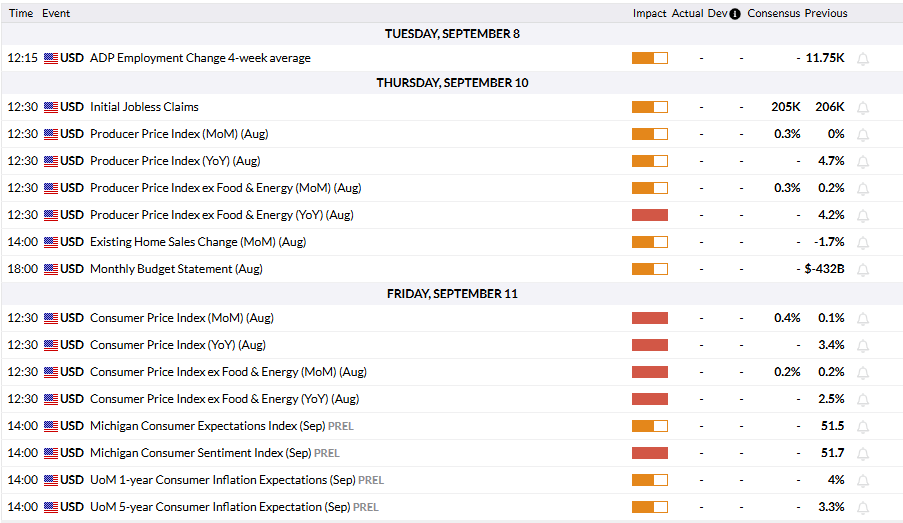
The Fed will be in the blackout period until the September 15-16 policy meeting. Hence, the US Bureau of Labor Statistics’ (BLS) Consumer Price Index (CPI) data on Friday will be the final, and arguably the most important, clue on whether the US central bank will opt for a rate hike.
Fed Governor Waller said that “continued progress toward our 2% goal” is needed for him to vote in favor of a policy hold and explained that his decision will be “influenced by what we learn about August inflation." Although the 2% goal Waller mentioned relates to the annual core Personal Consumption Expenditures (PCE) Price Index, a reading below July’s 0.2% in the monthly core CPI could be seen as a confirmation of “progress” and trigger a USD selloff with the immediate reaction. In this scenario, XAU/USD is likely to gather bullish momentum heading into the Fed meeting. Conversely, a monthly core CPI reading at or above 0.2% could feed into expectations for a rate hike and weigh heavily on Gold.
In short, Gold is facing a two-way risk with the US inflation data due on Friday, given markets currently see the odds of a rate hike at about 60%, thanks to the strong August jobs data.
According to strategists at TD Securities, the backdrop for bullion has become more supportive, with the bank emphasizing that “we do not anticipate material downside for the yellow metal as the landscape for precious metals has improved amid a renewed Dollar debasement theme, while Fed hikes remain far from certain.” This combination of a softer US Dollar narrative and lingering uncertainty over the Fed’s policy path is seen as helping to anchor Gold prices despite recent volatility.
Gold technical analysis: Bullish bias holds but lacks strength
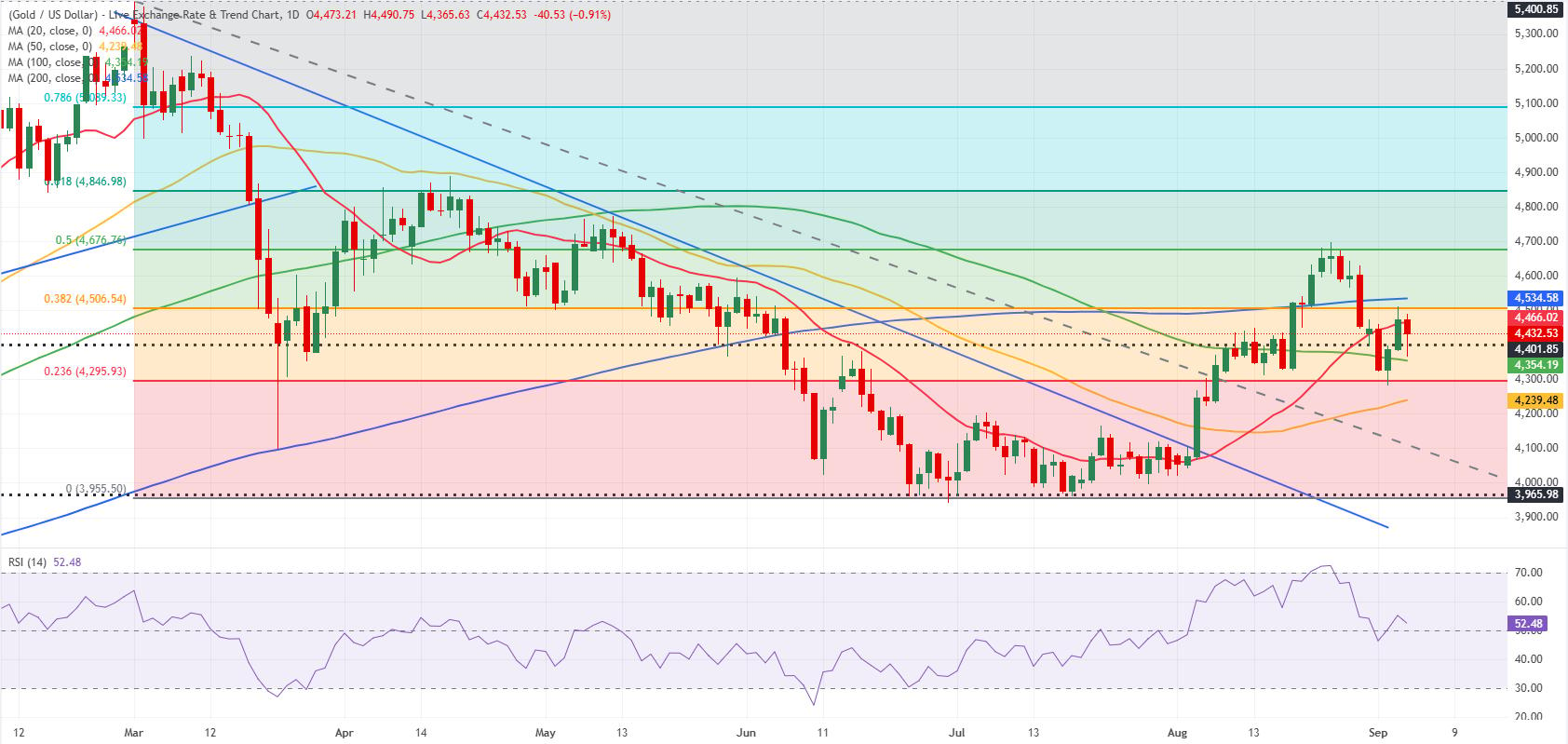
The Relative Strength Index (RSI) indicator on the daily chart managed to recover above the neutral line at 50 after falling below that level earlier in the week. Additionally, Gold reclaimed the 100-day Simple Moving Average (SMA), currently located near $4,350, despite making a daily close below it. Still, the daily RSI remains flat above 50 and Gold is yet to clear the 200-day SMA at $4,535, suggesting that buyers are still reluctant to bet on a steady uptrend.
On the upside, $4,510-$4,535 (Fibonacci 38.2% retracement of the March-August downtrend, 200-day SMA) aligns as a key resistance area. In case Gold stabilizes above this region and confirms it as support, $4,675-$4,700 (Fibonacci 50% retracement of the March-August downtrend, round level) could be seen as the next bullish target before $4,850 (Fibonacci 61.8% retracement).
Looking south, the first important support level could be spotted at $4,350 (100-day SMA), followed by $4,300-$4,295 (static level, Fibonacci 23.6% retracement) and $4,240 (50-day SMA).
Gold FAQs
Gold has played a key role in human’s history as it has been widely used as a store of value and medium of exchange. Currently, apart from its shine and usage for jewelry, the precious metal is widely seen as a safe-haven asset, meaning that it is considered a good investment during turbulent times. Gold is also widely seen as a hedge against inflation and against depreciating currencies as it doesn’t rely on any specific issuer or government.
Central banks are the biggest Gold holders. In their aim to support their currencies in turbulent times, central banks tend to diversify their reserves and buy Gold to improve the perceived strength of the economy and the currency. High Gold reserves can be a source of trust for a country’s solvency. Central banks added 1,136 tonnes of Gold worth around $70 billion to their reserves in 2022, according to data from the World Gold Council. This is the highest yearly purchase since records began. Central banks from emerging economies such as China, India and Turkey are quickly increasing their Gold reserves.
Gold has an inverse correlation with the US Dollar and US Treasuries, which are both major reserve and safe-haven assets. When the Dollar depreciates, Gold tends to rise, enabling investors and central banks to diversify their assets in turbulent times. Gold is also inversely correlated with risk assets. A rally in the stock market tends to weaken Gold price, while sell-offs in riskier markets tend to favor the precious metal.
The price can move due to a wide range of factors. Geopolitical instability or fears of a deep recession can quickly make Gold price escalate due to its safe-haven status. As a yield-less asset, Gold tends to rise with lower interest rates, while higher cost of money usually weighs down on the yellow metal. Still, most moves depend on how the US Dollar (USD) behaves as the asset is priced in dollars (XAU/USD). A strong Dollar tends to keep the price of Gold controlled, whereas a weaker Dollar is likely to push Gold prices up.
Author

Eren Sengezer
FXStreet
As an economist at heart, Eren Sengezer specializes in the assessment of the short-term and long-term impacts of macroeconomic data, central bank policies and political developments on financial assets.