Gold Weekly Forecast: Bull hesitancy persists despite weaker US Dollar
- Gold failed to capitalize on broad USD weakness.
- Widening conflict in the Middle East keeps markets on edge.
- Technical outlook highlights bulls’ hesitancy in the near term.

Gold (XAU/USD) struggled to make a decisive move in either direction as the persistent US Dollar (USD) weakness was offset by a widening conflict in the Middle East. July employment data from the United States (US) could trigger a big reaction in Gold, while the near-term technical outlook highlights a lack of buyer interest.
Middle East crisis caps Gold’s upside
Gold started the week with a bullish gap as geopolitical tensions eased after the US announced over the weekend that it put military operations against Iran on hold and Iran also paused its retaliatory strikes. However, the yellow metal erased a portion of its daily gains later on Monday after Iran clarified that they were not engaged in direct ceasefire talks with the US.
Reports of Saudi forces joining the conflict by launching attacks on Iran-aligned groups in Iraq as retaliation to the Islamic Revolutionary Guard Corps' (IRGC) drone attacks on Saudi oil facilities pointed to a widening conflict, rather than a return to diplomacy. Additionally, Iran claimed an attack on a US military base located in Jordan. Gold turned south on Tuesday and lost more than 1% on the day.
On Wednesday, the USD came under heavy selling pressure and allowed XAU/USD to stage a rebound. Although the Federal Reserve (Fed) refrained from delivering a dovish message following the July policy meeting, the decision to leave the policy rate unchanged in the range of 3.5%-3.75% triggered a USD selloff, as markets had priced in about a 30% chance of a 25 basis points (bps) interest rate hike heading into the event, according to the CME FedWatch Tool.
Fed Chairman Kevin Warsh’s comments in the post-meeting press conference scored a 7/10 on FXS Speechtracker versus a historic 6/10, underscoring a firmer commitment to the inflation fight. The repeated insistence that “only one target and it is 2%” and “we will deliver the 2% target,” alongside remarks that inflation “cannot be cured in 9 weeks” and that the committee “will not hesitate to act,” signaled a resolute, patient hawkish stance despite acknowledging “impressive resilience” in the economy. The emphasis on trend over short-term data, higher nominal and real yields, and a robust, non-inertial policy debate pointed to a Fed comfortable with tight conditions for longer.
According to TD Securities, the latest FOMC decision to leave interest rates unchanged has supported bullion, but it was Fed Chair Kevin Warsh’s stance that proved more pivotal. The bank notes that “the FOMC held interest rates steady, but it was Fed Chair Warsh’s willingness to look through an inflation shock and steer away from data dependency that has given gold a lift higher.” Even so, TD Securities cautions that the broader policy backdrop remains a constraint, stressing that “we continue to believe that market expectations for rate hikes will keep a lid on any material bullishness across precious metals.”
The USD continued to weaken against its major rivals on Thursday and Gold managed to close the second consecutive day in positive territory. The US Bureau of Economic Analysis (BEA) reported that the US’ Gross Domestic Product (GDP) grew at an annual rate of 1.5% in the second quarter, falling short of the market expectation and the first-quarter’s 2.1% expansion. However, the unprecedented decline seen in USD/JPY suggested that the USD weakness was most likely caused by a suspected market intervention by Japanese authorities to support the Japanese Yen, rather than a change in the underlying fundamentals of the USD. With the dust settling down on Friday and investors shifting their focus back to the Middle East, the USD staged a rebound and XAU/USD turned south, retracing a majority of its two-day rebound.
Gold investors to stay focused on Middle East, Fed outlook
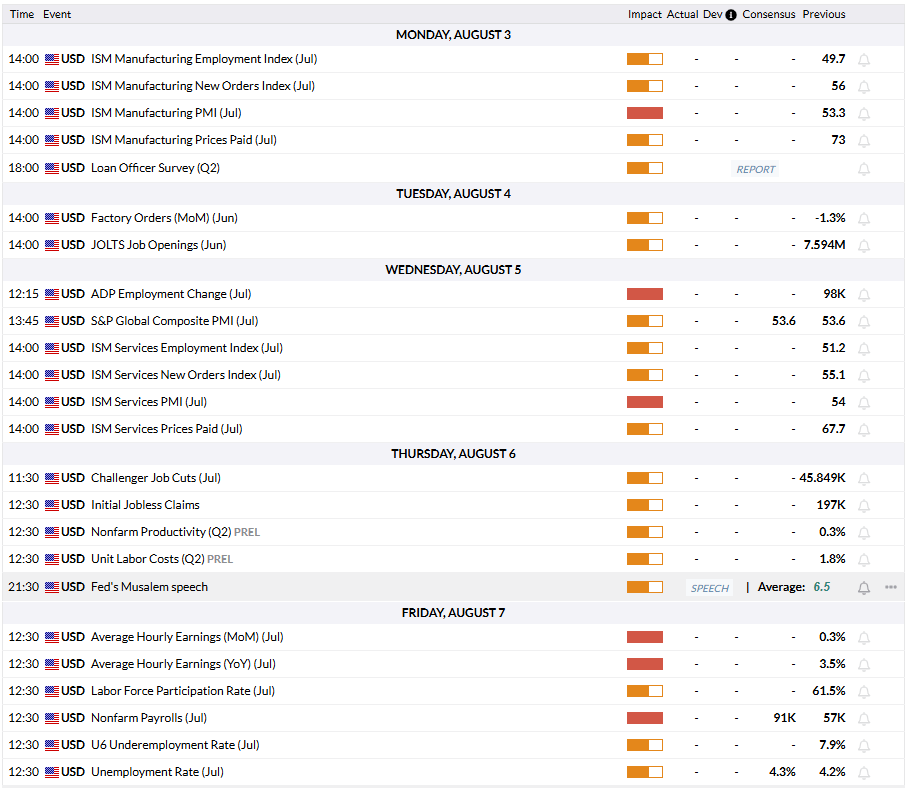
The US economic calendar will feature the Institute for Supply Management’s (ISM) Manufacturing and Services Purchasing Managers’ Index (PMI) reports on Monday and Wednesday, respectively. Ahead of Friday’s critical official employment report, however, PMI figures are unlikely to have a lasting impact on Gold’s performance. Still, the USD could struggle to find demand and help XAU/USD keep its footing in case either of the headline PMIs falls into contraction territory below 50.
Nonfarm Payrolls (NFP) rose by 57K in June and missed the market expectation of 110K by a wide margin, following three consecutive months of robust growth. A disappointing NFP print below 50K in July could revive concerns over worsening conditions in the labor market and weigh on the USD with the immediate reaction.
Conversely, a reading above 80K is likely to be seen as ‘good enough’ for the Fed to continue to prioritize taming inflation and support the USD. The CME FedWatch Tool shows that markets are currently pricing in about a 35% probability of a rate increase in September. If there is a significant upside surprise in NFP, with a print above 120K, markets could quickly position themselves for a September rate hike. Current market positioning suggests that the USD is likely to rally in this scenario and trigger another leg lower in XAU/USD heading into the weekend.
Economists at Wells Fargo anticipate a steady US labor backdrop over the coming months, noting that they “expect the job market to remain broadly stable, with payroll growth averaging ~80K per month and the unemployment rate holding near 4.2% for the remainder of the year.” While they acknowledge that the recent decline in unemployment “did not occur for the ‘right’ reasons,” Wells Fargo argues that the “sideways move in the unemployment rate signals that labor demand and supply are roughly in balance,” reinforcing the view of a jobs market that is neither overheating nor sharply weakening.
Investors will also pay close attention to comments from Fed policymakers throughout the week, especially from Cleveland Fed President Beth Hammack, Minneapolis Fed President Neel Kashkari and Dallas Fed President Lorie Logan, who dissented by voting in favor of a rate hike in the last Fed decision.
In case policymakers voice concerns over the inflation outlook and risks posed by the prolonged conflict in the Middle East, the USD is likely to stay resilient and limit XAU/USD’s recovery attempts. On the other hand, Gold could gain traction and push higher if US central bank officials support a steady policy for longer, dampening interest rate hike expectations by citing a cooling economy on the back of the disappointing second-quarter growth data.
Analysts at Commerzbank highlight that the latest Fed decision was far from unanimous, noting that “three of the five regional Fed presidents who serve on the Federal Open Market Committee voted in favor of a rate hike,” underscoring a meaningful hawkish contingent within the FOMC. They argue that Chair Kevin Warsh “apparently assumes that the financial markets will do the Fed’s work for it,” allowing higher market yields to shoulder more of the tightening burden in the near term. However, Commerzbank cautions that this strategy has clear limits: “If inflation does not slow noticeably soon, it will not be enough to merely speak resolutely. Then the Fed will also have to take action.”
Finally, fresh developments surrounding the crisis in the Middle East are likely to continue to impact Gold’s valuation. A retreat in military action could support the precious metal, while a further escalation and expansion of the conflict could continue to feed into global inflation fears and hurt it.
Gold technical analysis: Bulls hesitate
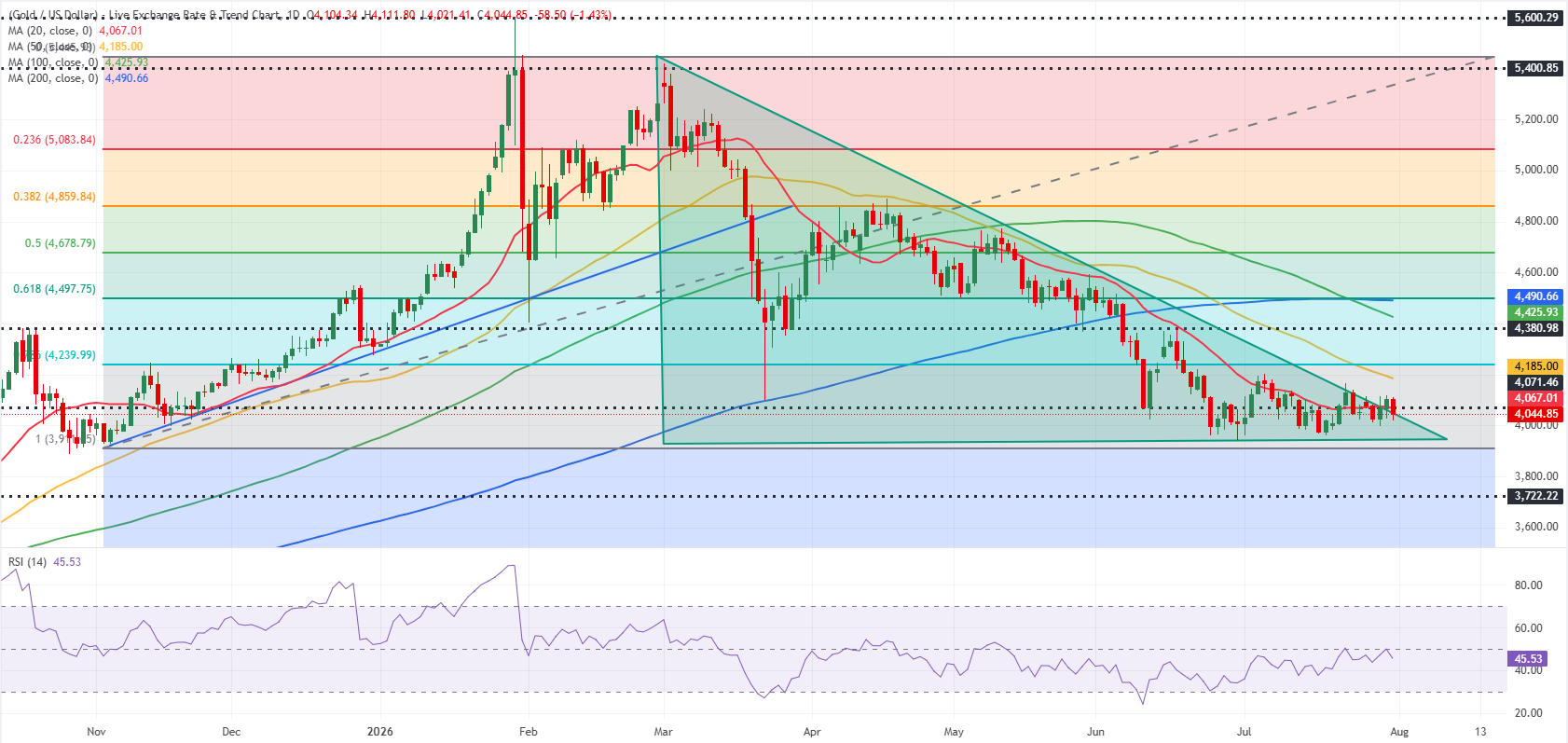
The Relative Strength Index (RSI) indicator on the daily chart fell short of clearing the 50 neutral level, and Gold’s break above the descending trend line and the 20-day Simple Moving Average (SMA) on Thursday failed to attract technical buyers.
The $3,950-$3,920 area stays as a key technical support, where the lower limit of the descending triangle formation and the beginning point of the November-February trend align. If Gold breaks below this region, $3,800 (static level, round level) could be seen as the next bearish target ahead of $3,720 (static level).
On the upside, $4,185 (50-day SMA) could be seen as the next resistance level in case Gold manages to confirm the $4,060-$4,070 (20-day SMA, descending trend line) area as support. If the bullish momentum builds up afterward, $4,240 (Fibonacci 78.6% retracement of the November-February uptrend) could be seen as an interim resistance level before $4,380 (static level).
Gold FAQs
Gold has played a key role in human’s history as it has been widely used as a store of value and medium of exchange. Currently, apart from its shine and usage for jewelry, the precious metal is widely seen as a safe-haven asset, meaning that it is considered a good investment during turbulent times. Gold is also widely seen as a hedge against inflation and against depreciating currencies as it doesn’t rely on any specific issuer or government.
Central banks are the biggest Gold holders. In their aim to support their currencies in turbulent times, central banks tend to diversify their reserves and buy Gold to improve the perceived strength of the economy and the currency. High Gold reserves can be a source of trust for a country’s solvency. Central banks added 1,136 tonnes of Gold worth around $70 billion to their reserves in 2022, according to data from the World Gold Council. This is the highest yearly purchase since records began. Central banks from emerging economies such as China, India and Turkey are quickly increasing their Gold reserves.
Gold has an inverse correlation with the US Dollar and US Treasuries, which are both major reserve and safe-haven assets. When the Dollar depreciates, Gold tends to rise, enabling investors and central banks to diversify their assets in turbulent times. Gold is also inversely correlated with risk assets. A rally in the stock market tends to weaken Gold price, while sell-offs in riskier markets tend to favor the precious metal.
The price can move due to a wide range of factors. Geopolitical instability or fears of a deep recession can quickly make Gold price escalate due to its safe-haven status. As a yield-less asset, Gold tends to rise with lower interest rates, while higher cost of money usually weighs down on the yellow metal. Still, most moves depend on how the US Dollar (USD) behaves as the asset is priced in dollars (XAU/USD). A strong Dollar tends to keep the price of Gold controlled, whereas a weaker Dollar is likely to push Gold prices up.
Author

Eren Sengezer
FXStreet
As an economist at heart, Eren Sengezer specializes in the assessment of the short-term and long-term impacts of macroeconomic data, central bank policies and political developments on financial assets.

















