Gold Price Forecast: XAU/USD resumes the upside, fresh record highs and counting
- Gold kicks off the US Nonfarm Payrolls week with a bang, printing fresh record highs.
- US Dollar loses further ground on US government shutdown fears, Fed easing prospects.
- Technically, Gold appears a ‘buy-the-dips’ trade amid extreme overbought conditions.

Gold has resumed its record-setting rally, setting off a new week with a bang, as buyers challenge the $3,800 hurdle for the first time ever.
Gold capitalizes on US government shutdown fears
Investors scurry for safety in the traditional store of value, Gold, as fears over a US government shutdown, heading into the first day of the government's 2026 fiscal year on October 1, intensify, weighing on the demand for the US Dollar (USD).
Traders also remain wary about whether the September US labor market report will be published if the US government shuts down.
Meanwhile, markets pay little attention to an Axios report, citing that US President Donald Trump and his Israeli counterpart Benjamin Netanyahu near a Gaza peace agreement, although Hamas approval seems pending. The report is not yet confirmed by official sources.
Last week, a slew of encouraging US data releases showed the economic resilience, pushing back against expectations of two US Federal Reserve (Fed) interest rate cuts this year.
Markets are now pricing in about 40 basis points (bps) worth of easing by December, according to Refinitiv’s USD interest rate probabilities.
Attention now turns to figures on Job Openings, private payrolls, the ISM Manufacturing and Services PMIs ahead of Friday’s Nonfarm Payrolls (NFP) for further clues on the health of the US economy, which will help reprice markets’ expectations of future Fed rate cuts, in turn, influencing the USD-denominated and non-interest-bearing Gold.
In the meantime, trade and geopolitical headlines will likely drive the Gold price action alongside speeches from Fed officials.
Gold price technical analysis: Daily chart
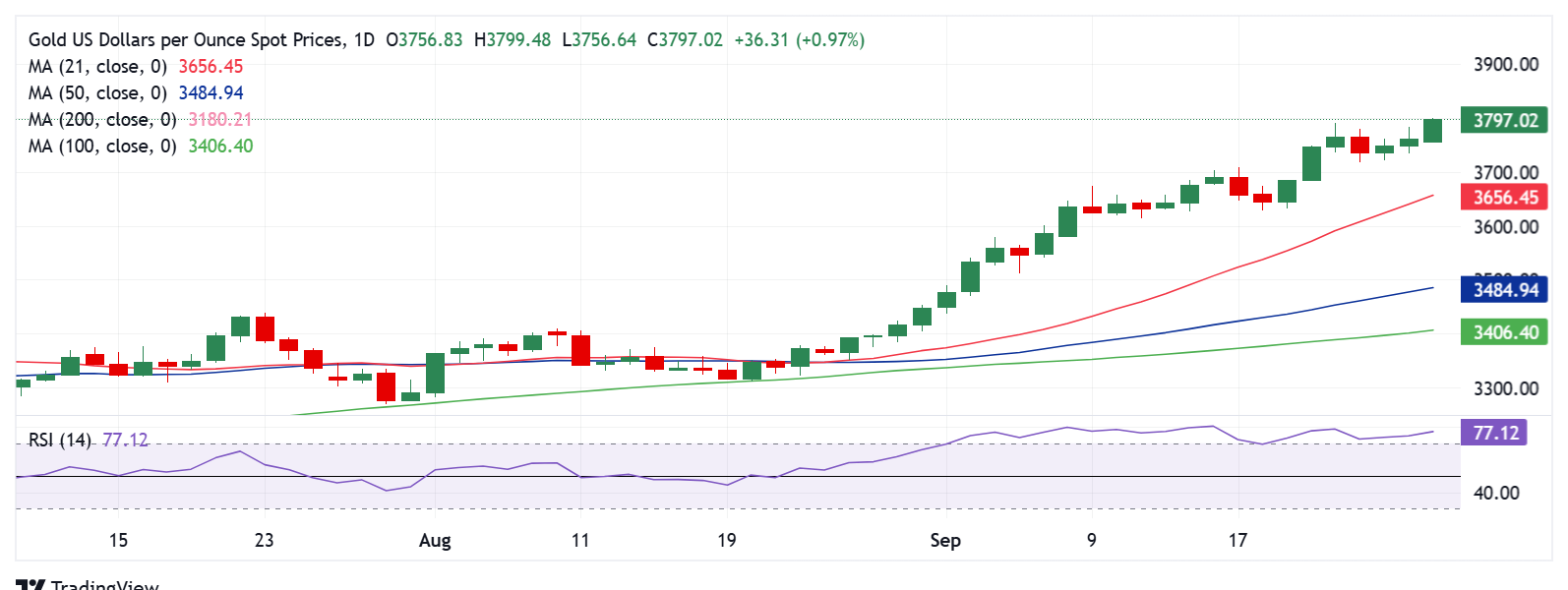
Technically, buyers appear defiant even as the 14-day Relative Strength Index (RSI) moves deeper within the extreme overbought region.
The leading indicator currently trades at 77, pointing north at the start of the week.
Buyers need acceptance above the $3,800 psychological level on a daily closing basis to provide extra legs to the revival of the record rally.
The next topside hurdle is located at the $3,850 barrier.
A sustained and decisive break above the latter could fuel a fresh advance toward the $3,880 region.
On the flip side, initial support is seen at the intraday low of $3,756, below which the September 24 low at $3,718 could offer some comfort to buyers.
Further down, the $3,650 psychological barrier would act as a tough nut to crack for sellers.
Nonfarm Payrolls FAQs
Nonfarm Payrolls (NFP) are part of the US Bureau of Labor Statistics monthly jobs report. The Nonfarm Payrolls component specifically measures the change in the number of people employed in the US during the previous month, excluding the farming industry.
The Nonfarm Payrolls figure can influence the decisions of the Federal Reserve by providing a measure of how successfully the Fed is meeting its mandate of fostering full employment and 2% inflation. A relatively high NFP figure means more people are in employment, earning more money and therefore probably spending more. A relatively low Nonfarm Payrolls’ result, on the either hand, could mean people are struggling to find work. The Fed will typically raise interest rates to combat high inflation triggered by low unemployment, and lower them to stimulate a stagnant labor market.
Nonfarm Payrolls generally have a positive correlation with the US Dollar. This means when payrolls’ figures come out higher-than-expected the USD tends to rally and vice versa when they are lower. NFPs influence the US Dollar by virtue of their impact on inflation, monetary policy expectations and interest rates. A higher NFP usually means the Federal Reserve will be more tight in its monetary policy, supporting the USD.
Nonfarm Payrolls are generally negatively-correlated with the price of Gold. This means a higher-than-expected payrolls’ figure will have a depressing effect on the Gold price and vice versa. Higher NFP generally has a positive effect on the value of the USD, and like most major commodities Gold is priced in US Dollars. If the USD gains in value, therefore, it requires less Dollars to buy an ounce of Gold. Also, higher interest rates (typically helped higher NFPs) also lessen the attractiveness of Gold as an investment compared to staying in cash, where the money will at least earn interest.
Nonfarm Payrolls is only one component within a bigger jobs report and it can be overshadowed by the other components. At times, when NFP come out higher-than-forecast, but the Average Weekly Earnings is lower than expected, the market has ignored the potentially inflationary effect of the headline result and interpreted the fall in earnings as deflationary. The Participation Rate and the Average Weekly Hours components can also influence the market reaction, but only in seldom events like the “Great Resignation” or the Global Financial Crisis.
Author

Dhwani Mehta
FXStreet
Residing in Mumbai (India), Dhwani is a Senior Analyst and Manager of the Asian session at FXStreet. She has over 10 years of experience in analyzing and covering the global financial markets, with specialization in Forex and commodities markets.
















