Gold Weekly Forecast: Key US data could help investors decide whether rally has more legs
- Gold corrected lower after hitting a new record-high near $3,800.
- The US Dollar benefited from upbeat data releases, halting Gold’s rally.
- Labor market and PMI data from the US could drive XAU/USD’s action.

Gold (XAU/USD) touched a new record-high near $3,790 before correcting lower. Investors will scrutinize high-tier data releases from the United States to decide whether XAU/USD’s rally could continue in the near term.
Gold enters consolidation phase below record-peak
Escalating geopolitical tensions allowed Gold to gather bullish momentum at the beginning of the week. News of NATO forces intercepting three Russian MiG-31 fighters after they entered Estonia's airspace kept investors on edge and boosted safe-haven demand.
After rising more than 1.5% on Monday, XAU/USD continued to push higher early Tuesday and hit a new all-time high at $3,791. XAU/EUR and XAU/GBP also hit record-high after disappointing Purchasing Managers’ Index (PMI) data releases, showing that Gold managed to capture capital outflows out of the Euro and Pound Sterling.
In the second half of the day, the renewed US Dollar (USD) strength on Federal Reserve (Fed) Chairman Jerome Powell’s cautious tone on policy-easing and September US S&P Global PMI data, which showed that the business activity in the private sector continued to expand at a healthy pace, caused XAU/USD to retreat.
While speaking on the economic outlook on Tuesday, Powell reiterated that they will make sure a one-time increase in prices does not become an ongoing inflation problem. He further noted that they will look at the labor market, growth, and inflation data to assess if the policy is in the right place by the next meeting.
The USD continued to outperform its rivals on Wednesday after the data showed that New Home Sales rose by 20.5% in August, easing concerns over the housing market conditions. On Thursday, the USD gathered further bullish momentum after the US Bureau of Economic Analysis (BEA) announced that it revised the annualized Gross Domestic (GDP) growth for the second quarter to 3.8% from 3.3% in the previous estimate. Moreover, Durable Goods Orders increased by 2.9% in August, surpassing the market expectation for a decrease of 0.5% by a wide margin, and the weekly Initial Jobless Claims declined to 218,000 from 232,000 in the previous week. The broad-based USD strength caused XAU/USD to stay in a consolidation phase at around $3,750 in the second half of the week.
The final data release of the week showed that the annual inflation in the US, as measured by the change in the Personal Consumption Expenditures (PCE) Price Index, edged higher to 2.7% in August from 2.6% in July. The core PCE Price Index, which excludes volatile food and energy prices, rose 2.9% in the same period, matching July's increase and analysts' estimate. These figures were largely ignored by market participants. However, the bullish opening in Wall Street caused the USD to lose some interest and allowed Gold to stretch higher in the American session on Friday.
Gold investors will examine US data to assess Fed policy outlook
The US economic calendar will offer several high-tier data releases that could influence the market pricing of the Fed’s policy outlook and drive Gold’s valuation in the near term.
The CME Group FedWatch Tool shows that markets are widely expecting the Fed to opt for another 25-basis-points (bps) rate cut in October. The probability of one more reduction in rates in December holds at around 60%, down from nearly 80% before the above-mentioned US data. Powell and several other policymakers acknowledged rising risks to the labor market and explained that the September rate cut was appropriate to offset these risks.
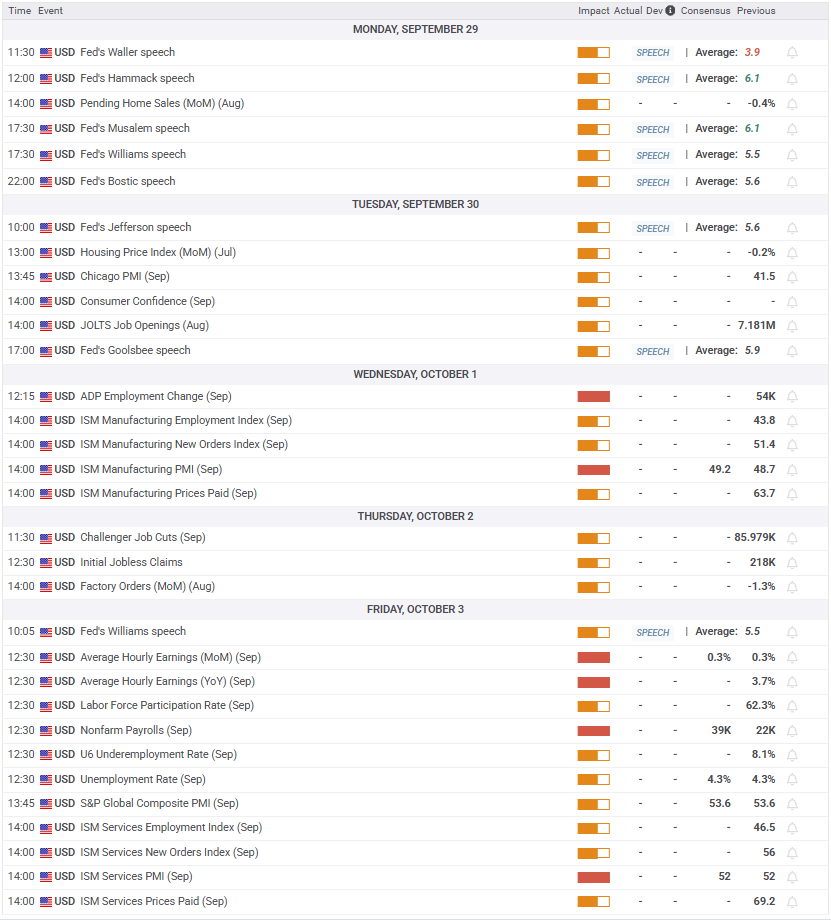
On Tuesday, the US Bureau of Labor Statistics (BLS) will publish the JOLTS Job Openings data for August. Although this is widely seen as a lagging indicator, a noticeable decline, with a reading below 7 million, or a significant positive surprise above 7.5 million could trigger a straightforward reaction.
The ADP Employment Change and the ISM Manufacturing PMI data for September will be watched closely midweek. In case payrolls in the private sector rise more than 70,000 and the headline Manufacturing PMI recovers into the expansion territory above 50, the USD could preserve its strength and cause XAU/USD to edge lower.
Nonfarm Payrolls (NFP) could ramp up market volatility on Friday. Following the past few months’ dismal readings, another disappointing NFP print could reaffirm a Fed rate cut in December and weigh heavily on the USD and US Treasury bond yields. In this scenario, Gold could gather bullish momentum heading into the weekend. Conversely, the USD could extend its rally and weigh heavily on XAU/USD if the NFP arrives above 70,000 and alleviates worries about labor market conditions.
Gold technical analysis
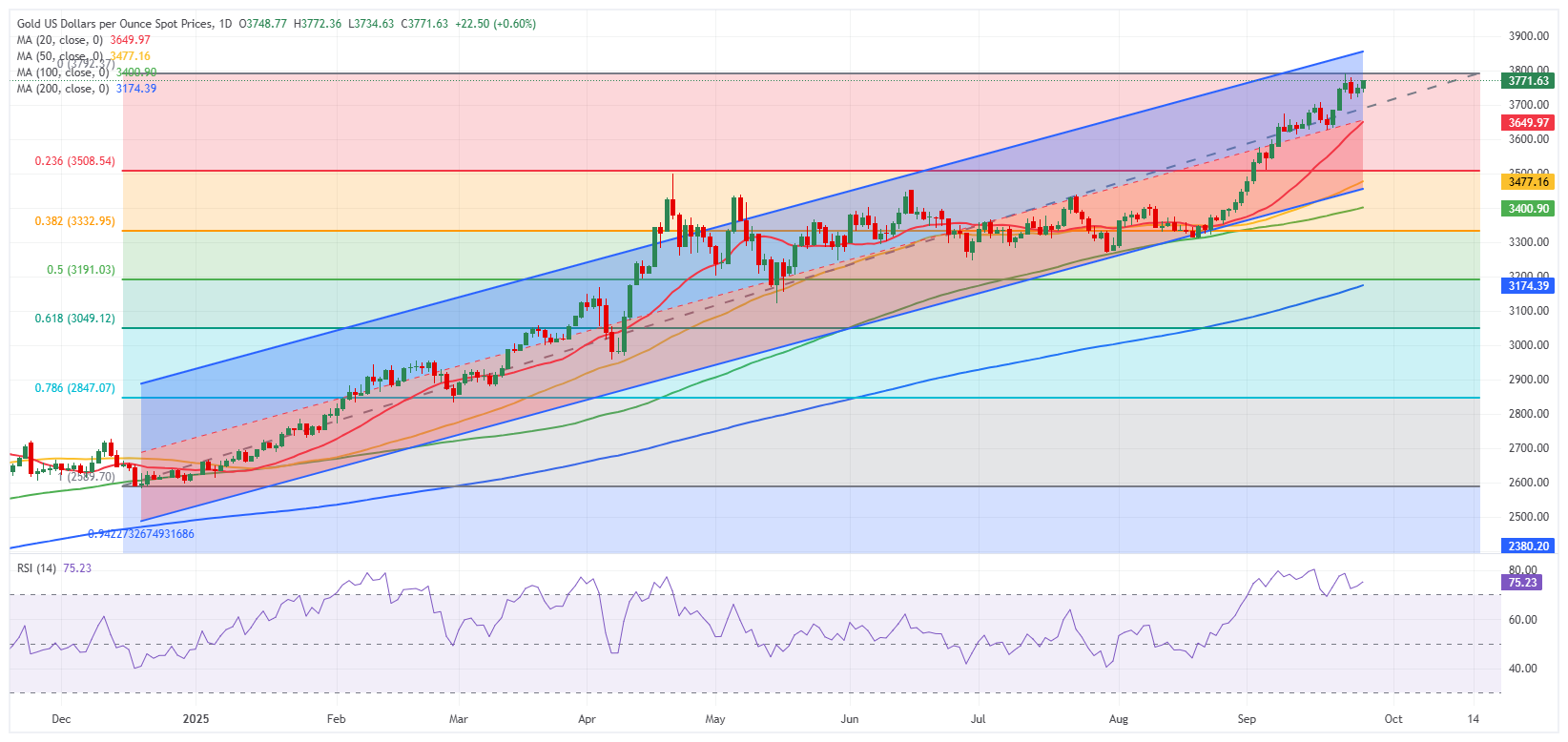
Despite the recent pullback, Gold remains technically overbought with the Relative Strength Index (RSI) indicator on the daily chart holding well above 70. Nevertheless, XAU/USD remains within the upper half of the nine-month-old ascending regression channel and trades well above the 20-day Simple Moving Average (SMA), suggesting that the bullish bias remains intact with the potential of a technical correction.
On the downside, $3,670 (mid-point of the ascending regression channel, 20-day SMA) aligns as the first support, followed by $3,500-$3,480 (static level, round level, 50-day SMA). Looking north, the first resistance level could be spotted at $3,790-$3,800 (record-high, round level) $3,860 (upper-limit of the ascending channel) and $3,900 (round level).
Gold FAQs
Gold has played a key role in human’s history as it has been widely used as a store of value and medium of exchange. Currently, apart from its shine and usage for jewelry, the precious metal is widely seen as a safe-haven asset, meaning that it is considered a good investment during turbulent times. Gold is also widely seen as a hedge against inflation and against depreciating currencies as it doesn’t rely on any specific issuer or government.
Central banks are the biggest Gold holders. In their aim to support their currencies in turbulent times, central banks tend to diversify their reserves and buy Gold to improve the perceived strength of the economy and the currency. High Gold reserves can be a source of trust for a country’s solvency. Central banks added 1,136 tonnes of Gold worth around $70 billion to their reserves in 2022, according to data from the World Gold Council. This is the highest yearly purchase since records began. Central banks from emerging economies such as China, India and Turkey are quickly increasing their Gold reserves.
Gold has an inverse correlation with the US Dollar and US Treasuries, which are both major reserve and safe-haven assets. When the Dollar depreciates, Gold tends to rise, enabling investors and central banks to diversify their assets in turbulent times. Gold is also inversely correlated with risk assets. A rally in the stock market tends to weaken Gold price, while sell-offs in riskier markets tend to favor the precious metal.
The price can move due to a wide range of factors. Geopolitical instability or fears of a deep recession can quickly make Gold price escalate due to its safe-haven status. As a yield-less asset, Gold tends to rise with lower interest rates, while higher cost of money usually weighs down on the yellow metal. Still, most moves depend on how the US Dollar (USD) behaves as the asset is priced in dollars (XAU/USD). A strong Dollar tends to keep the price of Gold controlled, whereas a weaker Dollar is likely to push Gold prices up.
Author

Eren Sengezer
FXStreet
As an economist at heart, Eren Sengezer specializes in the assessment of the short-term and long-term impacts of macroeconomic data, central bank policies and political developments on financial assets.