Gold Price Forecast: XAU/USD remains confined in a range amid Fed taper talks, COVID jitters
- Gold posted its first weekly loss in the previous five amid stronger USD/rallying US bond yields.
- COVID-19 woes weighed on the risk sentiment and extended support to the safe-haven metal.
- The market focus now shifts to this week’s key US macro data – CPI report and Retail Sales data.

Gold edged higher during the first half of the trading action on Friday, albeit continued with its struggle to find acceptance or build on the momentum beyond the $1,800 round-figure mark. The XAU/USD posted its weekly loss in the previous five and was pressured by a combination of factors. Despite the dismal US jobs report for August, investors seem convinced that the Fed would begin rolling back its massive pandemic-era stimulus sooner rather than later. This was evident from a solid rebound in the US Treasury bond yields, which helped revive demand for the US dollar and acted as a headwind for the dollar-denominated commodity.
In fact, the yield on the benchmark 10-year US government bond jumped closer to the 1.35% threshold following the release of US Producer Price Index (PPI) figures. The headline PPI rose 0.7% in August, down from a 1% increase in the previous month. The core PPI, which excludes volatile food and energy prices, climbed 0.3% during the reported month against a 0.9% gain in July. On a yearly basis, the PPI recorded the largest gain since the data was first collected in November 2010. The data indicated that higher inflation could persist for some time and reinforced hawkish Fed expectations. This was seen as another factor that weighed on the non-yielding yellow metal.
Hence, the market focus now shifts to this week's release of the latest US consumer inflation report, scheduled for release on Tuesday. Apart from this, the US monthly Retail Sales figures will also be looked upon for a fresh directional impetus. In the meantime, the risk-off impulse in the markets assisted the traditional safe-haven precious metal to regain some positive traction during the Asian session on Monday. Investors remain worried about the fast-spreading Delta variant and a global economic slowdown. This, along with reports that US Democrats were considering proposals to raise taxes on corporations and the wealthy, further contributed to the cautious mood.
Short-term technical outlook
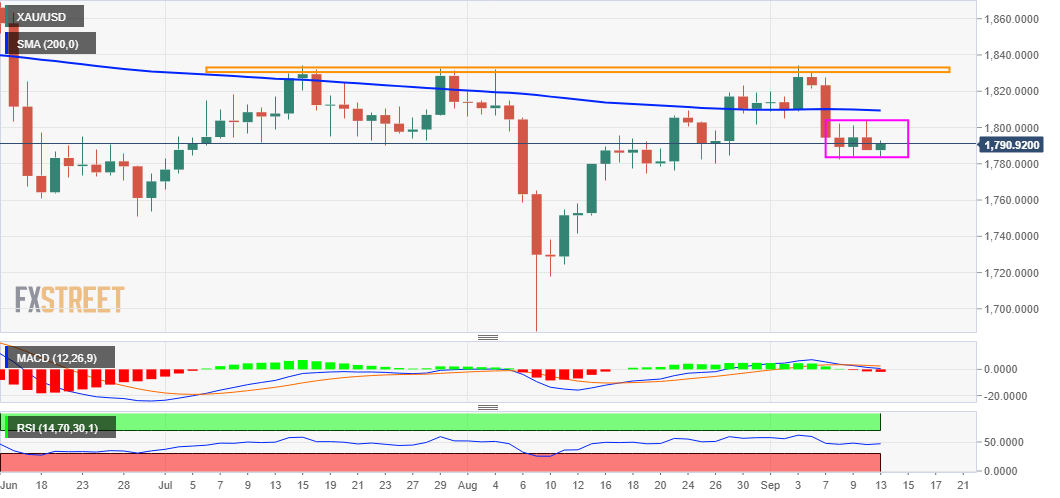
From a technical perspective, the range-bound price action witnessed over the past four trading sessions constitutes the formation of a rectangle and points to indecision among traders. Moreover, neutral technical indicators haven't been supportive of any firm near-term direction and further warrant some caution before placing aggressive bets.
However, the recent pullback from the $1,832-34 supply zone and repeated failures near the $1,800 mark favours bearish traders. Some follow-through selling below the $1,785-84 region, or the lower boundary of the trading range, will reaffirm the negative outlook and set the stage for a deeper retracement to the $1,750 level. The XAU/USD could further extend the downward trajectory towards the $1,729-28 region before eventually dropping back to the $1,700 round figure.
On the flip side, the $1,800 level now seems to have emerged as immediate strong resistance and is closely followed by the very important 200-day SMA, currently around the $1,810 region. A sustained move beyond might prompt some short-covering move and lift the metal back towards the $1,832-34 strong barrier. Some follow-through buying will be seen as a fresh trigger for bullish traders and lift the commodity further towards the $1,853 intermediate resistance en-route the $1.868-70 region.
Author

Haresh Menghani
FXStreet
Haresh Menghani is a detail-oriented professional with 10+ years of extensive experience in analysing the global financial markets.