Gold Price Forecast: XAU/USD nears $3,200 aims to extend its slide

XAU/USD Current price: $3,214.00
- De-escalating global trade tensions backed demand for the US Dollar.
- Wall Street extends its Wednesday recovery in thin market conditions.
- XAU/USD trades at fresh two-week lows just above the $3,200 mark.
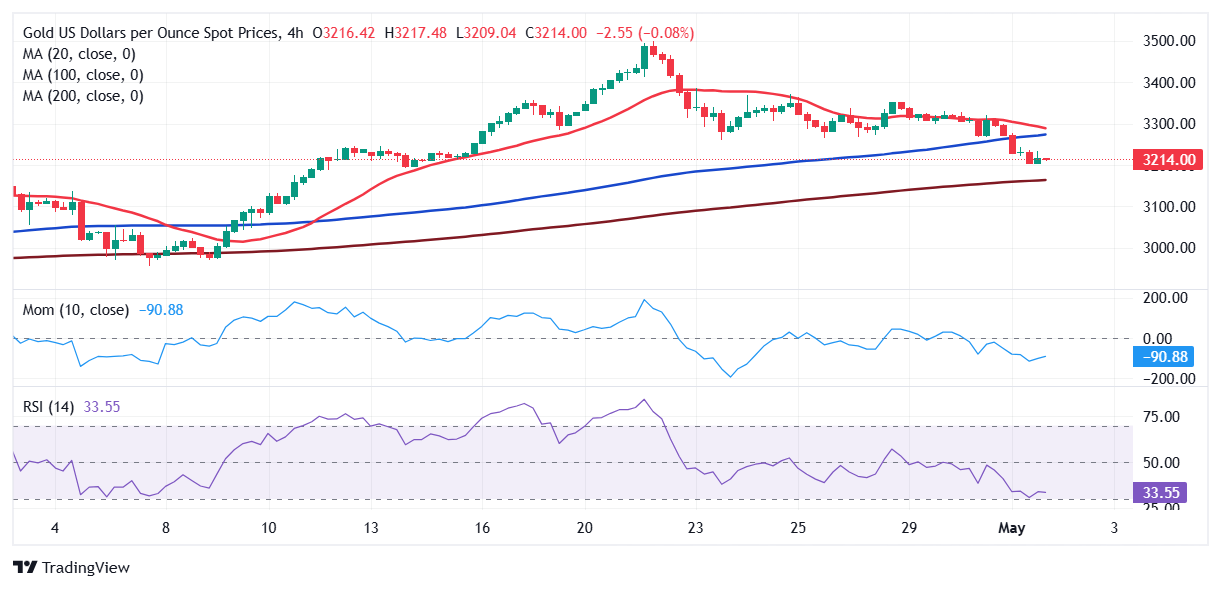
Gold price edged lower on Thursday, trading at fresh two-week highs just above the $3,200 mark. De-escalating global trade tensions backed demand for the US Dollar (USD) despite mixed first-tier figures released in the last two sessions. Stocks also benefited from the better mood, with Wall Street extending Wednesday’s rally.
Most Asian and European markets were closed amid the celebration of Labor Day, but the United States (US) ones worked normally. The country released some mixed data, as Initial Jobless Claims for the week ended April 26 rose by 241K, worse than the 224K anticipated and the previous weekly figure of 223K. The April ISM Manufacturing Purchasing Managers’ Index (PMI), on the contrary, posted 48.7, down from the 49 posted in March, but better than the 48 expected.
Earlier in the day, US President Donald Trump noted progress on talks with some Asian countries, including India and Japan. Regarding China, Trump stated that there’s a “very good” chance of making a deal with China, yet added that any deal with Beijing has to be in US terms. Meanwhile, a Beijing-backed outlet reported on Thursday that United States officials have contacted their Chinese counterparts for talks.
Finally, White House trade advisor Peter Navarro down-talked data, saying, “I got to say just one thing about today’s news, that’s the best negative print I have ever seen in my life,” while saying he likes “where we’re at now.”
The week will end with the release of the US Nonfarm Payrolls (NFP) report. The country is expected to have added 130K new job positions in April, while the Unemployment Rate is foreseen at 4.2%, unchanged from March. Employment-related data ahead of the NFP report, however, hints at a soft reading, which may end up weighing on the USD.
XAU/USD short-term technical outlook
From a technical point of view, the daily chart for XAU/USD shows that the risk skews to the downside. The pair is down for a third consecutive day, piercing a mildly bullish 20 Simple Moving Average (SMA) currently at around $3,232.10. The 100 and 200 SMAs maintain their upward slopes far below the current level, yet technical indicators head firmly south, approaching their midlines from above. Selling interest seems strong, and a break below $3,200 should open the door for a continued slide.
In the near term, and according to the 4-hour chart, the XAU/USD pair is poised to extend its slide. After meeting sellers around a mildly bullish 20 SMA, Gold slid below its 100 SMA, which, anyway, maintains its upward slope. Finally, technical indicators resumed their slides within negative levels, anticipating lower lows ahead.
Support levels: 3,200.00 3,188.30 3,176.40
Resistance levels: 3,232.10 3,245.20 3,261.70
Tariffs FAQs
Tariffs are customs duties levied on certain merchandise imports or a category of products. Tariffs are designed to help local producers and manufacturers be more competitive in the market by providing a price advantage over similar goods that can be imported. Tariffs are widely used as tools of protectionism, along with trade barriers and import quotas.
Although tariffs and taxes both generate government revenue to fund public goods and services, they have several distinctions. Tariffs are prepaid at the port of entry, while taxes are paid at the time of purchase. Taxes are imposed on individual taxpayers and businesses, while tariffs are paid by importers.
There are two schools of thought among economists regarding the usage of tariffs. While some argue that tariffs are necessary to protect domestic industries and address trade imbalances, others see them as a harmful tool that could potentially drive prices higher over the long term and lead to a damaging trade war by encouraging tit-for-tat tariffs.
During the run-up to the presidential election in November 2024, Donald Trump made it clear that he intends to use tariffs to support the US economy and American producers. In 2024, Mexico, China and Canada accounted for 42% of total US imports. In this period, Mexico stood out as the top exporter with $466.6 billion, according to the US Census Bureau. Hence, Trump wants to focus on these three nations when imposing tariffs. He also plans to use the revenue generated through tariffs to lower personal income taxes.
Author

Valeria Bednarik
FXStreet
Valeria Bednarik was born and lives in Buenos Aires, Argentina. Her passion for math and numbers pushed her into studying economics in her younger years.