Gold Price Forecast: XAU/USD focuses on daily close and tariff updates
- Gold price kicks off the week on a bearish note after facing rejection again near $3,350.
- US Dollar finds fresh haven demand amid renewed trade jitters as Trump’s tariff letter to go out on Monday.
- Gold price breaches the 50-day SMA support as the daily RSI pierces below the midline.

Gold price is trading close to the $3,300 mark early Monday in a bearish start to a new week, having gained roughly 2% last week.
Gold price awaits tariff talks ahead of Fed Minutes
Gold price has resumed its retreat from the weekly high of $3,366 on account of the reviving safe-haven demand for the US Dollar (USD) amid US President Donald Trump’s latest tariff concerns-led risk aversion.
Markets remain unnerved as Trump’s July 9 trade deal deadline approaches and his tariff letters are going to be sent to 12 countries this Monday for those who haven’t struck a trade deal with the United States (US).
Trump said last Thursday that the rates in the letters would go into effect August 1 and warned some could be as high as 70%.
The US President in April announced a 10% base tariff rate on most countries and higher "reciprocal" rates ranging up to 50%, with an original deadline of this Wednesday.
His latest warning of charging 10% additional tariffs on nations aligned with BRICS is sending jitters across the markets, leaving investors on the edge and scurrying to the safe-haven currency, the Greenback.
Meanwhile, the non-yielding Gold price is also reeling from the pain of a strong US employment report, which squashed hopes for aggressive Federal Reserve (Fed) easing.
Data on Thursday showed that the headline Nonfarm Payrolls rose by 147,000 in June, against expectations of a 110,000 increase and the previous revision of 144,000. The Unemployment Rate unexpectedly dropped to 4.1% last month versus 4.3% expected and May’s 4.2%.
Looking ahead, Gold price will likely remain at the mercy of the tariff headlines and their impact on the USD price action.
Meanwhile, traders remain expectant of the Minutes of the Fed’s June meeting on Wednesday for more clarity on the timing of the next interest rate cut.
Gold price technical analysis: Daily chart
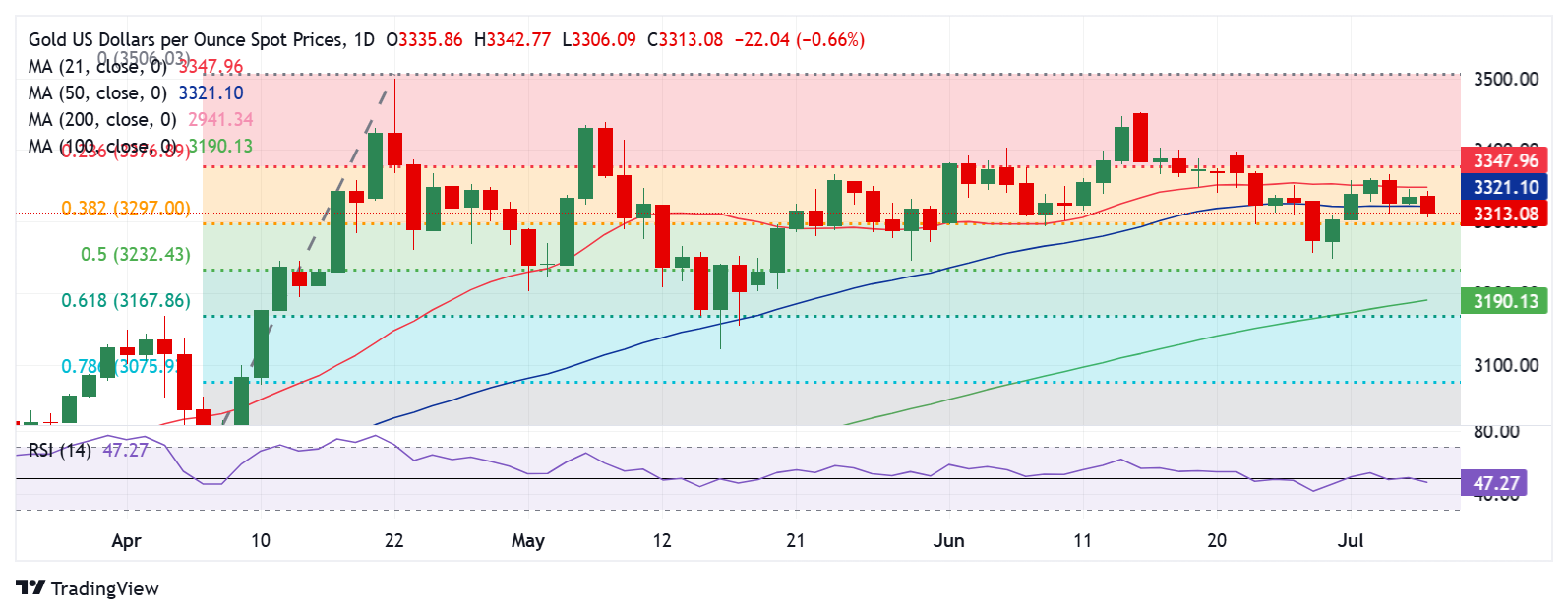
Having faced rejection above the 21-day Simple Moving Average (SMA) once again at $3,350, Gold price has breached the 50-day SMA support at $3,321.
The 14-day Relative Strength Index (RSI) is pointing lower below the midline, currently near 47, suggesting that more downside is opening up for the bright metal.
Sellers need a daily candlestick close below the 50-day SMA to flex their muscles toward the 38.2% Fibonacci Retracement (Fibo) level of the April record rally at $3,297.
A sustained move below the latter will target the monthly low of $3,248.
On the flip side, recapturing the 21-day SMA is critical to reviving the recovery from five-week lows.
Further up, the 23.6% Fibo level of the same advance at $3,377 could act as a tough nut to crack once again.
The next topside hurdle is seen at the $3,400 threshold.
Tariffs FAQs
Tariffs are customs duties levied on certain merchandise imports or a category of products. Tariffs are designed to help local producers and manufacturers be more competitive in the market by providing a price advantage over similar goods that can be imported. Tariffs are widely used as tools of protectionism, along with trade barriers and import quotas.
Although tariffs and taxes both generate government revenue to fund public goods and services, they have several distinctions. Tariffs are prepaid at the port of entry, while taxes are paid at the time of purchase. Taxes are imposed on individual taxpayers and businesses, while tariffs are paid by importers.
There are two schools of thought among economists regarding the usage of tariffs. While some argue that tariffs are necessary to protect domestic industries and address trade imbalances, others see them as a harmful tool that could potentially drive prices higher over the long term and lead to a damaging trade war by encouraging tit-for-tat tariffs.
During the run-up to the presidential election in November 2024, Donald Trump made it clear that he intends to use tariffs to support the US economy and American producers. In 2024, Mexico, China and Canada accounted for 42% of total US imports. In this period, Mexico stood out as the top exporter with $466.6 billion, according to the US Census Bureau. Hence, Trump wants to focus on these three nations when imposing tariffs. He also plans to use the revenue generated through tariffs to lower personal income taxes.
Author

Dhwani Mehta
FXStreet
Residing in Mumbai (India), Dhwani is a Senior Analyst and Manager of the Asian session at FXStreet. She has over 10 years of experience in analyzing and covering the global financial markets, with specialization in Forex and commodities markets.