Gold Price Forecast: XAU/USD down but not out as Fed and tariff concerns linger
- Gold renews two-week highs just shy of $3,400, then retreats early Wednesday.
- US Dollar sees an uptick, but any upside appears limited amid Fed and tariff concerns.
- Technically, the $3,400 resistance area acts as a tough nut to crack for buyers; RSI stays bullish.

Gold is pulling back from the $3,400 neighbourhood, having refreshed two-week highs early Wednesday. Concerns over the US Federal Reserve’s (Fed) autonomy and latest US tariff threats could cushion any downside in Gold.
Gold: Bargain-buying to seep back in
The ongoing feud between US President Donald Trump and the Fed is expected to act as a headwind for the renewed US Dollar (USD) upside in the upcoming sessions.
On Tuesday, Trump announced that he plans to fire Fed Governor Lisa Cook over her false statements on mortgage applications. However, Cook stood her ground and said that Trump had no authority to remove her.
Late Tuesday, Bloomberg reported that Trump said he was ready for a legal fight with Cook.
Following these developments, markets remain wary of Trump’s constant attacks on the Fed’s independence.
This, combined with the increased odds of a September Fed interest rate cut contributes to the limited upside potential in the Greenback.
Therefore, the pullback in Gold will likely be bought into at lower levels as investors hunt for bargain bets.
Further, Gold could also draw some support from intensifying concerns over US President Trump’s latest tariff threats on China and the 50% levies to be effective on India from Wednesday.
Tariff threats revive economic growth concerns, undermining the attractiveness of US assets, including the US Dollar. As a result, Gold tends to benefit amid a weaker USD and also a safe-haven asset.
However, if the Greenback defies the bearish fundamentals and extends its rebound on intense risk aversion or profit-taking, Gold’s move higher will be in check.
Attention turns to Friday’s US core Personal Consumption Expenditures (PCE) Price Index for fresh cues on the Fed’s interest rate outlook, which could provide a firm directional impetus to Gold.
Gold price technical analysis: Daily chart
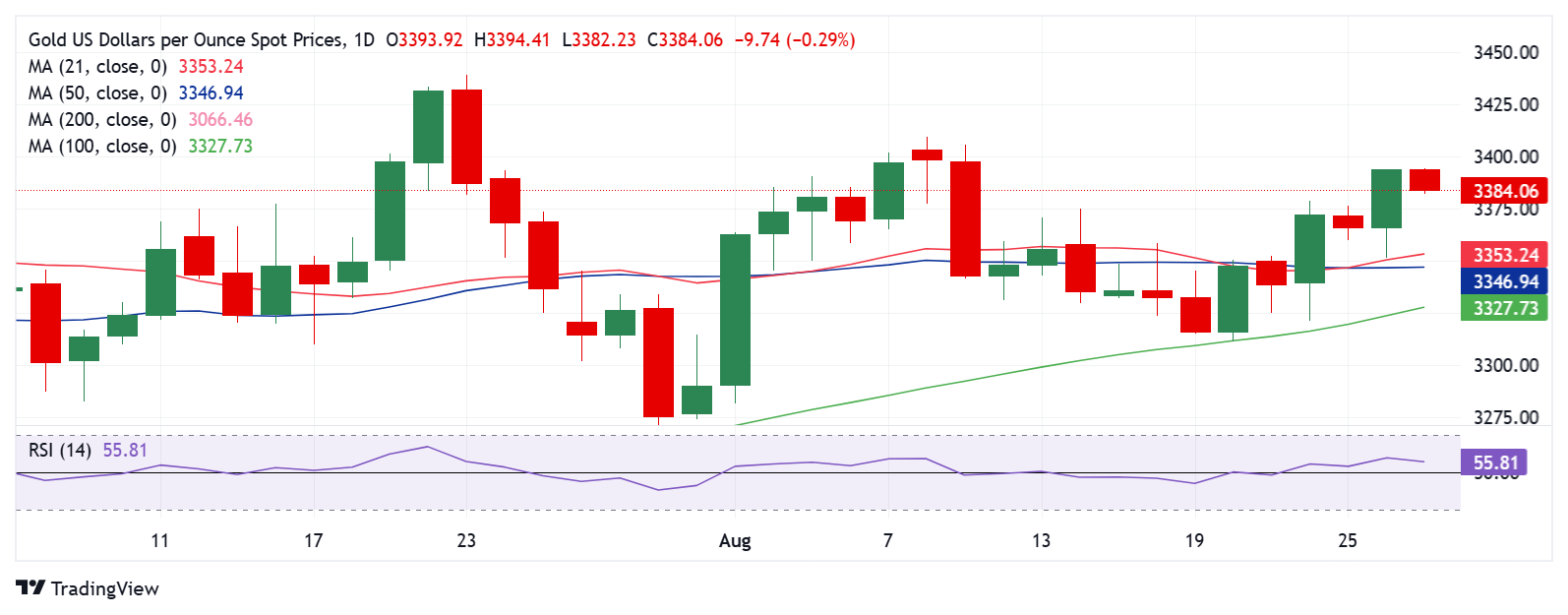
Nothing seems to have changed for Gold, technically in the short-term, as the bullish potential remains intact so long as the 14-day Relative Strength Index (RSI) stays above the 50 level. The leading indicator is currently edging lower to near 55.50.
Buyers also stay hopeful amid a Bull Cross, with the 21-day Simple Moving Average (SMA) having closed above the 50-day SMA on Monday.
The immediate topside hurdle is seen in the $3,400 area, above which the static resistance at around $3,440 will be back in play.
Alternatively, sellers need to crack the 21-day SMA and the 50-day SMA confluence area near $3,350 to regain control on a sustained basis.
The next solid support is located at the 100-day SMA at $3,328. Only a sustained move below the latter will negate any positive bias in the medium term.
Note that Gold hasn’t closed below the 100-day SMA since December 31 2024.
Gold FAQs
Gold has played a key role in human’s history as it has been widely used as a store of value and medium of exchange. Currently, apart from its shine and usage for jewelry, the precious metal is widely seen as a safe-haven asset, meaning that it is considered a good investment during turbulent times. Gold is also widely seen as a hedge against inflation and against depreciating currencies as it doesn’t rely on any specific issuer or government.
Central banks are the biggest Gold holders. In their aim to support their currencies in turbulent times, central banks tend to diversify their reserves and buy Gold to improve the perceived strength of the economy and the currency. High Gold reserves can be a source of trust for a country’s solvency. Central banks added 1,136 tonnes of Gold worth around $70 billion to their reserves in 2022, according to data from the World Gold Council. This is the highest yearly purchase since records began. Central banks from emerging economies such as China, India and Turkey are quickly increasing their Gold reserves.
Gold has an inverse correlation with the US Dollar and US Treasuries, which are both major reserve and safe-haven assets. When the Dollar depreciates, Gold tends to rise, enabling investors and central banks to diversify their assets in turbulent times. Gold is also inversely correlated with risk assets. A rally in the stock market tends to weaken Gold price, while sell-offs in riskier markets tend to favor the precious metal.
The price can move due to a wide range of factors. Geopolitical instability or fears of a deep recession can quickly make Gold price escalate due to its safe-haven status. As a yield-less asset, Gold tends to rise with lower interest rates, while higher cost of money usually weighs down on the yellow metal. Still, most moves depend on how the US Dollar (USD) behaves as the asset is priced in dollars (XAU/USD). A strong Dollar tends to keep the price of Gold controlled, whereas a weaker Dollar is likely to push Gold prices up.
Author

Dhwani Mehta
FXStreet
Residing in Mumbai (India), Dhwani is a Senior Analyst and Manager of the Asian session at FXStreet. She has over 10 years of experience in analyzing and covering the global financial markets, with specialization in Forex and commodities markets.