Gold Price Forecast: XAU/USD buyers stay hopeful on mounting Middle East tensions
- Gold price attempts recovery from weekly lows near $3,360 amid light trading on Thursday.
- US Dollar picks haven demand on reports that the US could strike Iran as early as this weekend.
- Gold price breaches key $3,377 support on Fed’s hawkish hold but daily RSI still remains bullish.

Gold price is finding fresh buyers near the weekly low of $3,363 early Thursday amid renewed Middle East tensions, as markets look past the US Federal Reserve’s (Fed) hawkish hold policy decision.
Gold price rebounds, will it last?
Risk sentiment takes a hit in Asian trading on Thursday after several media outlets reported that US is considering an attack on Iran as early as this weekend, with US President Donald Trump particularly weighing strikes on Iran’s heavily fortified Fordow nuclear facility.
The potential involvement of the US military against Iran could deepen the Middle East conflict, translating into a wider regional war.
These reports come after Iran's Supreme Leader Ayatollah Ali Khamenei warned on Wednesday that any military involvement by the Americans would cause “irreparable damage to them,” while refusing to surrender.
Renewed Middle East concerns sag investors’ confidence, reviving the safe-haven appeal of Gold price. However, Gold buyers seem to struggle amid resurgent demand for the US Dollar (USD) as another safety bet.
The Greenback builds on the previous day’s upswing, helped by the Fed’s patient stance and hints of higher inflation coming.
The US central bank maintained policy rates in the range of 4.25%-4.5% as widely expected while keeping the projections for two interest rate cuts this year intact.
However, it trimmed expectations for further cuts in 2026 and 2027. The Fed downgraded growth forecast while revising higher inflation outlook.
Amid persistent trade and geopolitical uncertainties, the Fed flagged upside risks to inflation, which prompted markets to perceive the decision as slightly hawkish.
The non-interest-bearing
Gold price breached the critical support at $3,377 and closed below that level on Wednesday, in the aftermath of the Fed’s decision.
Looking ahead, the Juneteenth holiday in the United States (US) could cause thin liquidity conditions, exaggerating the Gold price movement.
Traders will keep a close watch on the developments surrounding the Middle East conflict for fresh trading directives in Gold price.
Gold price technical analysis: Daily chart
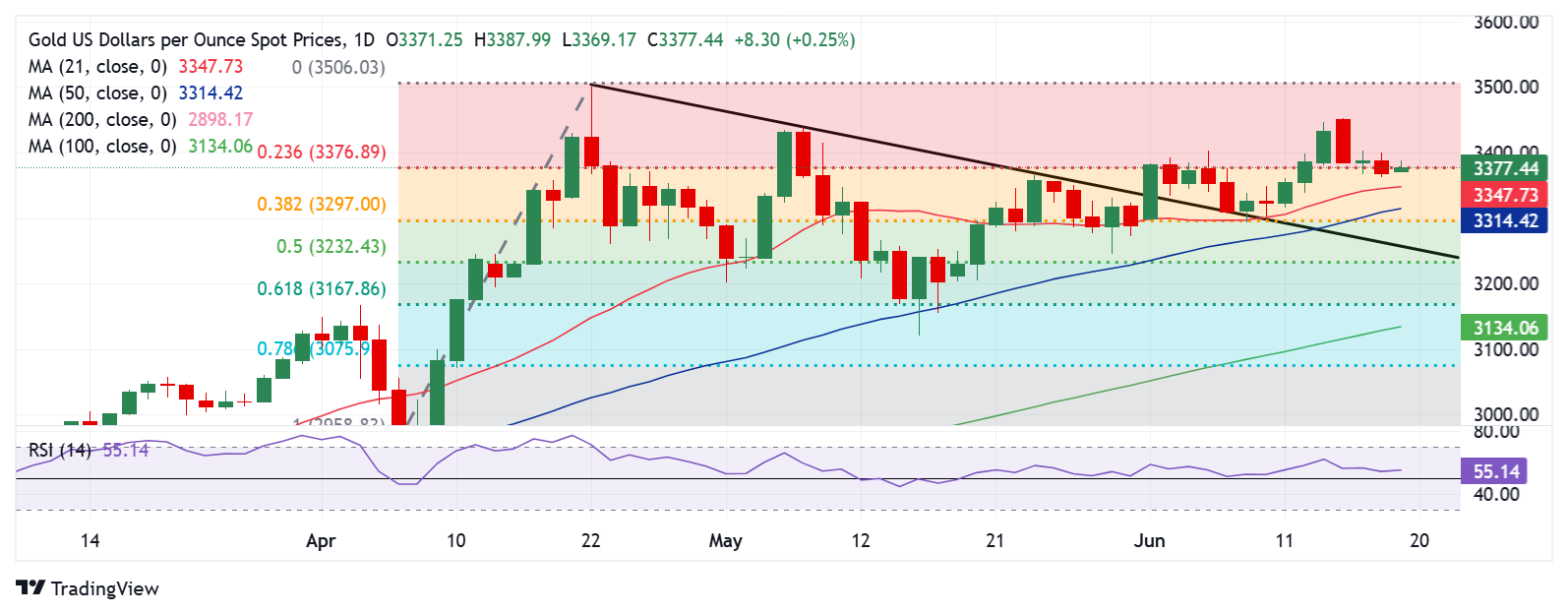
Technically, the bullish bias remains intact for Gold price as the 14-day Relative Strength Index (RSI) holds above the midline, currently near 55.
Gold price needs to recapture the strong resistance now support at $3,377, the 23.6% Fibonacci Retracement (Fibo) level of the April record rally, on a sustained basis for a fresh upside.
The next relevant hurdle is aligned at the $3,400 mark, above which the static resistance at $3,440 will be tested.
Buyers will then take on the two-month highs of $3,453.
On the flip side, if Gold price fails to hold onto the rebound, sellers will likely jump back.
The immediate downside cushion is seen at the 21-day Simple Moving Average (SMA) at $3,348.
Further south, the 50-day SMA at $3,308 will be put to the test.
Gold FAQs
Gold has played a key role in human’s history as it has been widely used as a store of value and medium of exchange. Currently, apart from its shine and usage for jewelry, the precious metal is widely seen as a safe-haven asset, meaning that it is considered a good investment during turbulent times. Gold is also widely seen as a hedge against inflation and against depreciating currencies as it doesn’t rely on any specific issuer or government.
Central banks are the biggest Gold holders. In their aim to support their currencies in turbulent times, central banks tend to diversify their reserves and buy Gold to improve the perceived strength of the economy and the currency. High Gold reserves can be a source of trust for a country’s solvency. Central banks added 1,136 tonnes of Gold worth around $70 billion to their reserves in 2022, according to data from the World Gold Council. This is the highest yearly purchase since records began. Central banks from emerging economies such as China, India and Turkey are quickly increasing their Gold reserves.
Gold has an inverse correlation with the US Dollar and US Treasuries, which are both major reserve and safe-haven assets. When the Dollar depreciates, Gold tends to rise, enabling investors and central banks to diversify their assets in turbulent times. Gold is also inversely correlated with risk assets. A rally in the stock market tends to weaken Gold price, while sell-offs in riskier markets tend to favor the precious metal.
The price can move due to a wide range of factors. Geopolitical instability or fears of a deep recession can quickly make Gold price escalate due to its safe-haven status. As a yield-less asset, Gold tends to rise with lower interest rates, while higher cost of money usually weighs down on the yellow metal. Still, most moves depend on how the US Dollar (USD) behaves as the asset is priced in dollars (XAU/USD). A strong Dollar tends to keep the price of Gold controlled, whereas a weaker Dollar is likely to push Gold prices up.
Author

Dhwani Mehta
FXStreet
Residing in Mumbai (India), Dhwani is a Senior Analyst and Manager of the Asian session at FXStreet. She has over 10 years of experience in analyzing and covering the global financial markets, with specialization in Forex and commodities markets.