Gold Price Forecast: XAU/USD buyers regain poise as focus shifts to US-Russia meeting
- Gold price rebounds after Friday’s profit-taking slide; light trading could exaggerate moves.
- The US Dollar and US Treasury yields consolidate losses, bracing for US-Russia talks and Fed Minutes.
- Gold price could see a fresh upside as the daily RSI eases from the overbought territory.

Gold price is back on the bids early Monday, reversing a part of Friday’s profit-taking decline. The further upside in Gold price depends on the upcoming US-Russia talks and developments around US President Donald Trump’s tariff plans amid a US holiday-led thin market conditions.
Gold price kicks off the week positively
Having registered eight straight weeks of gains, Gold price kicks off a fresh week on a positive note, underpinned by the sustained weakness in the US Dollar (USD) and the US Treasury bond yields.
Markets remain expectant that the Russia-Ukraine conflict could end soon as US President Donald Trump is scheduled to hold a meeting with Russian President Vladimir Putin in Saudi Arabia on Tuesday.
Prospects of diminishing geopolitical risks weigh on the USD, supporting the renewed upswing in Gold price. The Greenback also suffers from the increase in revival of bets surrounding two interest rate cuts by the US Federal Reserve (Fed) this year, following Friday’s dismal Retail Sales data.
Data showed that Retail Sales declined 0.9% over the month in January, compared to the estimated drop of 0.1%. This marked the biggest month-on-month (MoM) decrease since early 2023, rekindling expectations for two rate Fed cuts in 2025.
Discouraging triggered a fresh sell-off in the US Treasury bond yields across the curve, in turn, smashing the US Dollar despite some weakness in Wall Street indices on Friday. Gold price, however, failed to capitalize on US data-led USD weakness as markets resorted to profit-taking on their Gold longs after the record run.
Traders also preferred to cash in on the Gold price record rally ahead of the upcoming US-Russia meeting and the Minutes of the Fed’s January meeting.
At the moment, Gold price also derives strength from tensions around a looming tariff war between the US and the European Union (EU). “The European Commission would explore tough import limits on certain foods made to different standards to protect its farmers, echoing US President Donald Trump's reciprocal trade policy,” the Financial Times (FT) reported on Sunday.
It’s worth mentioning that Gold price could be subject to intense volatility in the day ahead as a US national holiday will likely exaggerate moves. Speeches will from Fed officials Christopher Waller, Patrick Harker and Michelle Bowman will be closely scrutinized before Wednesday’s Fed Minutes.
Gold price technical analysis: Daily chart
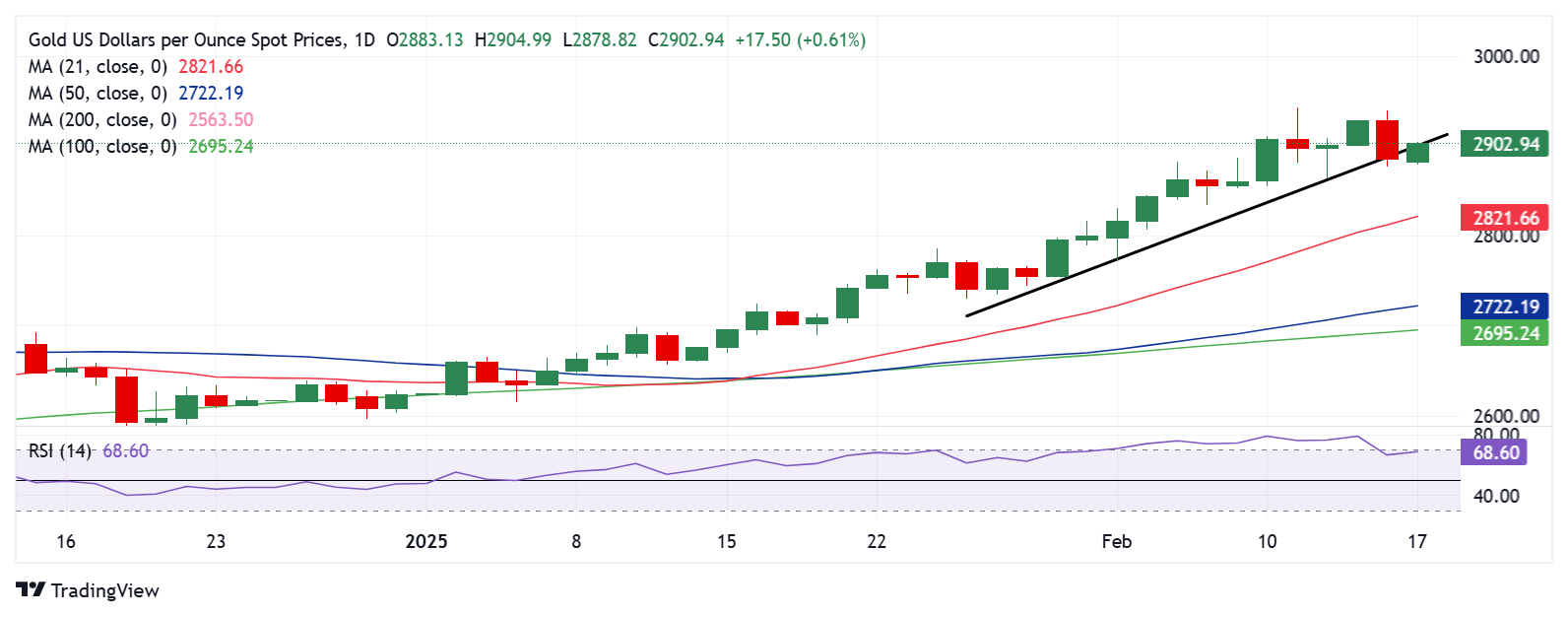
The daily chart shows that Gold price defended the rising trendline support, then at $2,885.
The 14-day Relative Strength Index (RSI) has eased from the overbought territory to trade in the bullish zone, currently near 69.
If the rebound gathers strength, Gold buyers will aim for the record high of $2,943. Ahead of that, the February 12 high of $2,909 could test bearish commitments.
The next relevant resistance is seen at the $2,970 round level.
Should sellers crack the February low of $2,864 decisively, a fresh downside could initiate toward the $2,850 psychological barrier.
Further south, the 21-day Simple Moving Average (SMA) at $2,822 could come into play.
Gold FAQs
Gold has played a key role in human’s history as it has been widely used as a store of value and medium of exchange. Currently, apart from its shine and usage for jewelry, the precious metal is widely seen as a safe-haven asset, meaning that it is considered a good investment during turbulent times. Gold is also widely seen as a hedge against inflation and against depreciating currencies as it doesn’t rely on any specific issuer or government.
Central banks are the biggest Gold holders. In their aim to support their currencies in turbulent times, central banks tend to diversify their reserves and buy Gold to improve the perceived strength of the economy and the currency. High Gold reserves can be a source of trust for a country’s solvency. Central banks added 1,136 tonnes of Gold worth around $70 billion to their reserves in 2022, according to data from the World Gold Council. This is the highest yearly purchase since records began. Central banks from emerging economies such as China, India and Turkey are quickly increasing their Gold reserves.
Gold has an inverse correlation with the US Dollar and US Treasuries, which are both major reserve and safe-haven assets. When the Dollar depreciates, Gold tends to rise, enabling investors and central banks to diversify their assets in turbulent times. Gold is also inversely correlated with risk assets. A rally in the stock market tends to weaken Gold price, while sell-offs in riskier markets tend to favor the precious metal.
The price can move due to a wide range of factors. Geopolitical instability or fears of a deep recession can quickly make Gold price escalate due to its safe-haven status. As a yield-less asset, Gold tends to rise with lower interest rates, while higher cost of money usually weighs down on the yellow metal. Still, most moves depend on how the US Dollar (USD) behaves as the asset is priced in dollars (XAU/USD). A strong Dollar tends to keep the price of Gold controlled, whereas a weaker Dollar is likely to push Gold prices up.
Author

Dhwani Mehta
FXStreet
Residing in Mumbai (India), Dhwani is a Senior Analyst and Manager of the Asian session at FXStreet. She has over 10 years of experience in analyzing and covering the global financial markets, with specialization in Forex and commodities markets.