Gold Price Forecast: XAU/USD bulls maintain the pressure aim for $3,400

XAU/USD Current price: $3,373.79
- The US Dollar consolidates dovish Fed-related losses at the beginning of the week.
- The US will publish the July Personal Consumption Expenditures Price Index on Friday.
- XAU/USD aims to extend its recovery towards the $3,400 level and beyond.
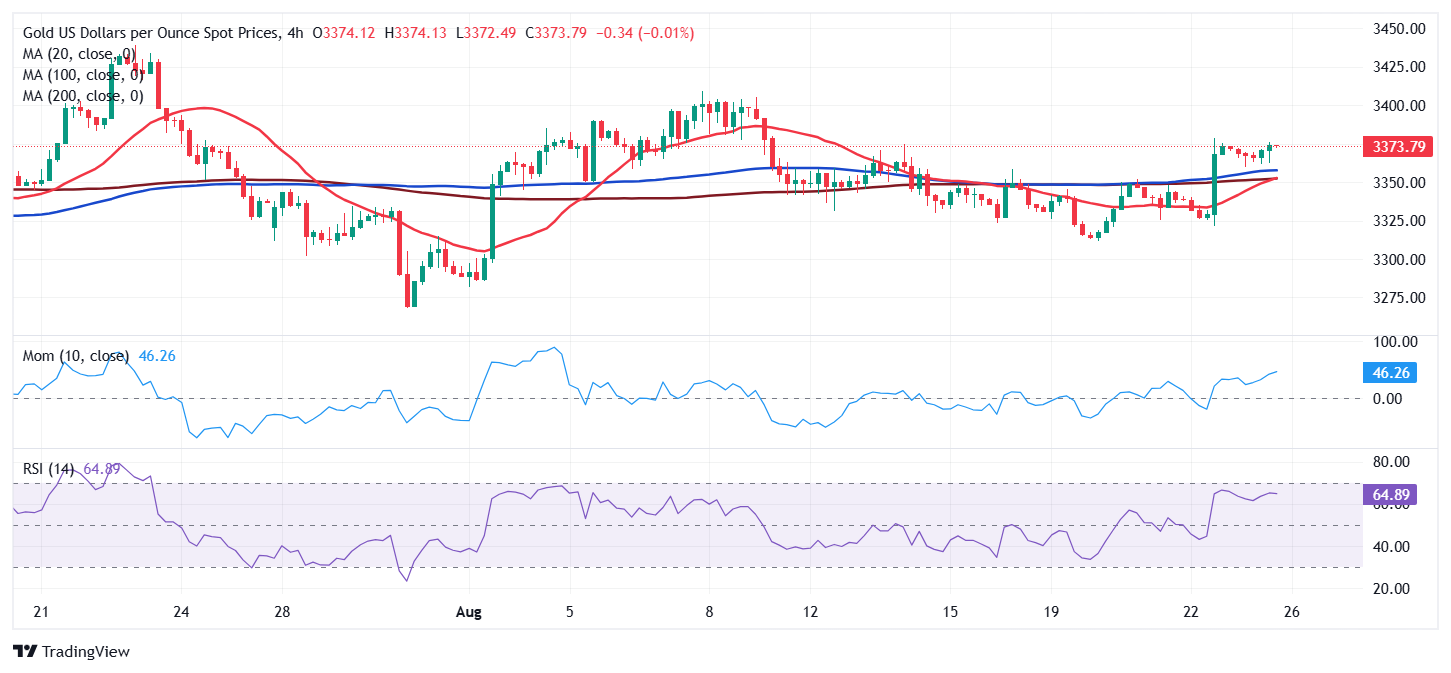
Spot Gold trades near its Friday peak at $3,378.91, consolidating gains yet confined to a tight intraday range at the beginning of the week. The US Dollar (USD) posted a modest intraday advance at the beginning of the day, a corrective advance that followed last week’s sell-off. Still, the American currency had little scope for a steady advance following the United States (US) Federal Reserve (Fed) Chair Jerome Powell's announcement at the Jackson Hole Symposium.
Powell surprised market players by being much more dovish than usual, and pretty much hinting at upcoming rate cuts. Market players are now betting on a roughly 85% chance of a 25 basis points (bps) trim in September. Investors are also increasing bets of another 25 bps cut when the Fed meets in December.
Other than that, the week will be lighter ahead of the monthly close, with the focus on the US July Personal Consumption Expenditures (PCE) Price Index, scheduled for the upcoming Friday. The Fed’s favorite inflation measure is foreseen little changed from July and holding below the 3% mark on a yearly basis.
Also, with the Fed’s future action seen clearly, investors may shift their attention to the trade-war front. US President Donald Trump has been relatively quiet on the matter, more centered on the Russia-Ukraine war. About the latter, hopes for a resolution continue to fade.
XAU/USD short-term technical outlook
From a technical point of view, the daily chart for the XAU/USD pair offers a neutral-to-bullish stance. The bright metal develops above all its moving averages, with the 20 Simple Moving Average (SMA) lacking directional strength at around $3,348.20. The 100 SMA, in the meantime, is partially losing its bullish strength, holding at around $3,319. Technical indicators, in the meantime, head nowhere at around their midlines, reflecting the ongoing consolidation.
In the near term, according to the 4-hour chart, XAU/USD is bullish. Technical indicators regain their upward scopes well above their midlines, and after a modest corrective decline. At the same time, a mildly bullish 20 SMA accelerated north below the longer ones, and is about to cross above the 200 SMA, bot around $3,350.
Support levels: 3,350.50 3,337.60 3,319.00
Resistance levels: 3,378.90 3,391.20 3,405.80
Fed FAQs
Monetary policy in the US is shaped by the Federal Reserve (Fed). The Fed has two mandates: to achieve price stability and foster full employment. Its primary tool to achieve these goals is by adjusting interest rates. When prices are rising too quickly and inflation is above the Fed’s 2% target, it raises interest rates, increasing borrowing costs throughout the economy. This results in a stronger US Dollar (USD) as it makes the US a more attractive place for international investors to park their money. When inflation falls below 2% or the Unemployment Rate is too high, the Fed may lower interest rates to encourage borrowing, which weighs on the Greenback.
The Federal Reserve (Fed) holds eight policy meetings a year, where the Federal Open Market Committee (FOMC) assesses economic conditions and makes monetary policy decisions. The FOMC is attended by twelve Fed officials – the seven members of the Board of Governors, the president of the Federal Reserve Bank of New York, and four of the remaining eleven regional Reserve Bank presidents, who serve one-year terms on a rotating basis.
In extreme situations, the Federal Reserve may resort to a policy named Quantitative Easing (QE). QE is the process by which the Fed substantially increases the flow of credit in a stuck financial system. It is a non-standard policy measure used during crises or when inflation is extremely low. It was the Fed’s weapon of choice during the Great Financial Crisis in 2008. It involves the Fed printing more Dollars and using them to buy high grade bonds from financial institutions. QE usually weakens the US Dollar.
Quantitative tightening (QT) is the reverse process of QE, whereby the Federal Reserve stops buying bonds from financial institutions and does not reinvest the principal from the bonds it holds maturing, to purchase new bonds. It is usually positive for the value of the US Dollar.
Author

Valeria Bednarik
FXStreet
Valeria Bednarik was born and lives in Buenos Aires, Argentina. Her passion for math and numbers pushed her into studying economics in her younger years.