Gold Price Forecast: XAU/USD appears ‘buy-on-dips’ despite hawkish rebound in Fed Sentiment Index
- Gold holds pullback from lifetime highs of $3,791 early Wednesday.
- US Dollar rebounds but not out of the woods yet amid government shutdown fears.
- Overbought RSI conditions on the daily chart fuels the retreat in Gold, will it last?
Gold is replicating the retracement moves seen in Tuesday’s Asian trades as buyers again catch a breath early Wednesday, bracing for more speeches from US Federal Reserve (Fed) officials.
Gold awaits US PCE inflation data for fresh directives
In the absence of top-tier US economic data releases on Wednesday, Gold traders turn their attention to Friday’s US core Personal Consumption Expenditures (PCE) Price Index, the Fed’s preferred inflation gauge for fresh insights on the US central bank’s further easing outlook.
On Tuesday, Fed Chair Jerome Powell, in his speech at the Greater Providence Chamber of Commerce in Rhode Island, stuck to the cautious rhetoric, providing little hints on the interest rates cut path.
"Chair Powell in his speech emphasised that 'near-term risks to inflation are tilted to the upside and risks to employment to the downside', highlighting the challenges of balancing the Fed’s dual mandate in the current environment," Westpac analysts explained in a research note.
Traders continue to bet on further easing, with CME Group’s FedWatch Tool now showing a 92% chance of a rate cut at the US central bank's October meeting, up from a 89.8% probability prior to Powell’s speech on Tuesday.
Meanwhile, the FXStreet Fed Sentiment Index is extending its overnight rebound, returning to the hawkish zone, trading near 102.00 as of writing.
The hawkish shift in the sentiment surrounding the Fed could be one of the factors capping the upside in Gold, helping the US Dollar stage a comeback after two back-to-back days of losses.
However, the USD upswing appears short-lived as US fiscal concerns intensify, with a government shutdown looming on October 1.
Meanwhile, markets paid limited attention to the S&P Global US preliminary PMI data, which came in mixed for September. The S&P Global Composite PMI eased to 53.6 from 54.6 in August, signalling continued expansion but at a weaker pace.
Next of note for markets remain the speech by San Francisco President Mary Daly, following a slew of mixed Fed commentaries so far this week.
Gold price technical analysis: Daily chart
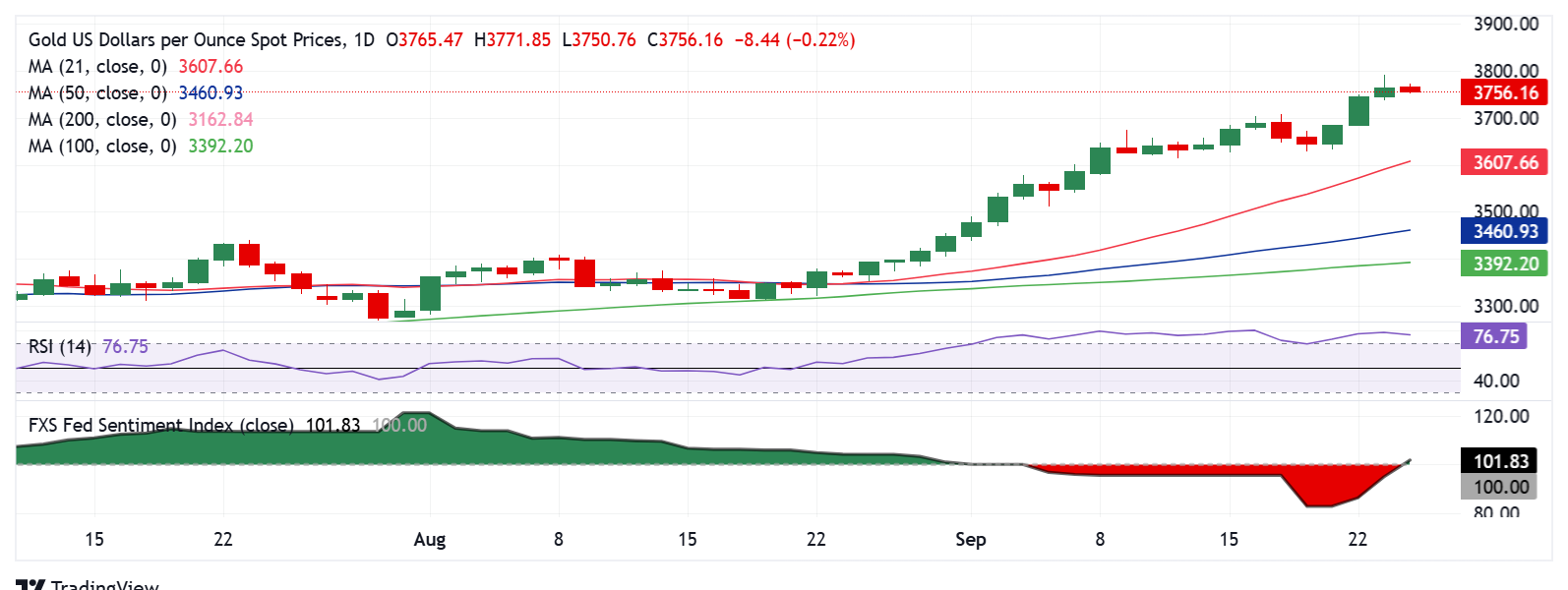
Technically, nothing seems to have changed for Gold in the near-term as the daily chart continues to portray overbought conditions, warranting caution for buyers.
The 14-day Relative Strength Index (RSI) is currently edging lower to near 76.
If the pullback sustains, the initial support is seen at the $3,700 threshold, below which Monday’s low of $3,684 will offer some comfort.
Further down, the $3,650 psychological barrier could come to the rescue of buyers.
On the other hand, buyers need acceptance above the previous day’s close of $3,765 to revive the record rally.
The next topside hurdle is located at the lifetime high of $3,791, followed by the $3,800 barrier.
A sustained and decisive break above the latter could fuel a fresh advance toward the $3,850 psychological level.
Fed FAQs
Monetary policy in the US is shaped by the Federal Reserve (Fed). The Fed has two mandates: to achieve price stability and foster full employment. Its primary tool to achieve these goals is by adjusting interest rates. When prices are rising too quickly and inflation is above the Fed’s 2% target, it raises interest rates, increasing borrowing costs throughout the economy. This results in a stronger US Dollar (USD) as it makes the US a more attractive place for international investors to park their money. When inflation falls below 2% or the Unemployment Rate is too high, the Fed may lower interest rates to encourage borrowing, which weighs on the Greenback.
The Federal Reserve (Fed) holds eight policy meetings a year, where the Federal Open Market Committee (FOMC) assesses economic conditions and makes monetary policy decisions. The FOMC is attended by twelve Fed officials – the seven members of the Board of Governors, the president of the Federal Reserve Bank of New York, and four of the remaining eleven regional Reserve Bank presidents, who serve one-year terms on a rotating basis.
In extreme situations, the Federal Reserve may resort to a policy named Quantitative Easing (QE). QE is the process by which the Fed substantially increases the flow of credit in a stuck financial system. It is a non-standard policy measure used during crises or when inflation is extremely low. It was the Fed’s weapon of choice during the Great Financial Crisis in 2008. It involves the Fed printing more Dollars and using them to buy high grade bonds from financial institutions. QE usually weakens the US Dollar.
Quantitative tightening (QT) is the reverse process of QE, whereby the Federal Reserve stops buying bonds from financial institutions and does not reinvest the principal from the bonds it holds maturing, to purchase new bonds. It is usually positive for the value of the US Dollar.
Author

Dhwani Mehta
FXStreet
Residing in Mumbai (India), Dhwani is a Senior Analyst and Manager of the Asian session at FXStreet. She has over 10 years of experience in analyzing and covering the global financial markets, with specialization in Forex and commodities markets.














