Gold Price Forecast: XAU/USD gains at start of Fed’s policy week
- Gold rises to near $4,010 ahead of the Fed’s monetary policy announcement on Wednesday.
- The Fed is almost certain to leave interest rates steady in the 3.75%-4.00% range.
- This week, investors will also focus on the US GDP and PCE Inflation data, and Q3 earnings of hyperscalers.

Gold finds bids below $4,000 in the Asian trade on Monday. The precious metal starts the Federal Reserve’s (Fed) monetary policy week on positive note, but is broadly vulnerable, being closer to its three-month low of $3,975.
Fed’s policy will be in spotlight
This week, the key trigger for the Gold price will be the Fed’s monetary policy announcement on Wednesday. According to the CME FedWatch tool, the Fed is almost certain to leave interest rates steady in the 3.75%-4.00% range; this makes the monetary policy guidance a major catalyst for the Gold price.
Latest remarks from several Fed officials have signaled that inflationary pressures are more prolonged in nature and more interest rate hikes are needed to tame them.
Hammack flags inflation mindset risk as Fed tone stays firmly hawkish
Fed’s Hammack delivers a moderately hawkish message, with a 7.2/10 FXS Speechtracker score slightly softer relative to the historical average of 7.6/10 but still signaling concern over persistent price pressures. The emphasis on lower-income Americans struggling with inflation, anecdotal evidence of rising input costs, and explicit worries about an emerging “inflation mentality” point to a bias toward keeping policy tight, especially given the acknowledgement that financial conditions do not appear restrictive and the neutral rate is uncertain. The warning that an entrenched inflationary mindset could force more aggressive action reinforces a risk that the Fed may lean toward further tightening if inflation expectations drift higher.
The FXS Fed Sentiment Index slipped by 0.25 points to 127.92, indicating a marginal pullback in hawkishness versus prior readings. However, with the index still well above the 100 neutral threshold, the Fed tone remains firmly in hawkish territory despite the slight moderation, aligning with Hammack’s focus on inflation risks and potential need for stronger policy responses.
Other than the Fed’s monetary policy, preliminary Q3 Gross Domestic Product (GDP) and Personal Consumption Expenditure (PCE) Price Index, and Q3 earnings reports of Amazon, Alphabet and Microsoft are key notable released this week.
Why Gold price underperformed in past few weeks?
Strategists at OCBC note that gold "came under renewed selling pressure even as US rates moved lower”. They highlight that "Brent’s sharp rise amid renewed Middle East supply concerns added to inflation worries and expectations that the Fed may need to keep rates restrictive for longer," weighing on the precious metal. What they regard as particularly notable is that "gold continued to weaken even as US Treasury yields fell sharply amid the global tech selloff," underlining the metal’s muted response to typically supportive drivers.
According to OCBC, "neither lower yields nor heightened geopolitical uncertainty has been sufficient to support gold, suggesting that near-term sentiment remains fragile." The bank adds that "we remained cautious in the near term, particularly as gold has struggled to respond positively to the recent decline in yields," indicating that a more convincing reaction to easing financial conditions may be needed before confidence in the gold outlook improves.
Gold Technical Analysis
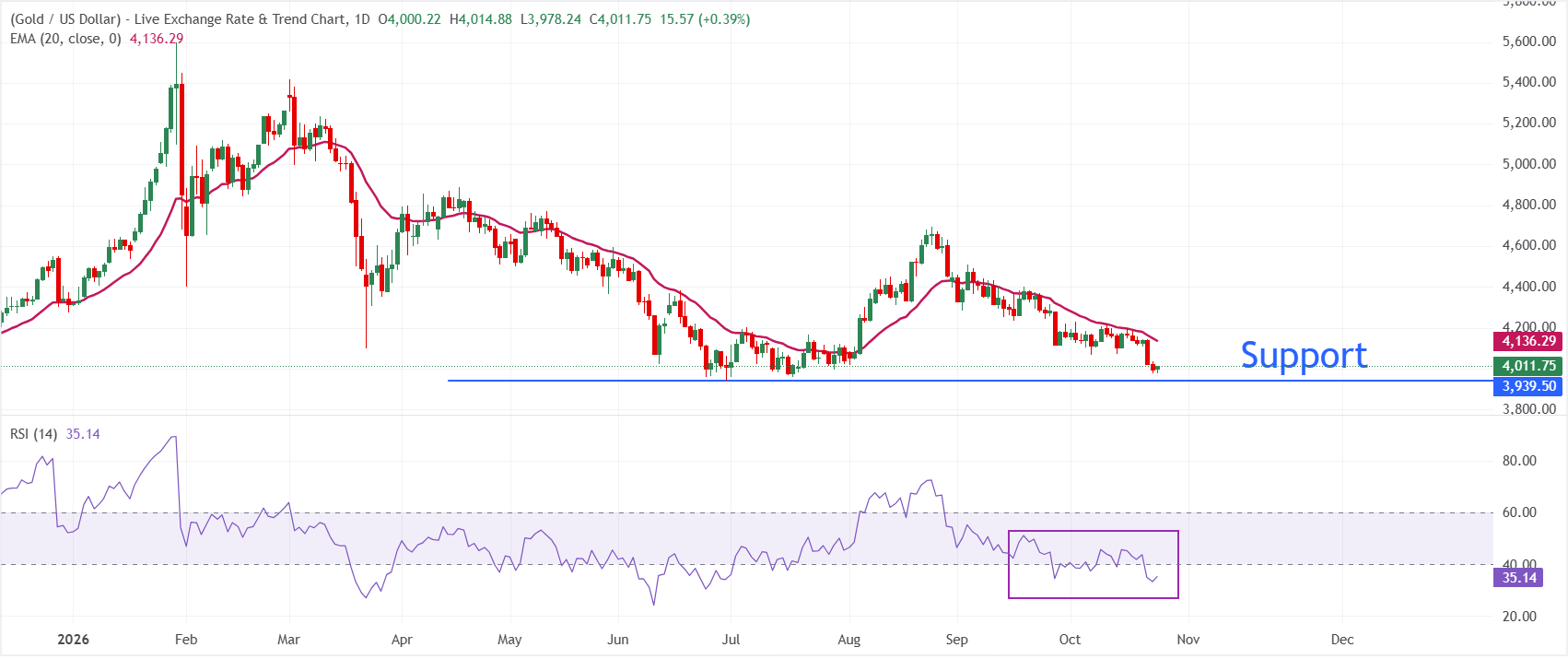
In the daily chart, XAU/USD trades at $4,011.06, maintaining a bearish near-term bias as it holds beneath the 20-day Exponential Moving Average (EMA) at $4,136.22.
The price action remains capped by this short-term trend proxy, while the Relative Strength Index (RSI) at 35.06 stays near the lower end of its range, hinting at persistent downside pressure without yet signaling extreme oversold conditions.
On the topside, immediate resistance is defined by the 20-day EMA at $4,136.22, which would need to be reclaimed to ease the current bearish tone and open the way for a more sustained recovery. On the downside, the June 30 low at $3,941.76 is the key support level.
(The technical analysis of this story was written with the help of an AI tool. Know more.)
(This story was corrected on October 26 at 03:50 GMT to say in the title that Gold Price Forecast: XAU/USD gains at start of Fed’s policy week, and not XAG/USD)
Gold FAQs
Gold has played a key role in human’s history as it has been widely used as a store of value and medium of exchange. Currently, apart from its shine and usage for jewelry, the precious metal is widely seen as a safe-haven asset, meaning that it is considered a good investment during turbulent times. Gold is also widely seen as a hedge against inflation and against depreciating currencies as it doesn’t rely on any specific issuer or government.
Central banks are the biggest Gold holders. In their aim to support their currencies in turbulent times, central banks tend to diversify their reserves and buy Gold to improve the perceived strength of the economy and the currency. High Gold reserves can be a source of trust for a country’s solvency. Central banks added 1,136 tonnes of Gold worth around $70 billion to their reserves in 2022, according to data from the World Gold Council. This is the highest yearly purchase since records began. Central banks from emerging economies such as China, India and Turkey are quickly increasing their Gold reserves.
Gold has an inverse correlation with the US Dollar and US Treasuries, which are both major reserve and safe-haven assets. When the Dollar depreciates, Gold tends to rise, enabling investors and central banks to diversify their assets in turbulent times. Gold is also inversely correlated with risk assets. A rally in the stock market tends to weaken Gold price, while sell-offs in riskier markets tend to favor the precious metal.
The price can move due to a wide range of factors. Geopolitical instability or fears of a deep recession can quickly make Gold price escalate due to its safe-haven status. As a yield-less asset, Gold tends to rise with lower interest rates, while higher cost of money usually weighs down on the yellow metal. Still, most moves depend on how the US Dollar (USD) behaves as the asset is priced in dollars (XAU/USD). A strong Dollar tends to keep the price of Gold controlled, whereas a weaker Dollar is likely to push Gold prices up.
Author

Sagar Dua
FXStreet
Sagar Dua is associated with the financial markets from his college days. Along with pursuing post-graduation in Commerce in 2014, he started his markets training with chart analysis.

















