Gold Price Forecast: Key $1850 hurdle to limit XAU/USD bulls amid US stimulus deadlock
- US stimulus deadlock and vaccine optimism weigh on gold.
- 100-HMA is the level to beat for the XAU/USD bulls.
- Sell the bounce could remain in play ahead of US data.

Gold (XAU/USD) witnessed technical selling at the long-held support now resistance of $1850 on Thursday, finishing the day with modest losses at around $1835. Expectations of the US Food and Drug Administration’s (FDA) approval of Pfizer’s coronavirus vaccine and no signs of additional fiscal stimulus in the near-term kept the bearish pressure intact on gold. However, broad-based US dollar weakness amid the vaccine optimism and weak US jobs data capped the downside in the metal.
So far this Friday, gold is treading water within the familiar range amid mixed markets, as the Brexit and US stimulus deadlock offset the optimism over the covid vaccine progress. The US FDA voted overwhelmingly to recommend the emergency use of Pfizer’s vaccine, although the authorization will take place in the coming days. Meanwhile, the persistent growth in the COVID-19 cases globally remains a cause for the market’s concern ahead of the US PPI and Michigan Consumer Sentiment data.
Gold Price Chart - Technical outlook
Hourly chart
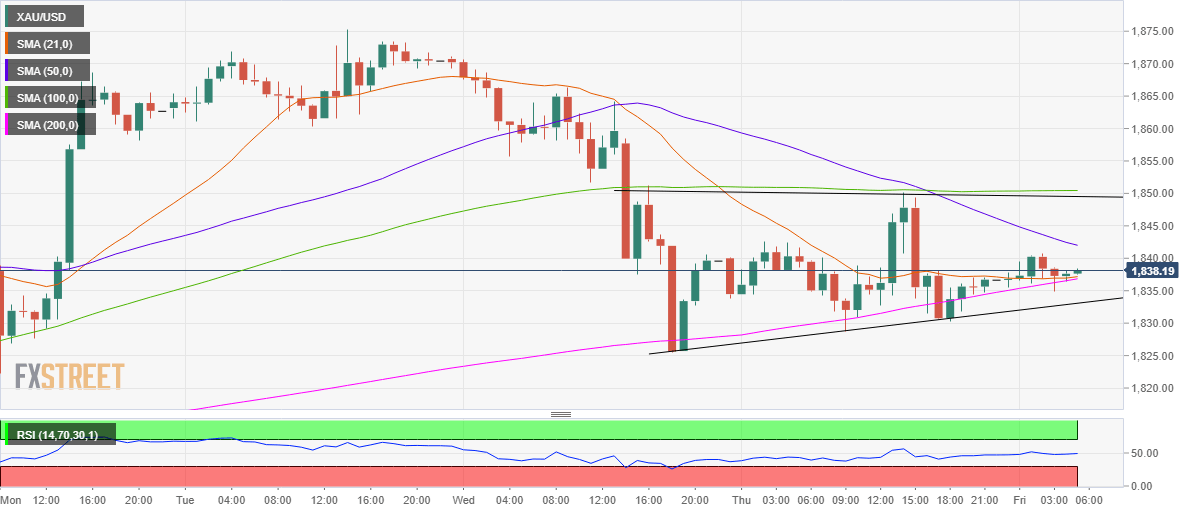
Gold wavers in an ascending triangle formation on the hourly chart, with a convincing break below the rising trendline support of $1833 to validate the pattern.
The bears could then look to test the measured target at $1808.
At the time of writing, gold is clinging on to the 200-hourly moving average (HMA) at $1837, where the 21-HMA coincides.
The hourly Relative Strength Index (RSI) holds flat but below the midline, suggesting that the downside appears more compelling.
To the upside, the bearish 50-HMA is likely to offer immediate resistance at $1842, above which the $1850 level will get challenged. That level is the confluence of the horizontal 100-HMA and trendline resistance.
A daily closing above the $1850 hurdle is needed to negate the near-term bearish bias.
Author

Dhwani Mehta
FXStreet
Residing in Mumbai (India), Dhwani is a Senior Analyst and Manager of the Asian session at FXStreet. She has over 10 years of experience in analyzing and covering the global financial markets, with specialization in Forex and commodities markets.

















