Gold Price Forecast: Further upside for XAU/USD appears elusive amid a US holiday
- Gold price builds on last week’s recovery early Monday on cautious optimism.
- The Dollar drifts lower amid sluggish US Treasury bond yields and US holiday.
- Gold price closed the week above 21-day SMA at $2,045, where next?
Gold price is sitting near the highest level in five days above $2,050 in Asian trading on Monday, helped by a cautiously optimistic market mood, increased US Federal Reserve (Fed) bets for a March rate cut and a US holiday-led thin trading conditions.
Gold price stays supported amid wobbly US Dollar
Gold price is capitalizing on persisting uncertainty in the market, as investors digest a bunch of the latest fundamental developments at the start of the week on Monday. The US Dollar is fluctuating between gains and losses, as the US Treasury bond yields trade listlessly amid light trading on account of the Martin Luther King Jr. Day holiday in the United States.
On Friday, the US Dollar slipped from higher levels after the US Producer Price Index (PPI) unexpectedly fell in December, ramping up Fed March rate cut bets while dragging US Treasury bond yields lower.
Market pricing now points to a 78% chance that the US central bank will begin easing rates in March, as compared to a 68% chance a week ago, according to the CME Group’s FedWatch tool. Dovish Fed expectations remain supportive of the ongoing upswing in the Gold price.
Markets, however, prefer to stay on a cautious footing ahead of the crucial Gross Domestic Product (GDP) from China, especially after the People’s Bank of China (PBOC) surprised markets with no reduction to the Medium-Term Lending Facility (MLF) rate.
Further, simmering tensions between China and Taiwan also keep investors on edge and the US Dollar broadly supported. Over the weekend, Taiwan’s ruling Democratic Progressive Party (DPP) won the presidential election while losing its legislative majority. US Secretary of State Antony Blinken sent Taiwanese president-elect William Lai a message of congratulations following the result.
In response, China's Foreign Ministry said, "China firmly opposes the US having any form of official interaction with Taiwan and interfering in Taiwan affairs in any way or under any pretext."
Fresh reports of Iran-backed Houthi militants launching an anti-ship cruise missile at a US Navy ship could also act as a tailwind for the Gold price.
Later in the day, Gold price could maintain its buoyant tone, in the absence of any significant economic data and amid light trading. The main focus this week remains on Fed Governor Christopher Waller’s speech, US Retail Sales data and Chinese quarterly GDP numbers.
Gold price technical analysis: Daily chart
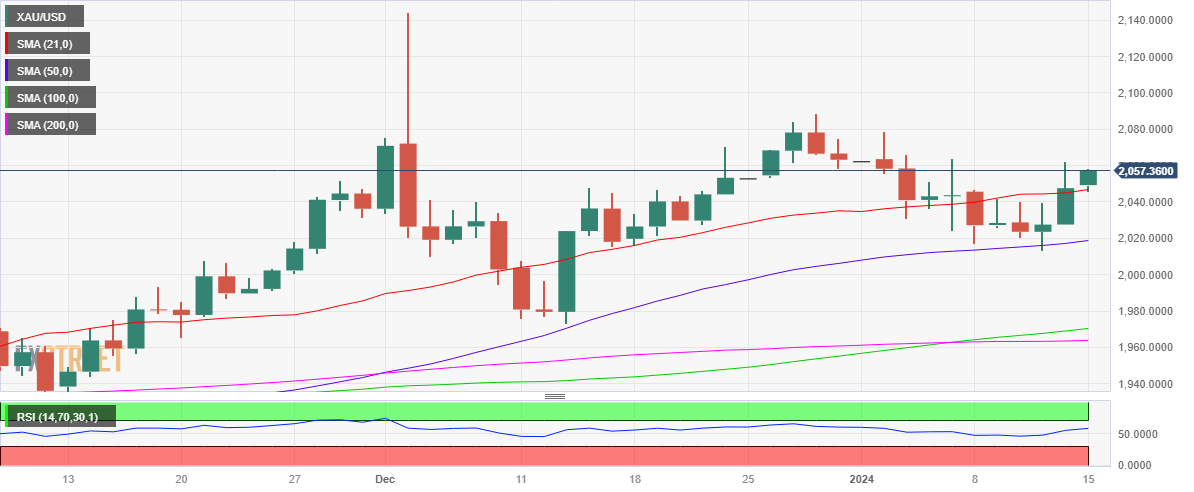
The short-term technical outlook for Gold price remains in favor of buyers after the bright metal closed Friday above the 21-day Simple Moving Average (SMA) at $2,046, breaking the weekly range trade to the upside.
The 14-day Relative Strength Index (RSI) indicator is looking firmer above the midline, suggesting that there is more scope to the upside for Gold price. Additionally, the 100- and 200-day SMA Bull Cross remains in play, supporting Gold price.
The immediate resistance is seen at the January 5 high of $2,064, above which the static resistance at $2,080 will be tested. If the upbeat momentum sustains, a retest of the $2,100 barrier cannot be ruled out.
However, if Gold sellers lurk at higher levels and trigger a pullback, the 21-day SMA resistance-turned-support at $2,046 will be the initial contention point. A daily closing below the latter is critical to negating the renewed uptrend.
The next downside target is seen at the 50-day SMA at $2,019. Ahead of that, Friday’s low of $2,027 could offer some temporary respite to Gold buyers.
(This story was corrected on January 15 at 9:19 GMT to say that "the immediate resistance is seen at the January 5 high of $2,064, not $2,06)
Gold FAQs
Why do people invest in Gold?
Gold has played a key role in human’s history as it has been widely used as a store of value and medium of exchange. Currently, apart from its shine and usage for jewelry, the precious metal is widely seen as a safe-haven asset, meaning that it is considered a good investment during turbulent times. Gold is also widely seen as a hedge against inflation and against depreciating currencies as it doesn’t rely on any specific issuer or government.
Who buys the most Gold?
Central banks are the biggest Gold holders. In their aim to support their currencies in turbulent times, central banks tend to diversify their reserves and buy Gold to improve the perceived strength of the economy and the currency. High Gold reserves can be a source of trust for a country’s solvency. Central banks added 1,136 tonnes of Gold worth around $70 billion to their reserves in 2022, according to data from the World Gold Council. This is the highest yearly purchase since records began. Central banks from emerging economies such as China, India and Turkey are quickly increasing their Gold reserves.
How is Gold correlated with other assets?
Gold has an inverse correlation with the US Dollar and US Treasuries, which are both major reserve and safe-haven assets. When the Dollar depreciates, Gold tends to rise, enabling investors and central banks to diversify their assets in turbulent times. Gold is also inversely correlated with risk assets. A rally in the stock market tends to weaken Gold price, while sell-offs in riskier markets tend to favor the precious metal.
What does the price of Gold depend on?
The price can move due to a wide range of factors. Geopolitical instability or fears of a deep recession can quickly make Gold price escalate due to its safe-haven status. As a yield-less asset, Gold tends to rise with lower interest rates, while higher cost of money usually weighs down on the yellow metal. Still, most moves depend on how the US Dollar (USD) behaves as the asset is priced in dollars (XAU/USD). A strong Dollar tends to keep the price of Gold controlled, whereas a weaker Dollar is likely to push Gold prices up.
Author

Dhwani Mehta
FXStreet
Residing in Mumbai (India), Dhwani is a Senior Analyst and Manager of the Asian session at FXStreet. She has over 10 years of experience in analyzing and covering the global financial markets, with specialization in Forex and commodities markets.