Australian Dollar Price Forecast: Bearish bias below 0.7000
- AUD/USD’s decline has come just short of the 0.7000 contention zone.
- The US Dollar remains bid on the back of rising Fed rate hike bets.
- The Australian jobs report came in mixed in August.

The Australian Dollar (AUD) has remained on the defensive for the fourth consecutive day on Thursday, motivating AUD/USD to come under extra pressure and flirt with the key 0.7000 zone.
Indeed, spot has suffered once again the persistent buying interest of the US Dollar (USD), which remained bolstered by steady speculation of further tightening by the Federal Reserve (Fed) in the second half of the year, rising yields and unabated uncertainty surrounding the Middle East conflict.
Following the September tops near 0.7240, the pair appears to have started a downward move that is now testing the critical 200-day SMA around 0.7015. However, the bar for a sustained and deeper retracement seems pretty high considering the Reserve Bank of Australia’s (RBA) hawkish policy bias and still elevated consumer prices at home.
Australia’s economy remains resilient despite signs of slowing momentum
Australia’s economy continues to compare favourably with many of its G10 peers, supported by domestic demand and positive economic growth. Persistent inflation also supports the RBA’s cautious, data-dependent policy stance.
However, business activity seems to have lost some momentum after preliminary data showed the Purchasing Managers’ Index (PMI) for Manufacturing cooling to 49.3 in September and easing to 51.4 when it comes to Services, from 52.0 and 53.2, respectively.
Trade data provided another positive signal: Australia recorded an A$1.923 billion surplus in July, adding to the A$2.341 billion surplus registered in June.
Growth figures were less encouraging, however. Indeed, the Gross Domestic Product (GDP) expanded by 0.4% QoQ in the second quarter of 2026, up from 0.3%, while annual growth came in at 2.1%, down from the previous 2.5% yearly expansion.
The labour market also showed mixed signs in August, with the Unemployment Rate rising to 4.6% and Employment Change increasing by 39.5K, reversing July’s nearly 16K drop.
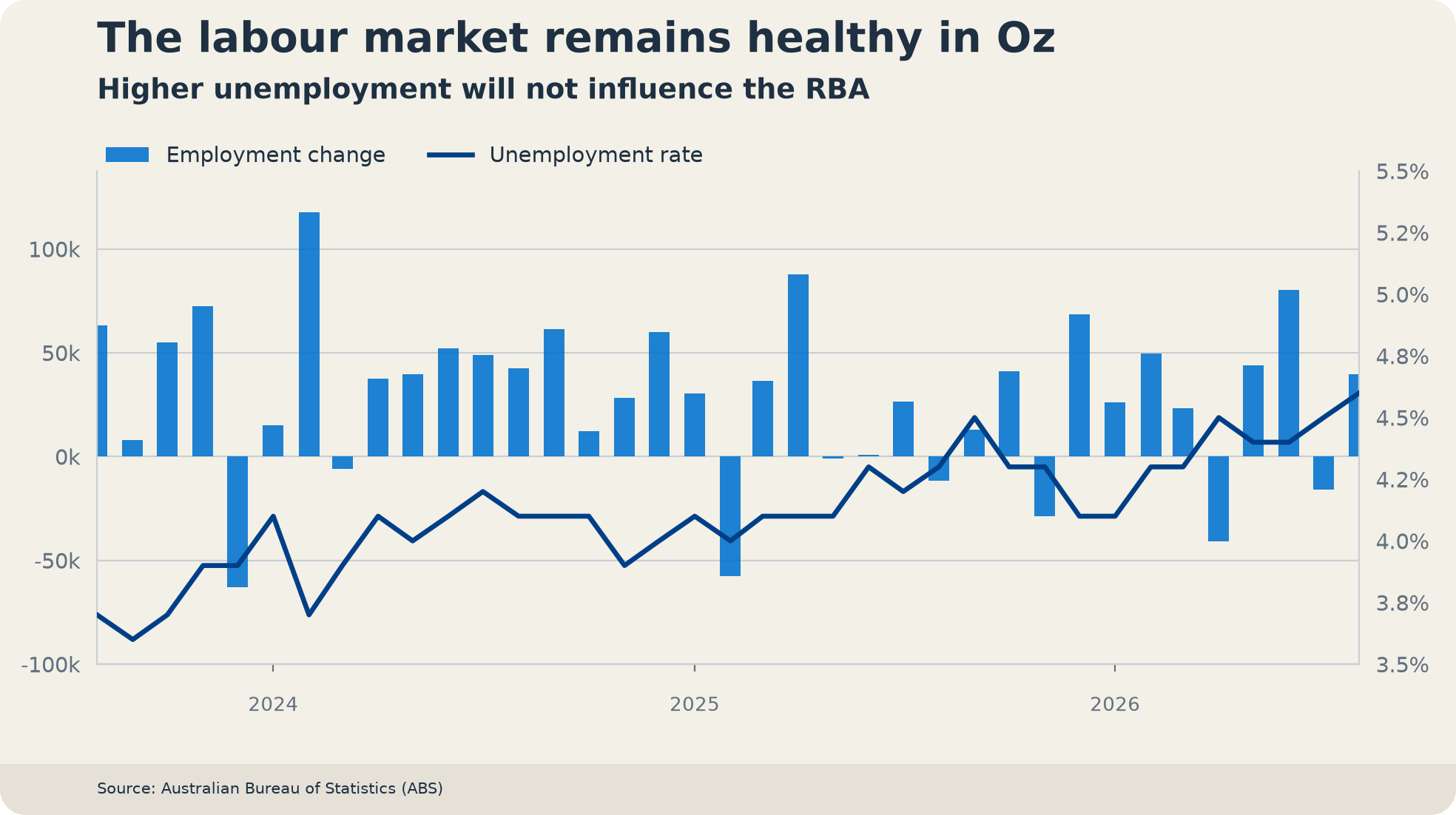
Inflation remains the main constraint, with July data showing price pressures running well above the RBA’s 2%-3% target band, suggesting that the return to target could remain uneven and prolonged. That said, the headline inflation eased to 3.5% in July (from 3.8%), while underlying price pressures tracked by the Trimmed Mean held steady at 3.6%.
The Melbourne Institute’s Consumer Inflation Expectations measure reinforced that view, holding steady at 4.9% in September.
The figures leave the RBA’s inflation task incomplete. Policymakers expect inflation to return to target only in early 2028, maintaining the emphasis on patience rather than an imminent policy pivot.
China offers stability, but little support for the Aussie
China is providing stability for the Australian economy, but not the growth impulse that has supported the Australian Dollar during previous expansions.
The Chinese economy grew by 4.3% YoY in the April-June period, while Industrial Production growth regained traction, expanding by 5.2% YTD, and the trade surplus widened to $119.1 billion in July, supported by decent increases in both imports and exports. However, on the downside, consumer spending remained sluggish after Retail Sales rose by only 0.4 % from a year earlier.
In addition, business surveys presented a mixed picture: the National Bureau of Statistics reported that the Manufacturing PMI improved to 49.8 in August from 49.2, while the Services PMI remained unchanged at 49.0. On the other hand, private measures like RatingDog remain in expansionary territory, with Manufacturing at 51.5 (from 50.9) and Services at 51.4 (from 50.4).
Disinflationary pressures seem to have taken a breather in August, with the CPI gaining 0.8% YoY, up from 0.5%, while prices rose by 0.4% on a monthly basis. Producer Prices rose by 3.8% over the previous twelve months, down from the 3.5% increase recorded in the previous month.
The People’s Bank of China (PBoC) left its Loan Prime Rates unchanged early on Monday, maintaining the one-year rate at 3.00% and the five-year rate at 3.50%.
China is therefore neither providing a major boost nor creating a significant drag. Unless the data reveal a clearer acceleration or deterioration, its influence on AUD/USD is likely to remain limited.
The RBA maintains a hawkish bias despite softer growth
The RBA left its Official Cash Rate (OCR) unchanged on August 11 and retained a clear tightening bias, citing above-target inflation and upside risks to the outlook. The decision to hold rates was unanimous.
The Minutes maintained that cautious but hawkish stance. Several officials warned that inflation risks could materialise, which would leave the Board ready to raise rates. Potential sources of pressure include increased investment in data centres, cost pass-through and higher energy prices.
Policymakers discussed a 25-basis-point increase but concluded that the current policy setting was sufficiently restrictive. They also acknowledged more balanced risks, including falling house prices and the possibility that inflation could decline without causing significant damage to employment.
Fresh GDP, labour-market and inflation figures are expected before the September meeting, leaving policy dependent on the incoming data.
So far, investors are pricing in roughly 42 basis points of tightening by year-end and expect the RBA to hike the OCR by 25 basis points at its meeting on September 29.
AUD/USD outlook: Bulls need to reclaim 0.7200
Baseline outlook
The medium-term outlook has deteriorated in the last few weeks, as the pair remains unable to regain upside traction in a sustained manner. While above the 200-day SMA (0.7019), the pair should keep its constructive tone unchanged. Against this backdrop, some consolidation in the short-term horizon should not be ruled out. Of note, the daily Relative Strength Index (RSI) is approaching the oversold zone, which could eventually spark some “technical” correction.
The resumption of the bullish bias will likely require a strong catalyst, namely a sustained improvement in risk appetite trends or continued US Dollar weakness.
Upside scenario
A stronger risk-on environment and a convincing break above 0.7200 would bring the 2026 high near 0.7280 into view.
Beyond that level, resistance emerges at the 0.7300 round level, followed by the 2022 ceiling at 0.7593.
Downside scenario
An additional deterioration in global risk sentiment, persistent strength in the Greenback, or renewed weakness in Chinese data could further fuel the ongoing selling mood.
Initial support is at the September floor of 0.7007 (September 24). A breach below the latter would increase the likelihood of a retest of the weekly low at 0.6922 (July 29)
Bearish positioning regains momentum
Speculative bearish positioning in the Australian Dollar strengthened in the week ending September 15, according to the Commodity Futures Trading Commission (CFTC). That said, net shorts increased to nearly 39K contracts, reversing part of the previous week’s improvement. However, the 4-week change increased to around 5.2K contracts, showing that the broader positioning trend remains less negative despite the latest setback.
In addition, open interest extended its climb, this time hitting around 494.1K contracts. The move suggests that traders are establishing new bearish positions as net shorts deepen and participation increases, rather than just unwinding prior longs. This suggests that conviction behind the negative AUD bias has picked up again.
Further data showed the speculative exposure edged lower to -7.9% from -7.7%, while its percentile remained elevated at 83.9. Bearish exposure is therefore historically significant, although the Net Position Percentile of 68.1 indicates that positioning is not yet at an extreme. The small change in exposure also suggests that the increase in open interest was broadly balanced.
Overall, the AUD’s bearish bias remains intact, but the wider trend has not fully reversed. Fresh short-building is a negative signal, yet the positive 4-week change indicates that bearish momentum is not accelerating decisively. For now, the data point to renewed pressure on the Aussie rather than a fully fledged bearish regime.
Key catalysts to watch for AUD/USD
US Dollar dynamics, global risk sentiment, and geopolitical developments remain the main near-term drivers of AUD/USD.
Meanwhile, next on tap on the domestic docket will be the interest rate decision by the RBA on September 29.
Beyond the immediate releases, the main risks include a sharper slowdown in China, a persistently cautious Fed, a deterioration in investor risk appetite or a change in the RBA’s current policy stance. Any of these developments could quickly alter the outlook for the Australian Dollar.
Technical analysis
In the daily chart, AUD/USD trades around 0.7014, extending a bearish near-term bias as spot holds beneath the 200-day simple moving average (SMA) at 0.7022 and the 100-day SMA at 0.7073. The pair is further capped by a nearby horizontal resistance at 0.7079 and the 55-day SMA at 0.7081, reinforcing the notion of topside supply. Momentum is weak, with the Relative Strength Index (RSI) hovering near 33, hinting at emerging oversold conditions, while the Average Directional Index (ADX) around 26 suggests a moderately developed downtrend rather than a ranging environment.
On the topside, initial resistance is located at the 200-day SMA at 0.7022, followed by the 100-day SMA at 0.7073 and the horizontal barrier at 0.7079, with the 55-day SMA at 0.7081 adding to this dense cap. Beyond there, higher resistance aligns at 0.7278 and 0.7283, before the more distant ceiling at 0.7661. On the downside, first meaningful support emerges at 0.6833, ahead of deeper levels at 0.6660 and 0.6593, with 0.6414 and 0.6373 marking a broader structural floor should selling pressure intensify.
(The technical analysis of this story was written with the help of an AI tool. Know more.)
External risks complicate the bullish outlook
Some dark clouds continue to hover around the AUD’s near-term outlook.
Australia’s domestic backdrop compares favourably with that of many advanced economies, and the RBA is in no hurry to abandon its hawkish stance. This should somewhat contain the bearish impulse.
The recovery nevertheless remains vulnerable to renewed strength in the Greenback, persistent geopolitical uncertainty and a Chinese economy that is stabilising rather than accelerating.
The 200-day SMA remains the key level for the medium-term outlook. Holding above it preserves the constructive structure, but a convincing break above 0.7200 is necessary to further extend the bull run.
However, such a move would require the resumption of the downward trend in the Greenback, stronger demand for risk-sensitive assets, additional cooling in US inflation, or a (less likely) dovish shift from the Fed.
Until then, external forces are likely to exert more influence over the Australian Dollar than domestic fundamentals.
Australian Dollar FAQs
One of the most significant factors for the Australian Dollar (AUD) is the level of interest rates set by the Reserve Bank of Australia (RBA). Because Australia is a resource-rich country another key driver is the price of its biggest export, Iron Ore. The health of the Chinese economy, its largest trading partner, is a factor, as well as inflation in Australia, its growth rate and Trade Balance. Market sentiment – whether investors are taking on more risky assets (risk-on) or seeking safe-havens (risk-off) – is also a factor, with risk-on positive for AUD.
The Reserve Bank of Australia (RBA) influences the Australian Dollar (AUD) by setting the level of interest rates that Australian banks can lend to each other. This influences the level of interest rates in the economy as a whole. The main goal of the RBA is to maintain a stable inflation rate of 2-3% by adjusting interest rates up or down. Relatively high interest rates compared to other major central banks support the AUD, and the opposite for relatively low. The RBA can also use quantitative easing and tightening to influence credit conditions, with the former AUD-negative and the latter AUD-positive.
China is Australia’s largest trading partner so the health of the Chinese economy is a major influence on the value of the Australian Dollar (AUD). When the Chinese economy is doing well it purchases more raw materials, goods and services from Australia, lifting demand for the AUD, and pushing up its value. The opposite is the case when the Chinese economy is not growing as fast as expected. Positive or negative surprises in Chinese growth data, therefore, often have a direct impact on the Australian Dollar and its pairs.
Iron Ore is Australia’s largest export, accounting for $118 billion a year according to data from 2021, with China as its primary destination. The price of Iron Ore, therefore, can be a driver of the Australian Dollar. Generally, if the price of Iron Ore rises, AUD also goes up, as aggregate demand for the currency increases. The opposite is the case if the price of Iron Ore falls. Higher Iron Ore prices also tend to result in a greater likelihood of a positive Trade Balance for Australia, which is also positive of the AUD.
The Trade Balance, which is the difference between what a country earns from its exports versus what it pays for its imports, is another factor that can influence the value of the Australian Dollar. If Australia produces highly sought after exports, then its currency will gain in value purely from the surplus demand created from foreign buyers seeking to purchase its exports versus what it spends to purchase imports. Therefore, a positive net Trade Balance strengthens the AUD, with the opposite effect if the Trade Balance is negative.
Author

Pablo Piovano
FXStreet
Born and bred in Argentina, Pablo has been carrying on with his passion for FX markets and trading since his first college years.