Gold outperformed every major asset class in H1


Gold was up nearly 26 percent through the first six months of 2025, ranking as the top-performing asset class.
This booming performance continued the momentum built in 2024 when gold surged by 26.5 percent.
After recording 40 all-time highs in 2024, gold set another 26 all-time highs through the first six months of this year. In April, gold cracked the $3,500 level for the first time. It also set a record in inflation-adjusted terms.
Gold outperformed every other major asset class. Developed market stocks (excluding the U.S.) came in second place, rising by about 19 percent.

Several factors drove gold’s continued bull market through H1, including a weak U.S. dollar, rangebound yields with expectations of more Federal Reserve rate cuts by the end of the year, and heightened geopolitical tensions, including trade turmoil and several military conflicts.
Continued central bank gold buying and more general de-dollarization also supported gold through the first half of 2025.
The dollar charted its worst start to a year since 1973. In fact, one could argue that it’s not so much that the gold is going up but that the greenback is sagging. Gold is reflecting the devaluation of the U.S. currency.
There also appears to be a developing bear market in bonds. U.S. Treasuries have historically been a go-to safe-haven asset. However, Treasury yields increased as bonds sold off in April at the height of geopolitical uncertainty.
While the final numbers aren’t in, preliminary data indicates gold demand was strong in H1, spurred by and supporting the price rally.
The World Gold Council reported increased trading activity across over-the-counter markets, exchanges, and ETFs. Average trading volumes in H1 hit $329 billion per day, the highest semi-annual number on record.
Flows of gold into ETFs hit the highest semi-annual level since the pandemic. Through the first half of 2025, gold-backed funds globally increased their holdings by 397.1 tonnes, totaling $38 billion.
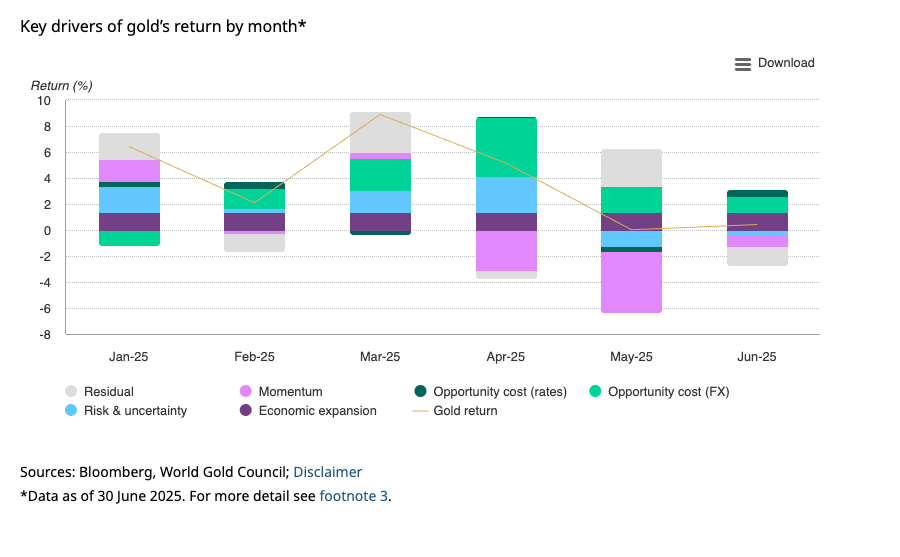
The World Gold Council has developed a Gold Return Attribution Model (GRAM) to evaluate the factors contributing to gold’s performance. Low opportunity cost, momentum, and a risk environment were significant factors through H1, contributing to about 16 percent of gold's returns.
Gold has generally been trading sideways in a consolidation phase since April. Jordan Roy-Byrne is a renowned technical analyst who specializes in long-term trends. He recently said it appears the yellow metal is setting up for another run higher next year.
Through the second half of the year, the World Gold Council forecasts, “Gold may move sideways with some possible upside – increasing an additional 0 percent to 5 percent in the second half.” Of course, this could change based on possible economic scenarios.
“The economy rarely performs according to consensus. Should economic and financial conditions deteriorate, exacerbating stagflationary pressures and geoeconomic tensions, safe haven demand could significantly increase pushing gold 10%-15% higher from here. On the flipside, widespread and sustained conflict resolution – something that appears unlikely in the current environment – would see gold give back 12%-17% of this year’s gains.”
To receive free commentary and analysis on the gold and silver markets, click here to be added to the Money Metals news service.
To receive free commentary and analysis on the gold and silver markets, click here to be added to the Money Metals news service.
Author
Mike Maharrey
Money Metals Exchange
Mike Maharrey is a journalist and market analyst for MoneyMetals.com with over a decade of experience in precious metals. He holds a BS in accounting from the University of Kentucky and a BA in journalism from the University of South Florida.