|

Gold in neutral mode, awaiting next signal

  • Gold faces low volatility around 20-day SMA.

  • Short-term bias looks neutral-to-bearish.

Chart

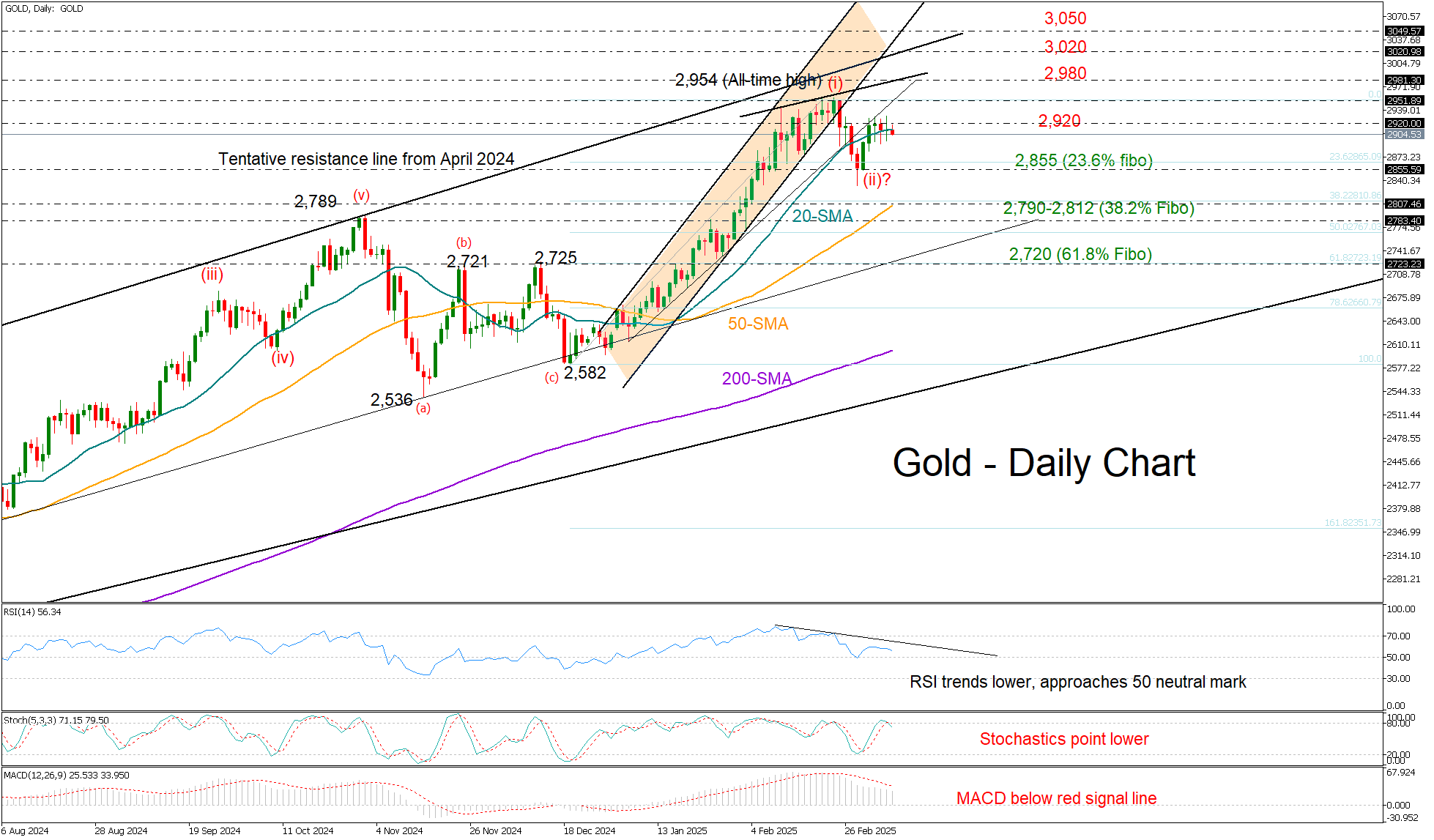
Gold maintained a muted tone around the 2,900 mark as the new week kicked off, disregarding concerns about a potential US economic slowdown. The precious metal continues to hover around its 20-day simple moving average (SMA) for the fourth-consecutive trading day, awaiting a fresh directional catalyst.

Upside momentum quickly faded after a rebound attempt at the start of the month, reinforcing fears that the decline from the all-time high of 2,954 has yet to bottom out.

With the RSI trending downwards and the stochastic oscillator on the verge of a negative crossover, optimism for a bullish continuation is dimming. If the price closes below its 20-day SMA and the 2,900 round-level, attention will shift back to the 2,855 support area. A breach of this floor could pave the way for further downside toward the 50-day SMA, aligning with the 38.2% Fibonacci retracement level of the December-February rally at 2,810. A firm drop below the October 2024 high of 2,790 could accelerate losses toward the critical support zone at 2,720.

On the flip side, if gold manages to cross above the nearby resistance of 2,920, bullish forces could initially pause near the top of 2,954 before aiming for a fresh all-time high near 2,980. Beyond that, the rally might extend toward the key trendline region of 3,025-3,050.

In summary, gold currently maintains a neutral-to-bearish stance. A decisive break above or below the 20-day SMA will likely set the stage for the next significant market move.

Author

Christina Parthenidou

Christina joined the XM investment research department in May 2017. She holds a master degree in Economics and Business from the Erasmus University Rotterdam with a specialization in International economics.


More from Christina Parthenidou
Share:

Editor's Picks

EUR/USD gathers strength above 1.1900 ahead of US January NFP data

The EUR/USD pair gains traction to near 1.1915 during the early European session on Wednesday, bolstered by a weaker US Dollar. Markets might turn cautious later in the day ahead of the delayed US employment report for January, which will offer clues on the path of Federal Reserve policy.

GBP/USD recovers losses despite rising UK political risks, BoE rate cut bets

Pound Sterling advances against the US Dollar after registering modest losses in the previous session, trading around 1.3650 during the Asian hours on Wednesday. The pair could extend losses as the Pound Sterling faces pressure from rising political risks in the UK and growing expectations of near-term Bank of England rate cuts.

Gold sticks to gains near $5,050 amid Fed-driven USD weakness; focus remains on US NFP

Gold climbs back above the $5,050 level during the Asian session on Wednesday, reversing a part of the previous day's modest losses amid dovish US Federal Reserve-inspired US Dollar weakness. This, in turn, is seen as a key factor acting as a tailwind for the non-yielding yellow metal. 

Bitcoin, Ethereum and Ripple show no sign of recovery

Bitcoin, Ethereum, and Ripple show signs of cautious stabilization on Wednesday after failing to close above their key resistance levels earlier this week. BTC trades below $69,000, while ETH and XRP also encountered rejection near major resistance levels. With no immediate bullish catalyst, the top three cryptocurrencies continue to show no clear signs of a sustained recovery.

Dollar drops and stocks rally: The week of reckoning for US economic data

Following a sizeable move lower in US technology Stocks last week, we have witnessed a meaningful recovery unfold. The USD Index is in a concerning position; the monthly price continues to hold the south channel support.

XRP holds $1.40 amid ETF inflows and stable derivatives market

Ripple trades under pressure, with immediate support at $1.40 holding at the time of writing on Tuesday. A recovery attempt from last week’s sell-off to $1.12 stalled at $1.54 on Friday, leading to limited price action between the current support and the resistance.