Gold Forecast: XAU/USD seems vulnerable as USD bulls shrug off softer US CPI
- Gold drifts lower on Friday and is weighed down by a combination of factors.
- Softer US CPI dents the precious metal’s status as a hedge against inflation.
- A modest USD strength also undermines the bullion, despite Fed rate cut bets.

Gold (XAU/USD) extends the previous day's late pullback from the vicinity of the record high and attracts some follow-through selling during the Asian session on Friday. The US Consumer Price Index (CPI) report released on Thursday pointed to cooling of inflationary pressure. This turns out to be a key factor undermining demand for the previous metal, which is seen as a hedge against rising prices. Furthermore, renewed US Dollar (USD) buying interest and a positive risk tone exert additional downward pressure on the commodity.
A delayed report published by the US Bureau of Labor Statistics on Thursday showed that the headline CPI rose by the 2.7% YoY rate in November against 3.1% expected. Moreover, the core CPI, which excludes volatile food and energy prices, also missed consensus estimates and climbed 2.6% last month. Economists, however, warned that the figures were likely distorted on the back of the longest-ever US government shutdown. This, in turn, assists the USD in attracting for the third straight day and climbs back closer to the weekly top, touched on Wednesday. A firmer Greenback tends to dent demand for USD-denominated commodities, including Gold.
Nevertheless, the crucial inflation data did little to temper expectations of further policy easing by the US Federal Reserve (Fed). Traders are still pricing in a 63 basis points (bps) of rate cuts in 2026. Adding to this, US President Donald Trump said the next Fed chair will be someone who backs sharply lower interest rates. This, in turn, could offer support to the non-yielding Gold. Meanwhile, the prospects for lower US interest rates revive investors' appetite for riskier assets. This is evident from a generally positive tone around the equity markets and offsets the supporting factor, backing the case for a further near-term depreciating move for the XAU/USD pair.
Traders now look to the US economic docket – featuring Existing Home Sales and the revised University of Michigan Consumer Sentiment Index. This, along with comments from influential FOMC members, might provide some impetus to the USD and produce short-term opportunities around the Gold. Meanwhile, the XAU/USD pair still seems poised to register modest gains for the second straight week. The fundamental backdrop, however, suggests that the path of least resistance for the bullion is to the downside and warrants caution for bullish traders, though a break and acceptance below the $4.300 mark is needed to reaffirm the negative outlook.
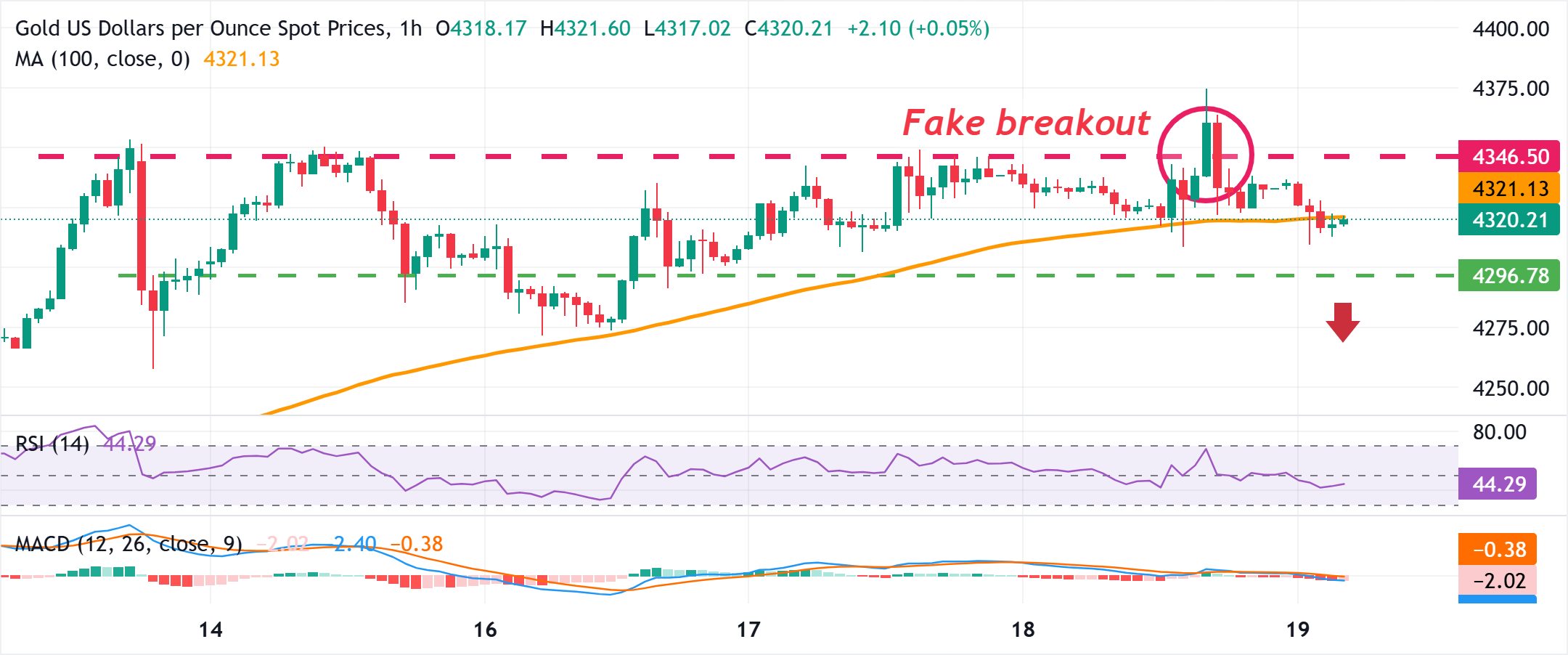
XAU/USD 1-hour chart
Technical Outlook
The overnight fake breakout through the $4,350-$4,355 supply zone and a subsequent fall below the 100-hour Simple Moving Average (SMA) on Friday favor the XAU/USD bears. However, mixed oscillators on hourly and daily charts make it prudent to wait for some follow-through selling below the $4,300 mark before positioning for deeper losses. The bullion might then fall to the $4,272-4,271 region, or the weekly low. This is followed by the $4,260-4,255 horizontal resistance breakpoint-turned-support, which, if broken, would suggest that the Gold price has topped out and expose the $4,200 round figure.
On the flip side, the $4,338-4,340 zone now seems to act as an immediate hurdle, above which the XAU/USD pair could make a fresh attempt towards challenging the all-time peak, around the $4,380 region, touched in October. Some follow-through buying, leading to a move beyond the $4,400 mark, will be seen as a fresh trigger for bullish traders and allow the Gold price to prolong its recent well-established trend from sub-$3,900 levels, or the October swing low.
Author

Haresh Menghani
FXStreet
Haresh Menghani is a detail-oriented professional with 10+ years of extensive experience in analysing the global financial markets.














