Gold drops after record rally, but is the bull market really over?


The United States economy continues to show impressive resilience. Growth remains steady, balance sheets are strong, and consumer spending has held up despite higher interest rates. The ongoing boom in artificial intelligence has only added fuel to this expansion, creating a feedback loop of optimism across equities and risk assets.
This backdrop has produced what many analysts describe as a Goldilocks scenario, an environment that is not too hot and not too cold. Inflation has cooled from its 2022 peaks, but the economy hasn’t rolled over. In these conditions, gold typically remains range bound, as investors favour growth assets over defensive ones.
However, beneath the surface, something significant has been taking shape, a structural shift in how governments, central banks, and investors view money itself. It began to unfold rapidly after the war between Russia and Ukraine, when Western sanctions included freezing Russia’s foreign reserves. That event sent a powerful message to global policymakers about the fragility of dollar-based assets. At the same time, persistent inflation and expanding government deficits were already eroding confidence in fiat currencies. Together, these forces accelerated the accumulation of gold by central banks and institutions, marking the beginning of what is now widely known as the debasement trade.
Central banks across emerging markets began diversifying away from the US dollar, increasing their gold reserves at the fastest pace in decades. They weren’t alone. Institutional investors, wealth funds, and even retail participants followed, viewing gold as a form of insurance against both inflation and geopolitical risk.
This broad wave of accumulation helped drive gold to record highs earlier this year. However, after nine consecutive winning weeks, one of the longest streaks in history, gold has now begun to cool off. The last time we saw such an extended run was in the 1970s, when the US dollar was removed from the gold standard, marking a structural turning point in the global monetary system.
The question now is whether this recent pullback marks the end of the rally or simply a pause before continuation? Let’s take a look at the technicals to see if we can find out.
Technical outlook: Structure and momentum
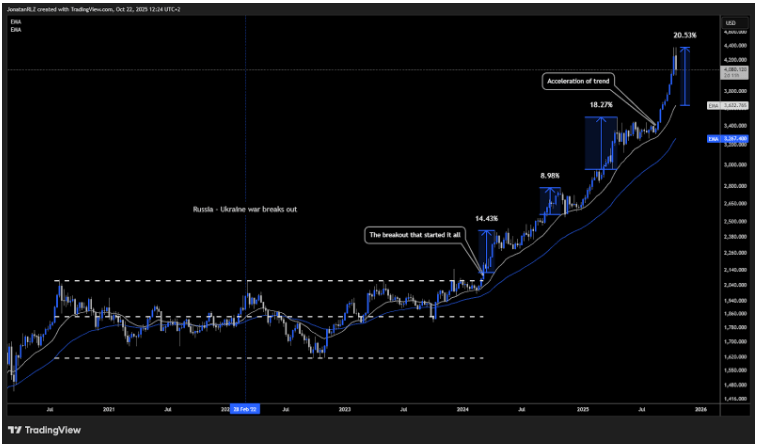
The range marked on the chart between August 2020 and the breakout in early 2024, with the Russia–Ukraine war (24 February 2022) highlighted in the middle, represents the area where many analysts believe governments and central banks were actively accumulating gold. This multi-year base has served as the foundation for the current bull market.
When gold finally broke above $2,100 in early 2024, it triggered a strong bull market that has since gained considerable momentum. In recent months, we’ve seen a clear acceleration of trend, where price extended rapidly away from its long-term mean. This latest surge produced nine consecutive winning weeks, one of the strongest streaks in decades, and is widely viewed as the final leg of the current move.
At the height of the rally, price traded more than 20% above the 20-week EMA, suggesting that the market had become overheated and due for a period of consolidation. The ongoing pullback can therefore be interpreted as a mean-reversion phase, and not necessarily the start of a broader reversal.
Fibonacci structure
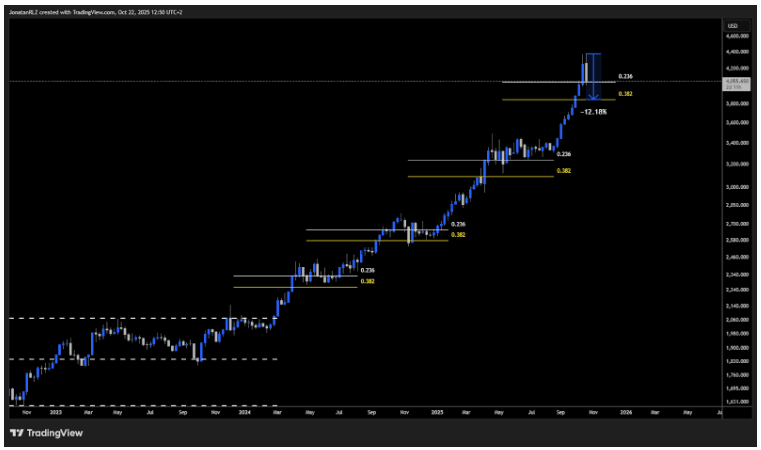
By applying the Fibonacci retracement tool to each of gold’s major impulsive moves on the weekly timeframe, we can observe a consistent pattern of shallow pullbacks throughout the current bull market. In most cases, price has not retraced beyond the 0.382 Fibonacci level, often finding support around the 0.236 zone before continuing higher.
In the ongoing move, gold is once again testing the 0.236 retracement, with the 0.382 level sitting roughly 5% below current price. A move toward this deeper level would represent an overall 12% correction from the highs, a normal and healthy reversion within the context of a long-term uptrend.
Zooming in on the current impulse
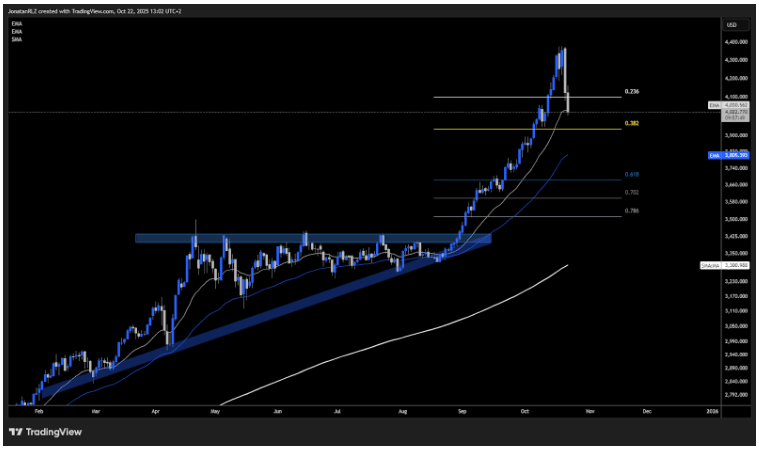
Zooming into the latest impulse move on gold’s daily chart, we can see how the current advance has become increasingly extended. One important point to remember when using Fibonacci tools is that as a trend accelerates and becomes more parabolic, the retracement and extension levels themselves stretch higher. What was once a deep correction relative to a prior move can appear increasingly shallow when momentum expands at this pace.
If the market is indeed forming a local top within this larger uptrend, a deeper retracement may be required to reset the structure. A key area to watch would be the Fibonacci reload zone, which spans between the 0.618 and 0.786 levels, with the 0.702 marking the midpoint. This midpoint currently aligns around $3,600, which, although a significant distance from current price, could serve as a long-term support zone if a major correction unfolds.
At the time of writing, gold is also testing the 20-day EMA, while approaching a lower-timeframe support area that previously acted as a base before the last leg higher. A reaction from this zone could determine whether gold stabilises for continuation or confirms a deeper retracement phase within the broader bull trend.
Four-hour structure
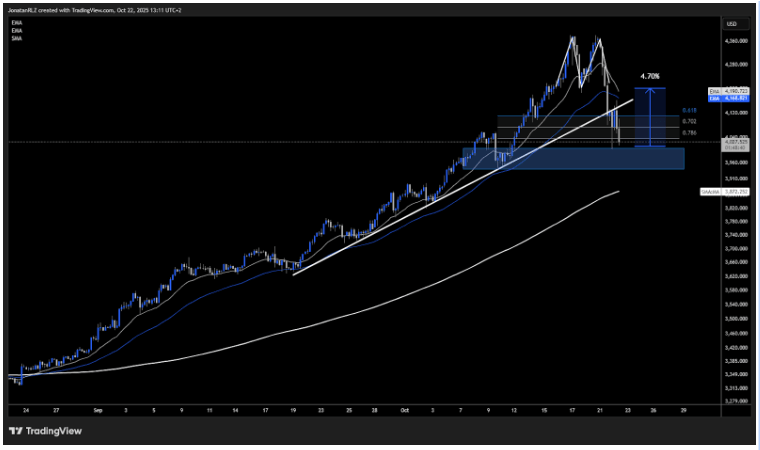
On the 4-hour chart, we can clearly see a textbook example of a break in structure. Gold first formed a double top (M-structure), followed by a decisive break to the downside. Using a measured move projection from the neckline of that double top, we can see that price completed the pattern almost perfectly, aligning with a break below a key ascending trend line.
Following that breakdown, gold retested the broken trend line from below, a bearish retest that confirmed the shift in market structure. The question now is whether price can reclaim the current reload zone it is trading within, or whether we will see further downside continuation.
If bearish momentum continues, the next key support sits around the $3,960 level, marked as the blue support zone on the chart. A deeper move could also bring gold toward the 200 simple moving average (4-hour), which at the time of writing is positioned near $3,875. This level represents a critical area to watch for potential exhaustion or a structural shift back in favour of the bulls.
Start trading with PrimeXBT
Start trading with PrimeXBT
Author
PrimeXBT Research Team
PrimeXBT
PrimeXBT is a leading Crypto and CFD broker that offers an all-in-one trading platform to buy, sell and store Cryptocurrencies and trade over 100 popular markets, including Crypto Futures, Copy Trading and CFDs on Crypto, Forex, I