German Gross Domestic Product Fourth Quarter Preview: Third time is not a recession charm
- GDP in Q4 is predicted to be unchanged on the quarter.
- Annual economic growth is predicted to decline sharply.
- Industrial production saw its worst decline in a decade in December.

The German Statistical Bureau will release its preliminary estimate for fourth quarter gross domestic product at 7:00 GMT on Friday February 14th, 2:00 EST. A revision to the figures will be issued on February 25th.
Forecast
Gross domestic product (GDP) is expected to expand 0.1% in the fourth quarter as it did in the third. Annual GDP will fall to 0.2% from 1%.
German GDP: The ides of December
The German economy which seemed headed for recovery in the third quarter became measurably worse in December raising the prospect an approaching recession.
Factory orders and industrial production fell steeply in last month of the year compounding manufacturing sentiment that has been in contraction for a year, declining exports, the unknown impacts of the corona virus in China and the trade negotiations with the UK. Germany’s export driven economy may fall into the recession it has skirted twice in the past 18 months.
The standard definition of recession is two consecutive quarters of negative GDP. German quarterly economic activity was -0.2% in the third quarter of 2018 followed by a flat reading in the final three months of the year. It was again negative in the second quarter of 2019 this time succeeded by 0.1% in the third quarter.
German GDP, M/M
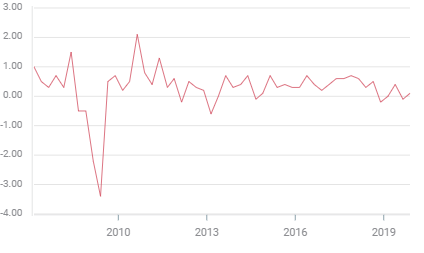
The Organization for Economic Cooperation and Development (OECD) expects Germany to expand 0.4% in 2020 and 0.9% in 2021.
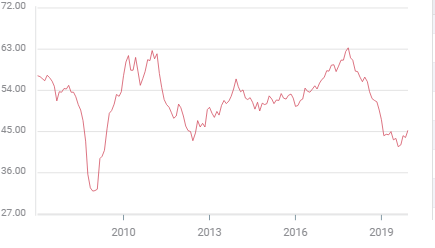
Markit Manufacturing PMI
The purchasing managers’ index in manufacturing from the London firm Markit Economics has been below the 50 expansion/contraction demarcation for 13 months, reaching a post-recession low of 41.7 last September. The rise to 45.3 in January still leaves sentiment below every score for the last decade except for four months from May to August 2012.
Markit Manufacturing PMI
FXStreet
ZEW Surveys
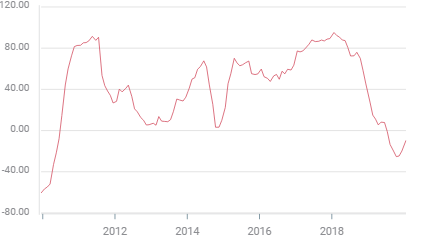
This current situation sentiment index has registered a modest improvement to 9.5 in January after the fourth quarter’s ten-year low of -25.3 in October. The economic sentiment index among investors has climbed sharply since reaching -44.1 in August an eight year low. At 26.7 in January it is about mid-point in its five year range.
ZEW Current Situation
FXStreet
Exports, imports, industrial production and factory orders
German exports rose just 0.1% in December, missing the 0.5% forecast after falling 2.2% in November. Imports dropped 0.7% in December well under their 0.2% expectation and falling 0.6% in November.
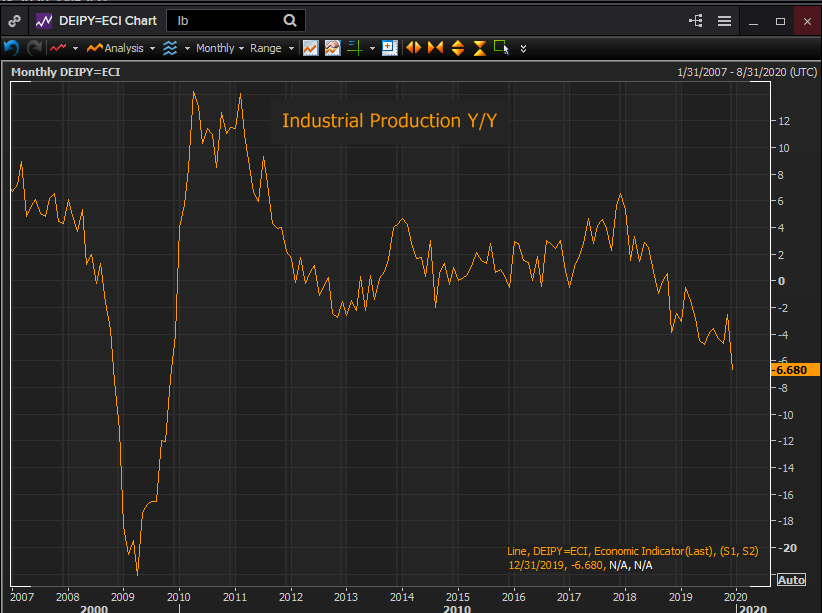
Industrial output fell 3.5% in December much steeper than the 0.2% projection and the fifth decline in the last seven months. On the year output is off 6.68% and down 13th months in a row.
Industrial Output Y/Y
Reuters
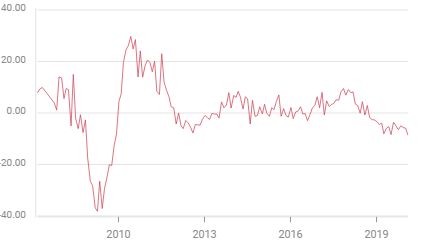
Factory orders slipped 2.1% in December on a 0.6% estimate following a 0.8% fall in November. On the year they are down 8.7%, the 17th straight negative month.
Factory Orders Y/Y
FXStreet
As negative as these four key German economic statistics were in December they record the economy before the hit to the Chinese economy and German exports from the viral crisis on the mainland. The first quarter numbers are bound to be considerably worse.
Conclusion and the euro
The dismal industrial output, export and factory orders numbers are recent and unincorporated into the survey projections for a 0.1% GDP expansion in the fourth quarter. They may be enough by themselves to drop the economy into contraction.
The rising risks to the export dominated German economy from the drag on global growth emanating from the China crisis is plain. If China buys less from the world, the world will buy less from Germany. Domestic consumption in Germany cannot replace declining exports.
Christine Lagarde, the head of the ECB, and other European policy makers in recent months have asked the German government to spend more on infrastructure and other stimulus measures. Thus far Berlin, committed to its so-called “schwarze null” or “black zero” law has refused. The statue effectively prohibits the government from assuming any new debt. It remains to be seen whether the threats from China will change Angela Merkel’s mind.
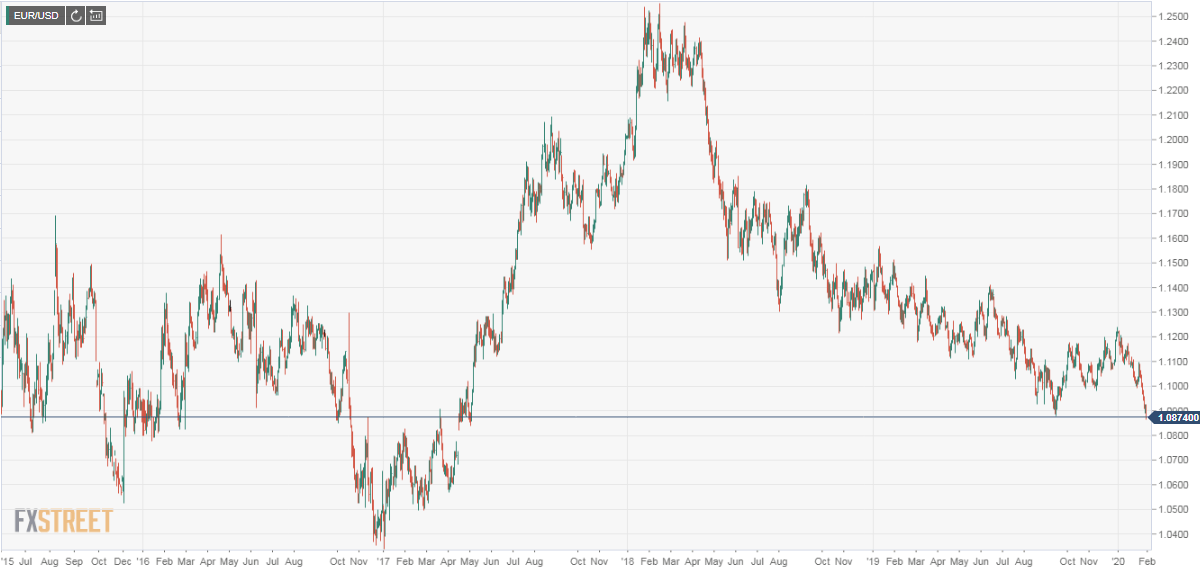
Germany is the largest and most dynamic economy in the euro zone. Its fate is the fate of the euro. If GDP does not meet its 0.1% forecast, the euro, already at a 33 month low against the dollar at 1.0874 on Wednesday afternoon will almost certainly fall further.
Author

Joseph Trevisani
FXStreet
Joseph Trevisani began his thirty-year career in the financial markets at Credit Suisse in New York and Singapore where he worked for 12 years as an interbank currency trader and trading desk manager.