GBP/USD Weekly Forecast: Recovery fades ahead of key inflation data
- The GBP/USD pair pared back half of its gains from last week, creating a mixed risk outlook.
- The US Dollar regained some strength after experiencing a significant decline last week.
- US economic fundamentals continue to support the US Dollar; next week, UK and US inflation data will be critical.

The GBP/USD pair dropped gradually throughout the week, primarily driven by a stronger US Dollar and on the back of subdued UK data and dovish comments from Bank of England (BoE) policymakers. The pair retreated from one-month highs above 1.2400 and settled around 1.2200. With fundamentals favoring the Dollar, any upside momentum in the pair is susceptible to significant corrections. Next week, important economic data will be released, including US and UK Consumer Price Index (CPI) for October. Inflation data will impact monetary policy expectations from the Federal Reserve (Fed) and the Bank of England.
UK economy narrowly avoids contraction, US activity remains robust
The United Kingdom's Office for National Statistics (ONS) reported on Friday that Gross Domestic Product (GDP) remained unchanged in the three months leading up to the end of September compared to the second quarter, surpassing expectations of a 0.1% contraction. However, it marks the worst quarter since Q3 2022.
The positive news came from the monthly reading, which showed an expansion of 0.2% in September, against expectations of a 0.1% contraction. Despite being above expectations, the economy is broadly stagnating and there is a risk of falling into a recession. During the week, the Bank of England's (BoE) Chief Economist, Huw Pill, surprised the market by stating that expectations of interest rate cuts by mid-2024 were not entirely unreasonable. These dovish remarks weighed on the Pound.
On the contrary, the US Dollar received support from Federal Reserve Chairman Jerome Powell, who spoke about inflation “head fakes” and the FOMC not being confident that they have achieved a sufficiently restrictive monetary policy stance. These comments fueled the Dollar’s recovery after last week’s slump.
After growing at an annualized rate of nearly 5% during the third quarter, the US economy is now expanding at around 2%, according to some models. This indicates that the US economy remains firm, outperforming the UK and the Eurozone. In a relatively quiet week for economic data, Continuing Jobless Claims rose for the seventh week in a row, to the highest level since mid-April, providing evidence of a softening labor market.
Attention on inflation data, employment, and the Treasury market
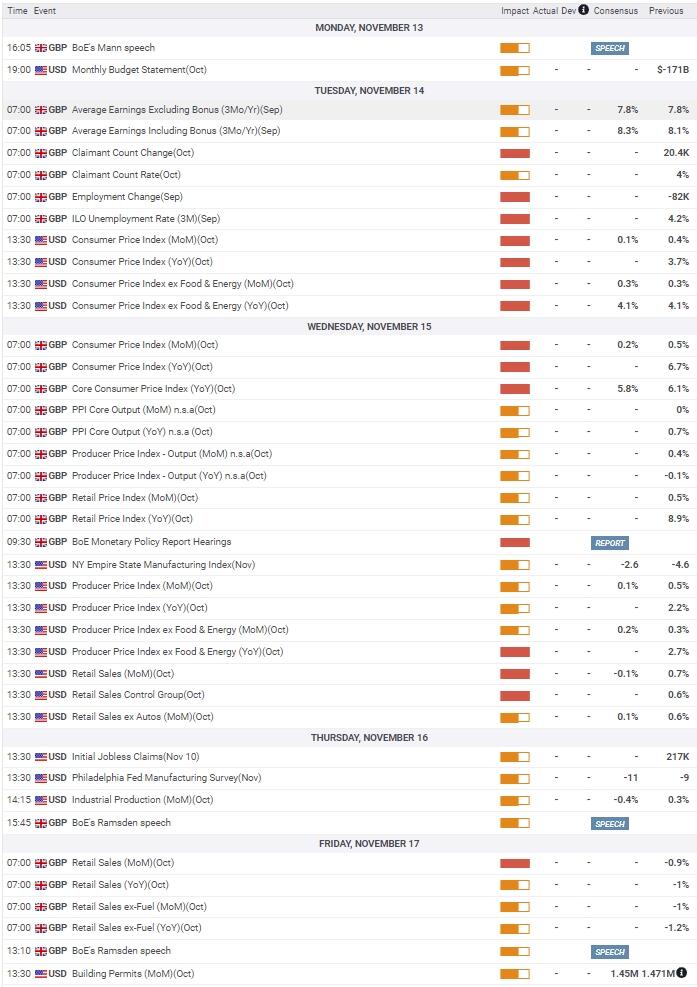
The UK economy faces growing challenges as it stagnates. On Tuesday, labor market data is due, and analysts will closely examine Average Earnings and changes in employment. The Pound needs optimistic data.
A critical report for the Pound is scheduled for Wednesday, with the release of the Consumer Price Index (CPI) for October. It is expected to show further moderation in inflation but still above the target. The CPI is projected to rise by 0.2% on a monthly basis. The annual rate of Core CPI is expected to decline from 6.1% to 5.8%. Evidence of inflation decelerating could put downward pressure on the Pound, but it would be welcomed by the Bank of England and the economy. This could mitigate all the negative momentum for the currency. Inflation and employment are decisive for the monetary policy stance.
More relevant UK data is due on Friday with Retail Sales. Bank of England policymaker Catherine Mann will speak on Monday, followed by Randall Kroszner and Dave Ramsden on Thursday. Reports suggest a UK cabinet shuffle could be seen as soon as next week, but this wouldn’t involve the economy team.
The Treasury market continued to offer volatile moves, affecting the US Dollar. US yields appeared ready to decline, but the bond rally seems to be over following a weak 30-year auction on Thursday and remarks from Fed Powell. If yields resume their upside and reach new highs, it could weigh on Wall Street, boost the US Dollar, and create concerns among investors.
Next Tuesday, the US will release the October Consumer Price Index (CPI) report, which will be more than important in the current environment. With the US economy showing resilience, a reading that offers evidence of inflation warming up could lead to a more serious consideration of another rate hike from the Fed. Conversely, a significant slowdown, particularly in the Core rate, expected to remain at 4.1% YoY, would support the current market narrative that the Fed is done with rate hikes.
On Wednesday, more inflation data is due with the Producer Price Index (PPI). That day, the Retail Sales report is also due. With personal consumption being a significant contributor to Q3 GDP growth, those figures will be important ahead of the holiday season. A 0.1% decline is expected after a surge of 0.7% in September.
The weekly Jobless Claims report on Thursday will be closely watched. The uptrend in Continuing Claims, which reached the highest level since mid-April in the week ended October 28, is a sign of softening in the labor market.
The combination of central banks pausing their rate hike cycle, taking a "data-dependent" stance, and upcoming inflation figures from the UK and the US next week could have a significant impact on the pair. Geopolitics and politics will also play their role.
GBP/USD: Technical outlook
After rising last week, the GBP/USD pair gradually fell, settling dangerously above 1.2200 and the 20-day Simple Moving Average (SMA). After declining for five days, a rebound is possible. However, it is imperative for the price to remain above 1.2200. A decline below that level could quickly take the pair toward 1.2100.
On the weekly chart, the GBP/USD encountered resistance at the 100-week SMA and retraced. The price remains below the 20-week SMA. The bias in the chart is downward, although that would change in the unlikely scenario of a weekly close above 1.2510. A close below 1.2100 would suggest further losses ahead.
-638352270112422566.png)
GBP/USD: Forecast poll
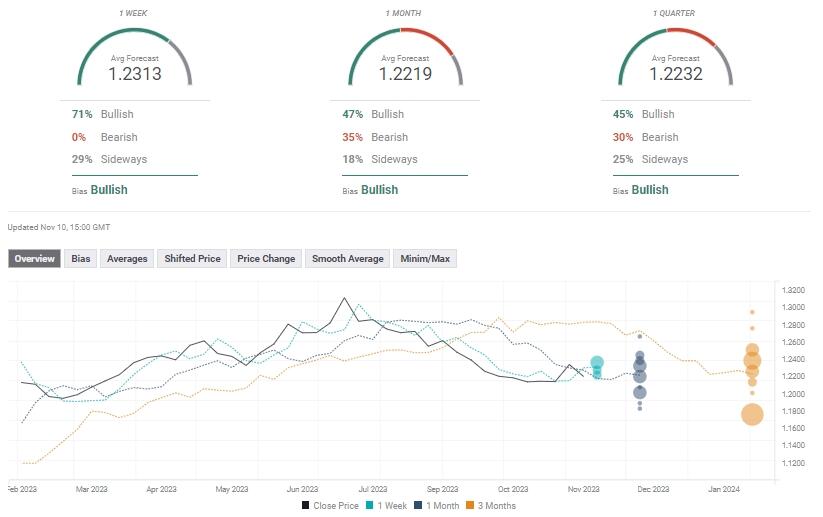
The FXStreet Forecast Poll suggests that experts anticipate the GBP/USD pair will continue to trade around current levels. For the next week, most of them see a recovery, with the average around 1.2310. However, the recovery is not expected to gather momentum, with predictions indicating that the pair may move to near 1.2220 within one month. Looking ahead to the next quarter, the average is at 1.2230.
Author

Matías Salord
FXStreet
Matías started in financial markets in 2008, after graduating in Economics. He was trained in chart analysis and then became an educator. He also studied Journalism. He started writing analyses for specialized websites before joining FXStreet.















