GBP/USD Weekly Forecast: Next on the upside emerges the 2022 peaks
- The Pound Sterling extends its march north past 1.3500 vs. the US Dollar.
- GBP/USD navigates its fourth consecutive month of gains.
- UK inflation rose more than expected in April, lifting eyebrows at the BoE.

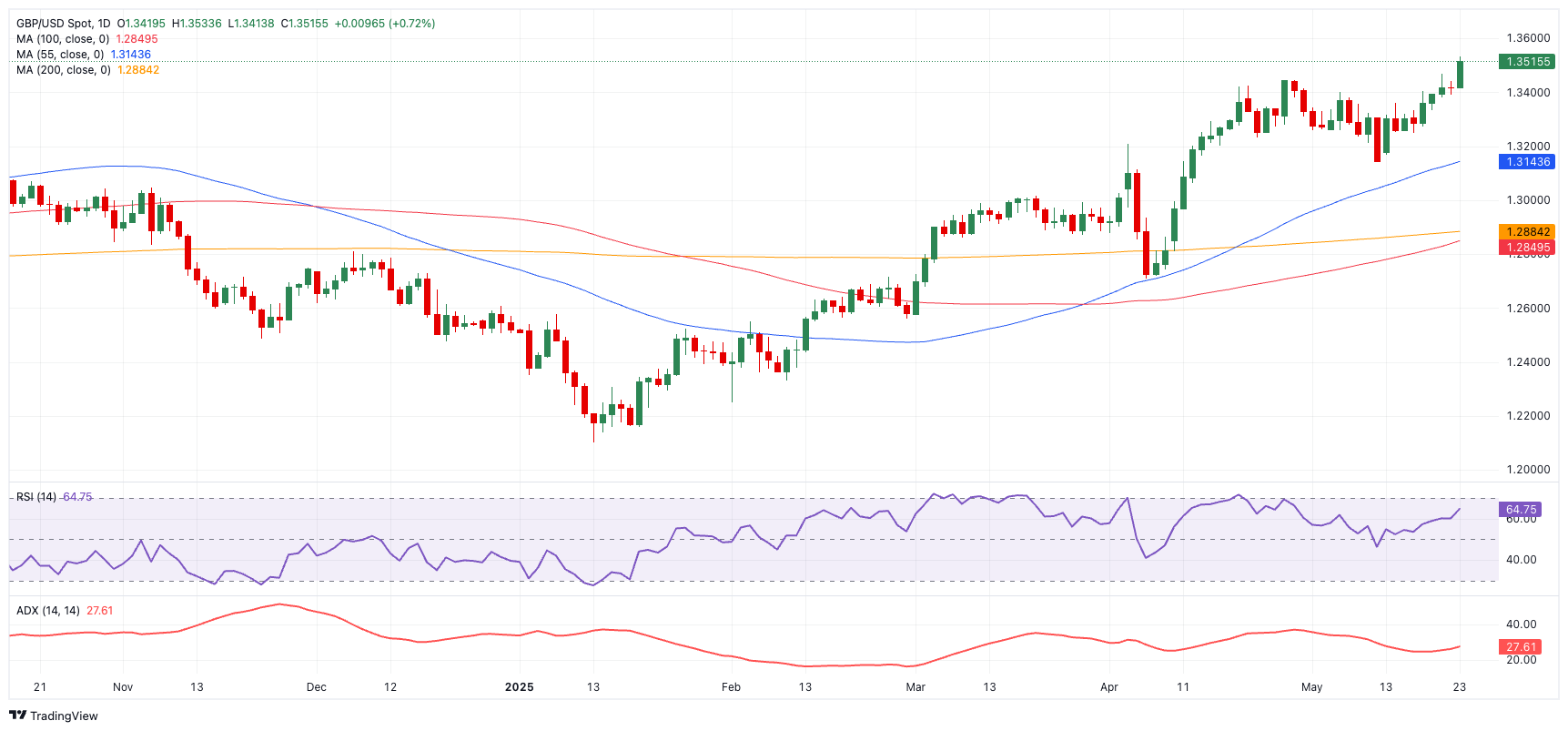
The British Pound held a firm tone throughout the week, pushing GBP/USD beyond the 1.3500 mark on Friday, territory last seen in late February 2022.
Sterling’s advance was driven largely by sustained pressure on the US Dollar (USD), which accelerated in the latter part of the week following President Donald Trump’s threat to impose 50% tariffs on European Union (EU) imports.
Adding to the bullish backdrop, UK 10-year gilt yields climbed to multi-week highs above 4.80% earlier in the week, though they later gave back some of those gains.
Data seems to underpin a BoE pause
Auspicious results from UK fundamentals highlighted the positive momentum the domestic economy appears to have walked into, at the same time prompting the “Old Lady” to maintain a prudent stance when it comes to deciding on future policy rates moves.
On the above, preliminary UK GDP figures surprised to the upside after showing the economy is expected to have expanded 0.7% QoQ in the January-March period, and 1.3% over the last 12 months.
Regarding the UK labour market, despite the jobless rate ticking higher by 0.1% in March, Average Earnings including Bonus, a proxy for inflation, rose more than expected, while the Claimant Count Change rose to just above 5K individuals.
In addition, UK inflation data was a big surprise this week, after the Consumer Price Index (CPI) rose more than initially estimated in April. While headline inflation gained 3.5% from a year earlier, core inflation advanced 3.8% on a yearly basis.
Following the data release, interest rate futures indicated that investors were pricing in roughly 37 basis points of rate cuts by the BoE by the end of 2025.
Tariff relief propped up the British Pound
There were a couple of news stories that have shaken the trade front in the past few weeks. Indeed, the White House announced a trade truce with China while announcing a trade agreement with the United Kingdom (UK).
The newly announced US-UK trade deal saw Britain remove its 20% retaliatory tariff on US beef, starting May 8, 2025, and introduce new tariff-free quotas for American beef and 1.4 billion litres of US ethanol. In return, the US has agreed to allow up to 100K UK-made vehicles to enter the US at a reduced 10% tariff.
The deal also sets the stage for further negotiations on quotas for UK steel and aluminium exports, while discussions will continue on broader issues including rules of origin, pharmaceuticals, digital trade, financial services and agriculture.
MPC does look cautious
So far this week, Chief Economist Huw Pill said that he believed a quarterly pace of interest rate cuts would have been too rapid given the current inflation outlook. However, he suggested that his decision earlier this month to vote for holding rates steady was likely to be just “a skip” rather than a change in direction.
What’s next on the UK docket
A light UK calendar next week should prompt investors to steer away from the domestic calendar and closely follow developments on the trade front as well as US Dollar dynamics.
GBP/USD: Technical landscape
Pablo Piovano, Senior Analyst at FX Street, notes: “If bullish momentum gathers pace, GBP/USD could attempt to revisit the 2025 high at 1.3533 (May 23). Beyond that, Cable may target the February 2022 top at 1.3643 (February 10), ahead of the 2022 peak at 1.3748 (January 13).”
Piovano added that initial support is seen at the May low of 1.3139 (May 12), which appears reinforced by the provisional 55-day SMA at 1.3140. A more substantial retreat could bring the key 200-day SMA at 1.2882 into play.
Momentum indicators seem to suggest that further gains should appear in the pipeline: The Relative Strength Index (RSI) rose past the 64 level, while the Average Directional Index (ADX) at nearly 28 indicates a moderately strong trend, Piovano concludes.
Pound Sterling FAQs
The Pound Sterling (GBP) is the oldest currency in the world (886 AD) and the official currency of the United Kingdom. It is the fourth most traded unit for foreign exchange (FX) in the world, accounting for 12% of all transactions, averaging $630 billion a day, according to 2022 data. Its key trading pairs are GBP/USD, also known as ‘Cable’, which accounts for 11% of FX, GBP/JPY, or the ‘Dragon’ as it is known by traders (3%), and EUR/GBP (2%). The Pound Sterling is issued by the Bank of England (BoE).
The single most important factor influencing the value of the Pound Sterling is monetary policy decided by the Bank of England. The BoE bases its decisions on whether it has achieved its primary goal of “price stability” – a steady inflation rate of around 2%. Its primary tool for achieving this is the adjustment of interest rates. When inflation is too high, the BoE will try to rein it in by raising interest rates, making it more expensive for people and businesses to access credit. This is generally positive for GBP, as higher interest rates make the UK a more attractive place for global investors to park their money. When inflation falls too low it is a sign economic growth is slowing. In this scenario, the BoE will consider lowering interest rates to cheapen credit so businesses will borrow more to invest in growth-generating projects.
Data releases gauge the health of the economy and can impact the value of the Pound Sterling. Indicators such as GDP, Manufacturing and Services PMIs, and employment can all influence the direction of the GBP. A strong economy is good for Sterling. Not only does it attract more foreign investment but it may encourage the BoE to put up interest rates, which will directly strengthen GBP. Otherwise, if economic data is weak, the Pound Sterling is likely to fall.
Another significant data release for the Pound Sterling is the Trade Balance. This indicator measures the difference between what a country earns from its exports and what it spends on imports over a given period. If a country produces highly sought-after exports, its currency will benefit purely from the extra demand created from foreign buyers seeking to purchase these goods. Therefore, a positive net Trade Balance strengthens a currency and vice versa for a negative balance.
Author

Pablo Piovano
FXStreet
Born and bred in Argentina, Pablo has been carrying on with his passion for FX markets and trading since his first college years.