|

GBP/USD turns sideways as 20-SMA blocks advances

  • GBP/USD faces tough resistance around 20-SMA and 61.8% Fibonacci.

  • Positive momentum appears to be waning.

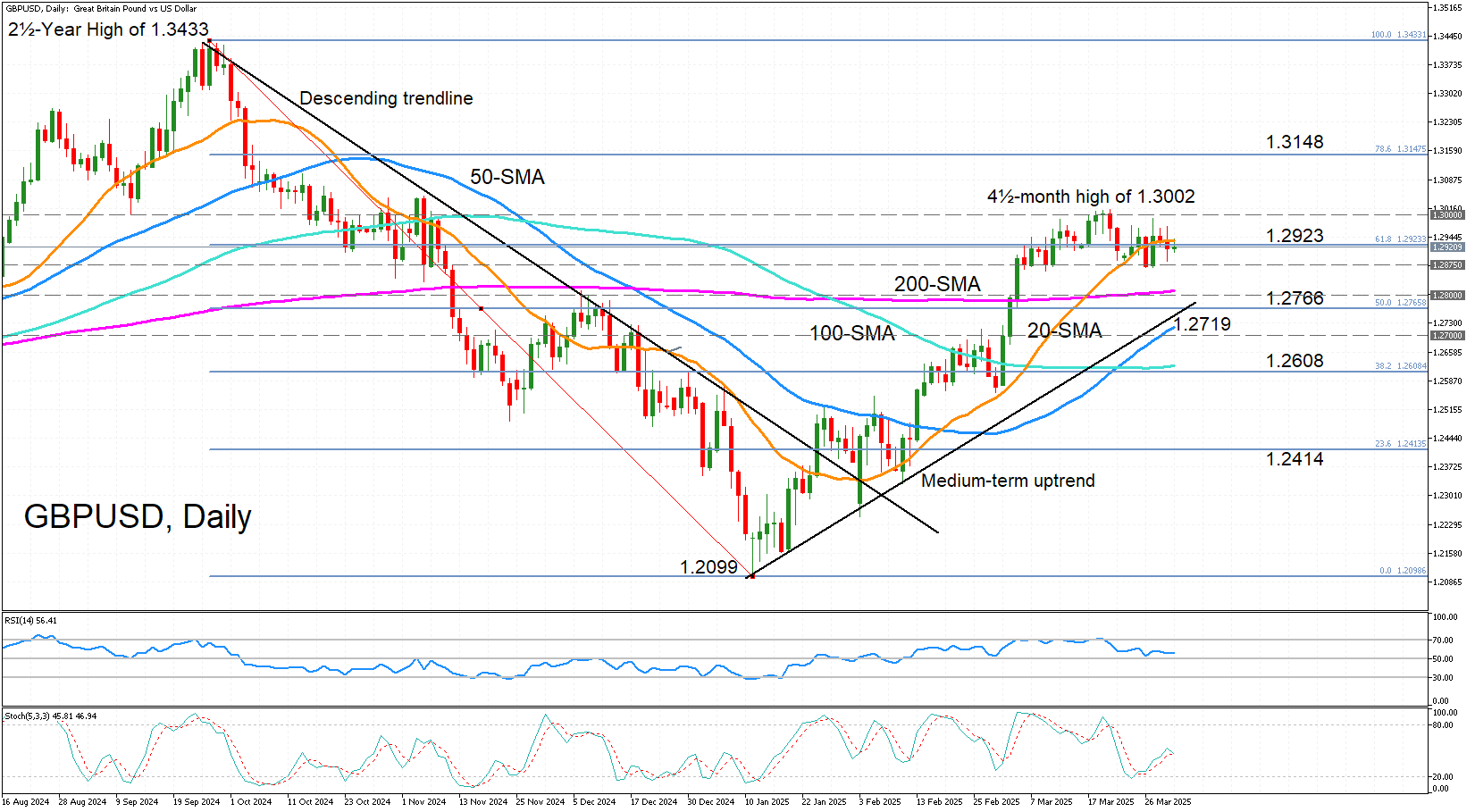
GBPUSD continues to consolidate after the rebound from the January low of 1.2099 ran out of steam around the 1.3000 area in mid-March. Uncertainty surrounding Trump’s tariffs is likely making it difficult for the bulls to charge ahead with confidence even as the recent UK economic data have been satisfactory.

Following the pullback, the 20-day simple moving average (SMA) initially acted as support but has now risen above the price action to cap any gains. Slightly beneath it is the 61.8% Fibonacci retracement of the September 2024-January 2025 downleg at 1.2923 and together with the 1.2875 level, they are acting as a strong support base for the pair.

The momentum indicators suggest a neutral bias in the near term, as the RSI has flatlined slightly above the 50 mark and the stochastics lack direction too.

Should GBPUSD slip below 1.2875, there’s likely to be further support just above the 1.2800 level where the 200-day SMA is slowly ascending. The 50% Fibonacci stands ready to halt steeper declines at 1.2766, while the 50-day SMA is another challenge for the bears at 1.2719. Even lower, the 100-day SMA is forming a tough support barrier together with the 38.2% Fibonacci just above 1.2600.

If, however, the bullish forces re-energize and manage to push the price above the 20-day SMA, and more importantly, above the crucial 1.3000 resistance, GBPUSD might be able to rally all the way until the 78.6% Fibonacci of 1.3148 before targeting the September 2024 peak of 1.3433, which was a two-and-a-half-year high.

All in all, GBPUSD looks set to consolidate for a while longer, but a drop below 1.2875 would increase the downside risks, endangering the medium-term uptrend, while a climb above 1.3000 would reinforce it.
Chart

Author

Raffi Boyadjian

Mr Boyadjian graduated from the London School of Economics in 1999 with a BSc in Business Mathematics and Statistics. Following graduation, he joined PricewaterhouseCoopers in the Business Recoveries team, where he was responsibl

More from Raffi Boyadjian
Share:

Markets move fast. We move first.

Orange Juice Newsletter brings you expert driven insights - not headlines. Every day on your inbox.

By subscribing you agree to our Terms and conditions.

Editor's Picks

EUR/USD recovers to 1.1750 region as 2025 draws to a close

Following the bearish action seen in the European session on Wednesday, EUR/USD regains its traction and recovery to the 1.1750 region. Nevertheless, the pair's volatility remains low as trading conditions thin out on the last day of the year.

GBP/USD stays weak near 1.3450 on modest USD recovery

GBP/USD remains under modest beairsh pressure and fluctuates at around 1.3450 on Wednesday. The US Dollar finds fresh demand due to the end-of-the-year position adjustments, weighing on the pair amid the pre-New Year trading lull. 

Gold retreats to $4,300 area, looks to post monthly gains

Gold stays on the back foot on the last day of 2025 and trades near $4,300, possibly pressured by profit-taking and position adjustments. Nevertheless, XAU/USD remains on track to post gains for December and extend its winning streak into a fifth consecutive month.

Bitcoin, Ethereum and XRP prepare for a potential New Year rebound

Bitcoin, Ethereum, and Ripple are holding steady on Wednesday after recording minor gains on the previous day. Technically, Bitcoin could extend gains within a triangle pattern while Ethereum and Ripple face critical overhead resistance. 

Economic outlook 2026-2027 in advanced countries: Solidity test

After a year marked by global economic resilience and ending on a note of optimism, 2026 looks promising and could be a year of solid economic performance. In our baseline scenario, we expect most of the supportive factors at work in 2025 to continue to play a role in 2026.

Crypto market outlook for 2026

Year 2025 was volatile, as crypto often is.  Among positive catalysts were favourable regulatory changes in the U.S., rise of Digital Asset Treasuries (DAT), adoption of AI and tokenization of Real-World-Assets (RWA).
















