GBP/USD Price Forecast: Bears opt to lighten their bets ahead of BoE rate decision
- GBP/USD recovers further from a multi-month low amid some repositioning ahead of the BoE.
- The USD drifts lower amid economic concerns and contributes to the ongoing recovery move.
- The UK’s fiscal concerns and rising BoE rate cut bets might keep a lid on any further appreciation.

The GBP/USD pair trades with a positive bias for the second straight day on Thursday and looks to build on the previous day's bounce from the vicinity of the 1.3000 psychological mark, or a nearly seven-month low amid a softer US Dollar (USD). Spot prices, however, lack follow-through buying as traders refrain from placing aggressive directional bets ahead of the crucial Bank of England (BoE) policy update.
The UK central bank is expected to hold its key interest rate unchanged at 4.0%, though analysts are not ruling out the possibility of a surprise cut as softer inflation and fiscal headwinds back the case for more easing. Furthermore, emerging signs of a slack in the UK labour market lifted bets for a 25-basis-point (bps) rate cut sooner rather than later. This, along with concerns about the UK's fiscal situation, is holding back traders from placing aggressive bullish bets around the British Pound (GBP) and acting as a headwind for the GBP/USD pair.
In fact, the Office for Budget Responsibility (OBR) is expected to lower its UK productivity forecast by approximately 0.3%, which could exacerbate the budget deficit by over £20 billion by 2030. Current UK government finances already reflect a £22 billion shortfall, putting pressure on Chancellor Rachel Reeves to increase taxes or borrow more in the November budget. Apart from this, the underlying USD bullish sentiment contributes to capping the GBP/USD pair, warranting caution for bulls heading into the key central bank event risk.
The USD Index (DXY), which tracks the Greenback against a basket of currencies, advanced to its highest level since late May on Wednesday following the release of the better-than-expected US macro data. Automatic Data Processing reported that private sector employment in the US rose by 42K in October compared to the 25K estimated and a 29K decrease recorded in the previous month. Separately, the Institute for Supply Management's (ISM) Non-Manufacturing Purchasing Managers' Index climbed to an eight-month high of 52.4 in October.
This comes on top of the US Federal Reserve's (Fed) hawkish tilt and suggests that the path of least resistance for the USD is to the upside. However, concerns about the potential economic fallout from a prolonged US government shutdown, which has entered its sixth week with no resolution in sight, seem to weigh on the buck. Nevertheless, the broader fundamental backdrop seems tilted in favor of the USD bulls, suggesting that a subsequent move up in the GBP/USD pair is more likely to be sold into and remain capped.
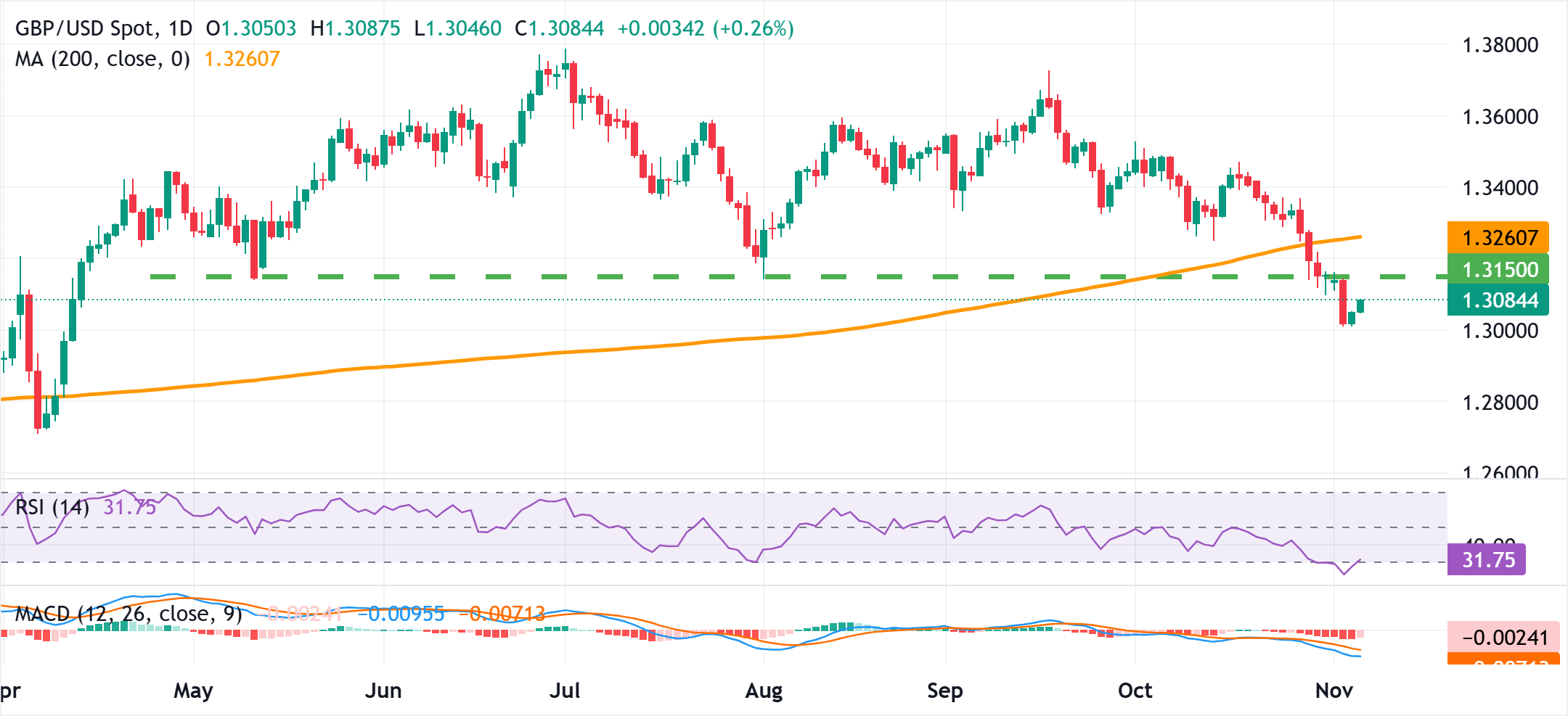
GBP/USD daily chart
Technical Outlook
A slightly overbought daily Relative Strength Index (RSI) is seen as a key factor prompting some short-covering around the GBP/USD pair for the second straight day. However, the recent breakdown below a technically significant 200-day Simple Moving Average (SMA) and the 1.3140 horizontal support favor bearish traders. The said area is more likely to cap any subsequent move up beyond the 1.3100 round figure. Some follow-through buying, however, could allow spot prices to surpass the 1.3200 mark and climb to the 1.3260 area, or the 200-day SMA.
On the flip side, the 1.3000 psychological mark, or a multi-month low, set this week, might continue to protect the immediate downside. A convincing break below will be seen as a fresh trigger for bearish traders and pave the way for a further near-term depreciating move. The GBP/USD pair might then fall to the 1.2940 intermediate support en route to the 1.2900 mark before eventually dropping to the next relevant support near the 1.2875-1.2870 region.
Author

Haresh Menghani
FXStreet
Haresh Menghani is a detail-oriented professional with 10+ years of extensive experience in analysing the global financial markets.