GBP/USD presses resistance as Dollar softens into data-heavy week

Market overview
Sterling starts September with a modest bid while the dollar eases, as traders look past the U.S. Labor Day lull to a run of American manufacturing readings and broader labor-market updates later in the week. A fresh dip in the greenback reflects elevated odds of a September Fed cut, with markets watching ISM manufacturing and employment components for confirmation. In the UK, house prices slowed on the month but still rose 2.1% on the year, leaving the pound broadly steady into today’s manufacturing PMI update.
Technical analysis
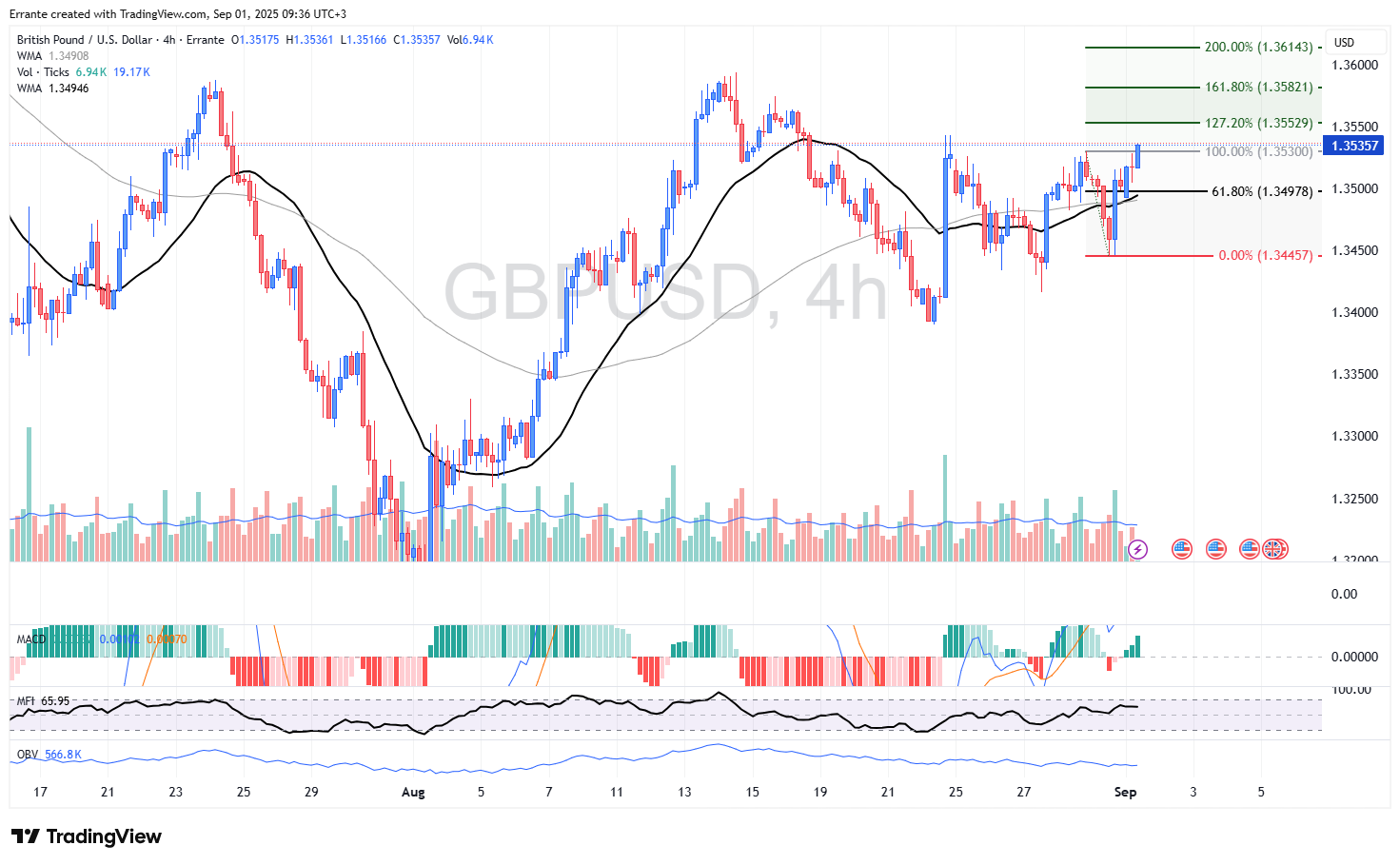
On the 4-hour chart, GBP/USD is probing the late-August swing high near 1.3530. Price trades above both the short and medium weighted moving averages (around 1.3491–1.3495), and the prior pullback held at the 61.8% retracement near 1.3498—keeping the short-term up-sequence intact.
If buyers break and close above 1.3530/1.3540, continuation targets sit at 1.3553 (127.2% extension), 1.3582 (161.8%), and 1.3614 (200%). The structure favors upside as long as pullbacks hold above the 1.3490s WMA cluster.
Oscillators and momentum read
MACD remains north of zero with a gently rising histogram, signaling constructive momentum rather than exhaustion. Money Flow Index hovers in the mid-60s, pointing to steady accumulation without overbought stress. On-balance volume has stabilized after last week’s expansion, consistent with dip-buying rather than distribution. The combination of higher lows in price and firming momentum argues that a topside break is the path of least resistance—provided 1.3536 yields.
Key levels
-
Supports: 1.3498 (61.8% of the latest swing), 1.3470, 1.3446 (0% base of the move).
-
Resistances: 1.3536/1.3540 (recent high/100% projection), 1.3553, 1.3582, 1.3614 (extension targets).
Alternative scenario (lower probability)
If sellers reject 1.3530 and force a close back below 1.3498, momentum would likely rotate lower toward 1.3470 and 1.3446. A daily close under 1.3446 would negate the immediate bullish sequence and re-open the wider August range to the downside.
Fundamental outlook
The calendar sets a clear narrative for GBP/USD. In the UK, Nationwide’s August house-price update showed a minor monthly slip (-0.1% m/m) but a still-positive 2.1% y/y—consistent with a market stabilizing at higher mortgage-rate levels.
The S&P Global Manufacturing PMI is due to hold near 47.3, keeping the sector in contraction but unlikely to be a major sterling driver on its own.
In the United States, the focus is squarely on manufacturing: the final S&P Global PMI sits at a two-year high of 53.3 and the ISM gauge is expected to improve to 48.9, with the prices-paid index watched closely for inflation stickiness and the employment sub-index as an early read into labor conditions.
Construction spending and the Atlanta Fed’s GDPNow (3.5% latest estimate) frame a picture of moderate activity. For GBP/USD, softer dollar tone tied to increased Fed-cut expectations supports the topside break case; however, a firmer ISM—especially if prices-paid stay hot or employment rebounds—could revive the dollar bid and cap gains near resistance.
Summary
Bias is modestly higher: if buyers clear 1.3536/1.3540, the technical roadmap points toward 1.3553, 1.3582, and 1.3614. The key macro swing factor is Tuesday’s U.S. manufacturing data; confirmation of cooling momentum would keep the dollar on the back foot and favor sterling’s breakout, while upside surprises—particularly in ISM prices or jobs—risk a fade back toward 1.3498.
Author

Ali Mortazavi
Errante
BEc, CMSA, Member of IFTA - International Federation of Technical Analysis, Associate Member of STA - Society of Technical Analysis (UK).