GBP/USD in the red for six weeks
-
GBP/USD hits a new two-month low as Trump wins White House.
-
Short-term outlook remains bearish; focus on 200-SMA for potential support.
-
Bank of England, Fed announce their rate decisions today.

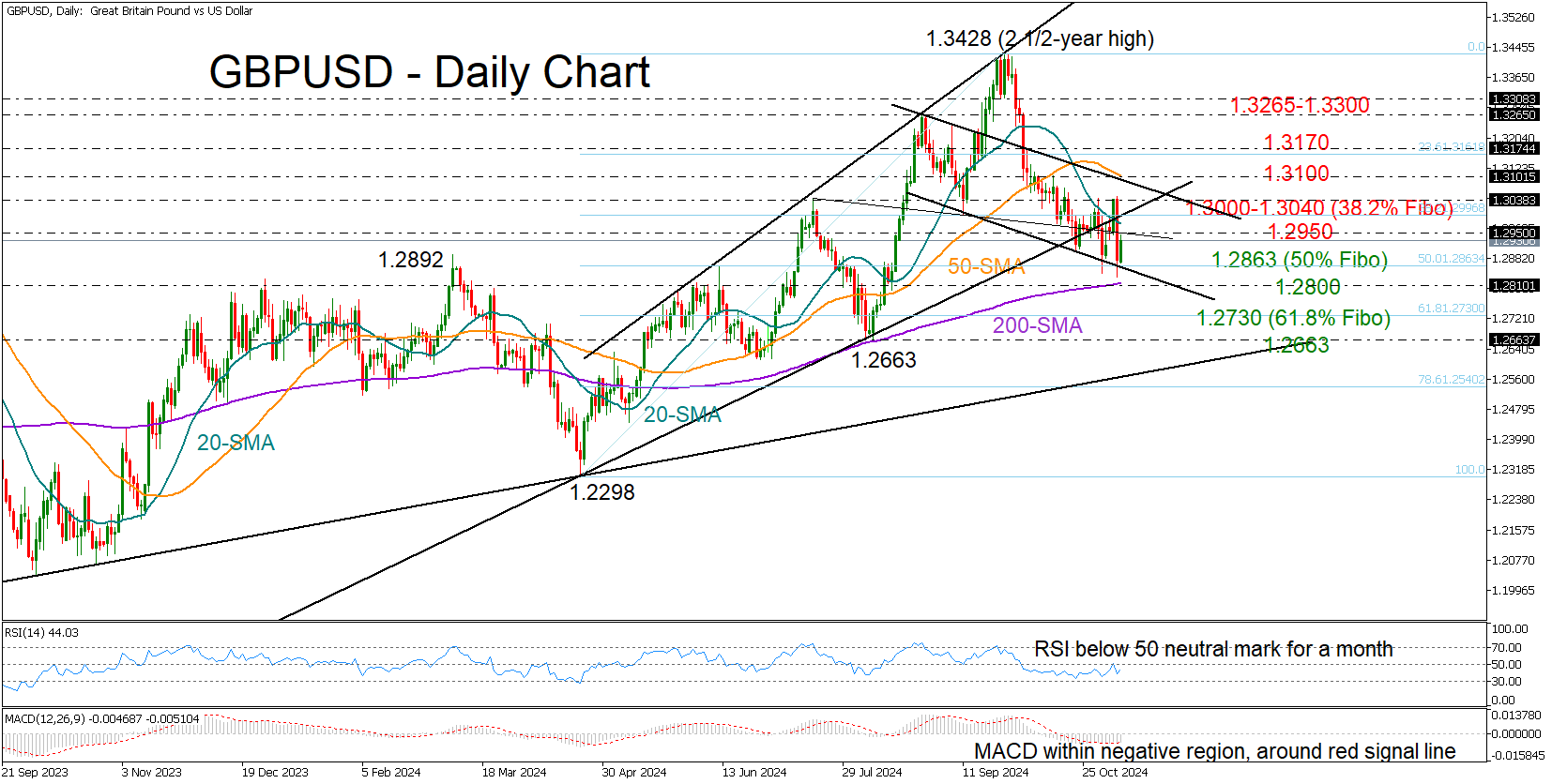
GBPUSD took a sharp dive to a two-month low of 1.2833 on Tuesday as the return of Trumponomics gave fresh impetus to the greenback.
On Wednesday, the 50% Fibonacci retracement level of the April-September rally came to support the market ahead of the BoE and Fed rate decisions, but with the price failing to hold above the ascending trendline from September 2022 and struggling to push past 1.3000 in recent days, the downside risks remain in play.
That said, the 200-day simple moving average (SMA), which triggered the rally to a 2½-year high of 1.3428 in August, is at a short distance near 1.2800. This could act as a potential rebound point if the bulls can manage a reversal. Plus, with the RSI and MACD staying in bearish territory for over a month, some traders might feel that the recent downfall has been overdone.
For the bulls to gain some power, they will initially need to clear the 1.2950 zone and then take out the 1.3000-1.3040 range. If that happens, the 50-day SMA near 1.3100 could be the next hurdle. Breaking above 1.3100 would violate the current bearish trend and set up a move toward 1.3265, unless resistance around 1.3170 holds things back.
On the flip side, if the price falls below the 1.2800 area, support could come in around the 61.8% Fibonacci level of 1.2730, or near the August low at 1.2663. A deeper decline could find support around 1.2565.
To sum up, GBPUSD remains in a bearish trend in the short-term picture, with the 200-day SMA at 1.2800 marking a key level to watch. For a potential shift to the upside, the pair needs to push past 1.3100 and hold above it. Otherwise, further downside could be in the cards.
Author

Christina joined the XM investment research department in May 2017. She holds a master degree in Economics and Business from the Erasmus University Rotterdam with a specialization in International economics.