GBP/USD Forecast: Pound Sterling faces extended correction below 1.2400
- GBP/USD has been struggling to find direction since late last week.
- 1.2400 aligns as key near-term support for the pair.
- March inflation data from the US will be the next catalyst for GBP/USD.

After having closed in negative territory on Friday, GBP/USD has managed to stage a rebound early Monday. The pair seems to have stabilized above 1.2400 on Easter Monday but it is likely to fluctuate in a tight range amid subdued market action.
The US Bureau of Labor Statistics reported on Friday that Nonfarm Payrolls (NFP) in the US increased by 236,000 in March, compared to the market estimate of 240,000. The Unemployment Rate declined to 3.5% from 3.6% and the Labor Force Participation Rate edged higher to 62.6% from 62.5%. Furthermore, annual wage inflation, as measured by the Average Hourly Earnings, fell to 4.2% from 4.6%.
The immediate market reaction to the US jobs report triggered a rebound in the US Treasury bond yields and provided a boost to the US Dollar, forcing GBP/USD to stretch lower ahead of the weekend.
According to the CME Group FedWatch Tool, markets are currently pricing in a 60% probability of the US Federal Reserve hiking its policy rate by 25 basis points at the next policy meeting, down from 71% on Friday.
In case US yields turn south in the American session, GBP/USD could extend its recovery. On the other hand, a negative opening in Wall Street's main indexes should help the US Dollar find demand and cap the pair's upside.
It's worth noting that ahead of Wednesday's March Consumer Price Index (CPI) data from the US on Wednesday, investors could opt to remain on the sidelines and make it difficult for GBP/USD to find direction.
GBP/USD Technical Analysis
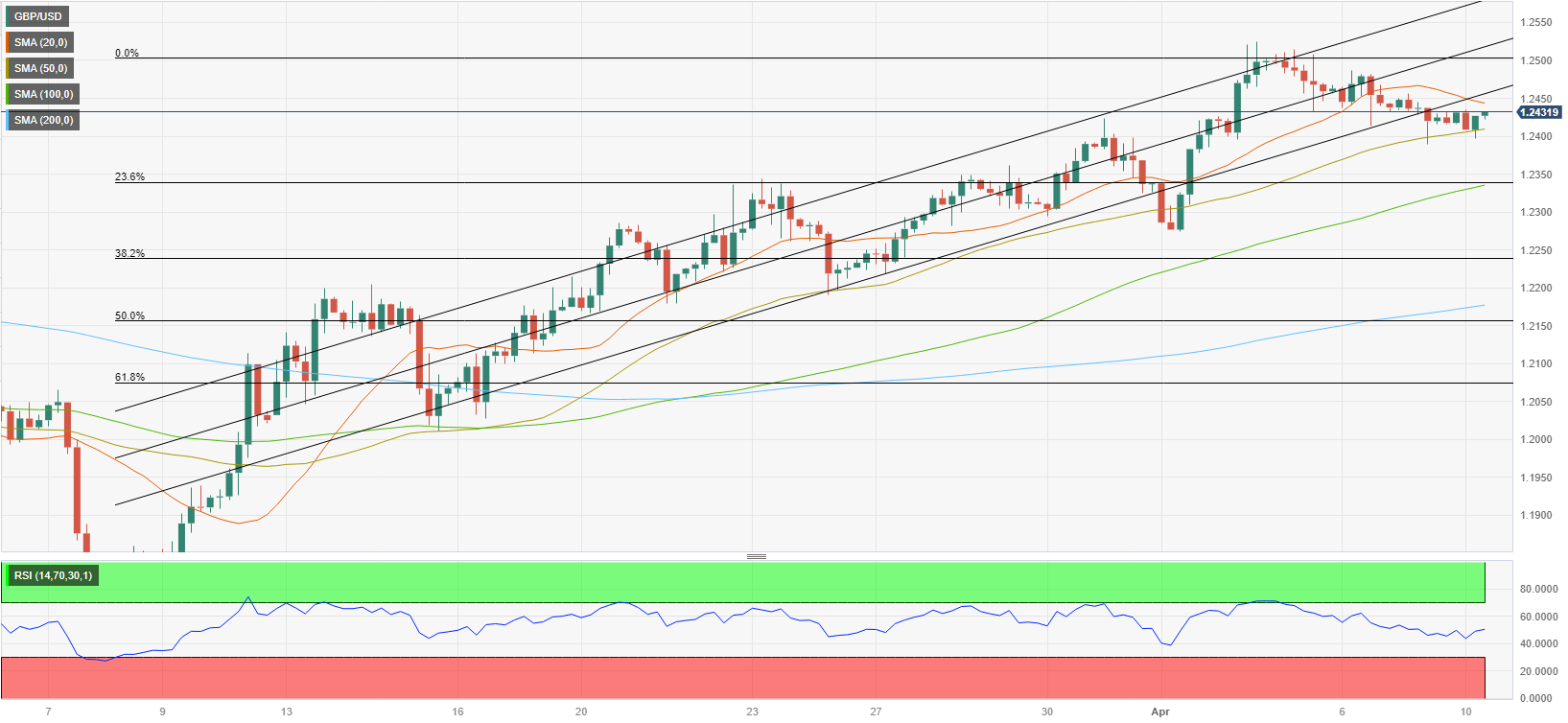
GBP/USD trades slightly below the lower limit of the ascending regression channel but the 50-period Simple Moving Average (SMA) on the four-hour chart stays intact as support. Meanwhile, the Relative Strength Index (RSI) indicator has recovered toward 50, reflecting the sellers' unwillingness.
On the downside, 1.2400 (psychological level, static level, 50-period SMA) aligns as first support. With a four-hour close below that level, additional losses toward 1.2350 (100-period SMA, Fibonacci 23.6% retracement of the latest uptrend) and 1.2300 (psychological level, static level) could be witnessed.
In case the pair rises above 1.2450 (lower limit of the ascending channel, 20-period SMA), buyers could show interest and GBP/USD could target 1.2500 (psychological level, static level) and 1.2525 (April 4 high).
Author

Eren Sengezer
FXStreet
As an economist at heart, Eren Sengezer specializes in the assessment of the short-term and long-term impacts of macroeconomic data, central bank policies and political developments on financial assets.
















