|

GBP/USD Forecast: Holding around 1.3700, bears cautious

GBP/USD Current price: 1.3701

  • The market’s mood deteriorated on the poor performance of Chinese equities.
  • US Federal Reserve Chief Jerome Powell will host an online event.
  • GBP/USD retreated from weekly highs, could extend its decline in the near term.
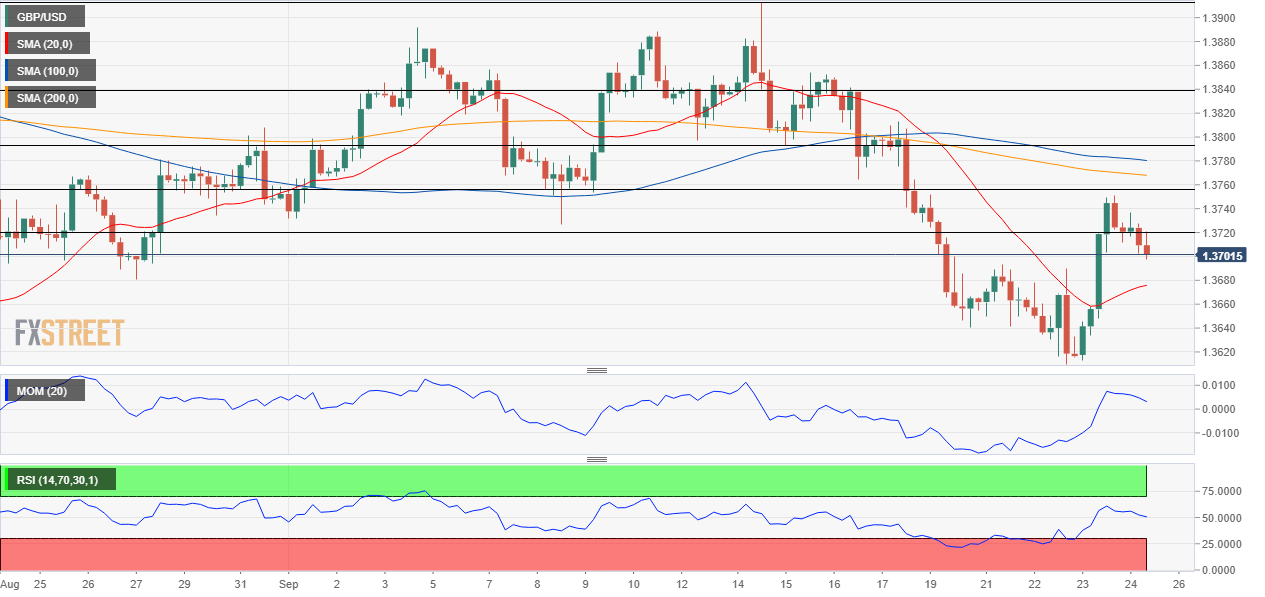
The greenback pared losses as the market’s optimism receded on the back of the poor performance of Chinese equities. The GBP/USD pair retreated from a weekly high at 1.3750, currently trading around the 13700 figure. The dollar strengthens particularly against commodity-linked currencies, while European rivals seem to be baring better with the downbeat mood. At the time being, European indexes post modest intraday losses, while US government bond yields retain gains at multi-month highs.

The macroeconomic calendar has nothing to offer this Friday, as the UK did not release macroeconomic figures, while the US will publish August New Home Sales. US Federal Reserve Chairman Jerome Powell will participate in an online event hosted by the central bank, although it seems quite unlikely that he will make fresh comments on monetary policy.

 GBP/USD short-term technical outlook

The GBP/USD pair is trading again below the 61.8% retracement of its latest daily advance, which increases the risk of a downward extension in the near term. Still, it seems sellers remain side-lined. The 4-hour chart shows that the pair remains above a mildly bullish 20 SMA, which seems to be losing its bullish strength while holding below the longer ones. Meanwhile, technical indicators head south, although within positive levels. Bears will have chances if the pair falls below 1.3680, the immediate support level.

 Support levels: 1.3680 1.3640 1.3600  

Resistance levels: 1.3720 1.3760 1.3805

View Live Chart for the GBP/USD

Author

Valeria Bednarik

Valeria Bednarik was born and lives in Buenos Aires, Argentina. Her passion for math and numbers pushed her into studying economics in her younger years.


More from Valeria Bednarik
Share:

Editor's Picks

GBP/USD extends the drop to 1.3360

GBP/USD builds on Monday’s decline and briefly clinches five-day lows near 1.3360 on Tuesday. Cable’s extra pullback follows the better tone in the Greenback as uncertainty in the Middle East prompts investors to adopt a cautious stance. Meanwhile, an apathetic UK labour market report also collaborates with the selling pressure on the British Pound.

EUR/USD stays offered just above 1.1400

EUR/USD keeps the downtrend well in place for yet another day, challenging the 1.1400 contention zone on Tuesday. The continuation of the selling impulse in spot comes amid decent gains in the US Dollar, which continues to find support in the persistent effervescence surrounding the US-Iran crisis.

Middle East crisis intensifies, Gold up

Gold now seems to have embarked on a consolidative phase below the key $4,100 mark per troy ounce in the latter part of Tuesday’s session. Meanwhile, uncertainty surrounding the Middle East conflict and rising expectations for a hawkish Fed policy outlook are expected to limit the precious metal’s bullish momentum in the near term.

XRP rebounds on rising on-chain activity
Ripple (XRP) ticks up and trades around $1.13 at the time of writing on Tuesday. This rebound aligns with a broader recovery in the cryptocurrency market, attributed to reports that mediators between the United States (US) and Iran are seeking a 10-day cessation of strikes to find a way back to the signed Memorandum of Understanding (MoU).
The Iranian war has again risen
The Iranian war has again risen to the top of the economics factor list. There is no end in sight. Intelligence experts say the current level of offense/retaliation will not change minds in Tehran, while in Washington, Trump fears all-out war, which would mean boots on the ground.
US Dollar mid-year outlook: Exceptional currency, exceptional risks?
The US Dollar enters the second half of 2026 in a markedly different position from a year ago. The King currency has recovered, reflecting persistent US inflation, changing expectations for Fed policy, geopolitical tensions and renewed demand for defensive assets.