|

GBP/USD flatlines near channel’s upper band

  • GBP/USD takes a breather after hitting a five-month high.

  • Overbought signals strengthen as price tests key resistance.

GBPUSD

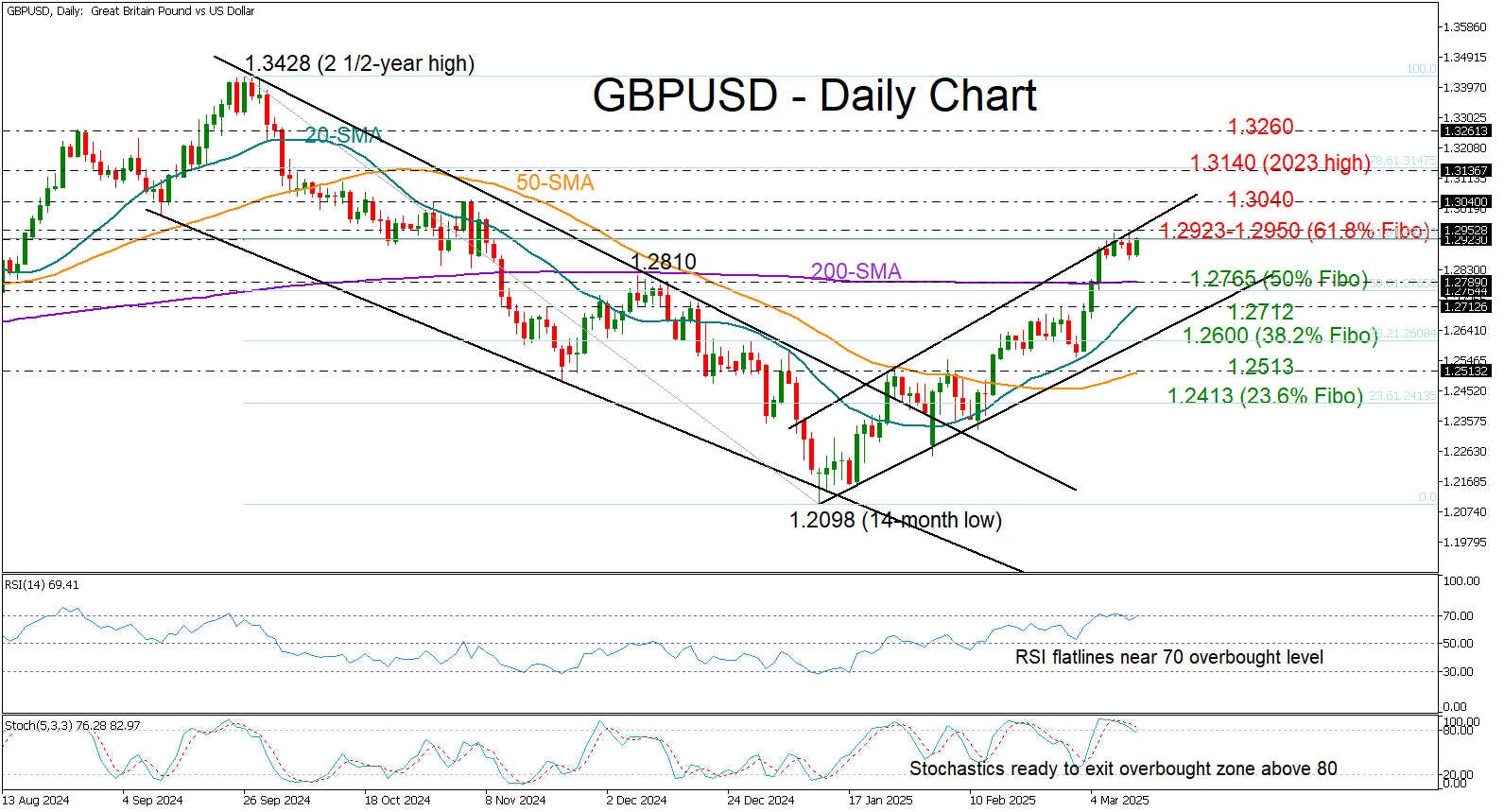
GBPUSD has been treading water around the 1.2923 level, struggling to gain further traction after its March bull run stalled near the upper boundary of its bullish channel.

The pair surged as high as 1.2945 last week, marking its highest level since November 2024. However, strengthening overbought signals suggest the recent rally may be losing steam, as the RSI and the stochastic oscillator seem to have peaked above 30 and 20, respectively.

A decisive breakout above the 1.2923-1.2950 resistance—aligned with the 61.8% Fibonacci retracement of the prior downtrend—could reignite buying interest. If the November peak of 1.3040 is surpassed, momentum could build toward the 2023 high of 1.3140, with the next resistance possibly emerging near 1.3260, a key barrier from August 2024 and March 2022.

On the flip side, if sellers regain control, the pair may retreat toward the 200-day simple moving average (SMA), which hovers just above the 50% Fibonacci level of 1.2765, and the 20-day SMA at 1.2712. Further losses could bring the lower band of the bullish channel into play around the 38.2% Fibonacci level of 1.2600, ahead of the 50-day SMA at 1.2513.

In summary, GBPUSD is at a crucial juncture. A push beyond 1.2950 and out of the bullish channel could inject fresh momentum. Otherwise, the next move could see the pair sliding backwards.

Author

Christina Parthenidou

Christina joined the XM investment research department in May 2017. She holds a master degree in Economics and Business from the Erasmus University Rotterdam with a specialization in International economics.


More from Christina Parthenidou
Share:

Editor's Picks

AUD/USD stuck as the RBA talks tough into a slowdown

The Australian Dollar is going nowhere in a hurry, and the contradiction at its core explains why. The Reserve Bank of Australia keeps dangling the prospect of another hike, yet the economy it governs just expanded 0.3% in the first quarter, a clear step down from the prior pace. A central bank threatening to tighten into a visible slowdown is not a recipe for conviction in either direction, and the tape shows it.

USD/JPY: Japanese Yen coiled at the line, leaning on everyone but Japan

The Yen is doing very little, and that stasis is the whole story. USD/JPY sits glued near 160.00 not because Japan has found new strength, but because two outside forces are fighting to a draw over it: a US rate complex that keeps the dollar bid, and a Ministry of Finance that refuses to let the line break.

Gold declines below $4,500 on stalled US-Iran ceasefire talks, US NFP data looms

Gold price edges lower to near $4,470 during the early Asian session on Friday. The precious metal remains volatile amid ongoing geopolitical turmoil. Traders will closely monitor the developments surrounding the US-Iran peace deal and the US May employment report later on Friday. 


DeFi hack losses drop 80% from 2022 peak as security defenses improve — Immunefi

Losses from decentralized finance exploits have fallen by 80% since reaching a record high in 2022, according to a report released by Immunefi. The report, which analyzed exploit-driven losses across major blockchain ecosystems between 2020 and 2025, found that DeFi protocol losses declined from $2.62 billion in 2022 to $534 million in 2024.

Nonfarm payrolls: Testing the limits of Fed policy patience

The upcoming nonfarm payrolls report for May will provide the final update on the US labor market before Kevin Warsh attends his first policy meeting as the new Fed Chair later this month.

Recession on paper: What really moves the Canadian Loonie now?

Statistics Canada handed the headline writers a gift and the analysts a headache. Real GDP shrank 0.1% on an annualized basis in the first quarter, and with the fourth quarter of 2025 revised down to a 1.0% contraction, that is two negative quarters in a row, the textbook definition of a technical recession and Canada's first since the pandemic.