|

GBP/USD Elliott Wave: Medium-term top

Executive summary

  • GBPUSD appears to be progressing lower in the final leg of wave 2.
  • Downside targets include 1.31 and possibly 1.28.
  • If Wednesday’s high of 1.3726 is broken, then we’ll reconsider the wave count.

GBP/USD Elliott Wave count
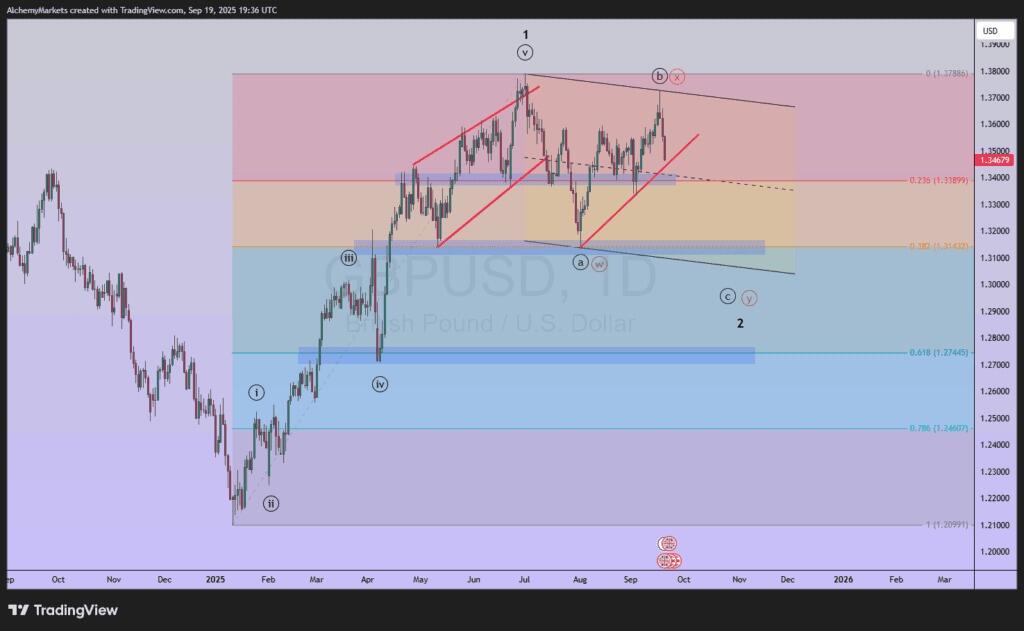
It appears that Cable completed wave ((b)) or ((x)) of wave 2 at Wednesday’s high of 1.3726. This means a multi-hundred pip decline is underway in wave ((c)) or ((y)) of 2. This decline likely carries down to 1.31 and possibly 1.28.

If the decline unfolds in 5-waves, then we’ll consider it to be wave ((c)), a five-wave Elliott wave pattern. If the decline unfolds in 3-waves, then we’ll consider it to be wave ((y)), a double zigzag pattern.

GBP/USD is approaching an upward sloping support trend line that has been in place since August. If this trend line breaks, then it opens the door to 1.31 and possibly lower levels.

Part of the reason to consider 1.31 a target zone is that the previous decline on August 4 reached a low of 1.3141. On May 12, GBPUSD reached a low of 1.3139. Then, on April 3, GBPUSD spiked higher and left a long topside wick piercing this same 1.3140 price zone. Additionally, there is a 38% Fibonacci retracement level near that price at 1.3143.

Bottom line

GBP/USD has been grinding sideways in wave 2 since July. A medium term top was reached earlier this week on September 17. Now it appears a strong leg lower has begun that may reach 1.28-1.31.

If Wednesday’s high of 1.3726 is breached, then we’ll reconsider the wave count.

Author

Zorrays Junaid

Zorrays Junaid

Alchemy Markets

Zorrays Junaid has extensive combined experience in the financial markets as a portfolio manager and trading coach. More recently, he is an Analyst with Alchemy Markets, and has contributed to DailyFX and Elliott Wave Forecast in the past.


More from Zorrays Junaid
Share:

Editor's Picks

AUD/USD stays defensive below 0.7150 after Chinese data

AUD/USD remains on the back foot below 0.7150 in the Asian session on Tuesday, close to an over three-week low touched the previous day. US bond yields hold near multi-year highs ahead of the FOMC meeting and oil-driven inflation risks, supporting the US Dollar and weighing on the currency pair. Mixed Chinese activity data for August also fail to inspire the Aussie.

USD/JPY extends gains toward 155.00 amid USD resurgence

USD/JPY keeps pushing higher toward 155.00 early Tuesday, looking for more upside, as traders await the FOMC and BoJ meetings this week. Meanwhile, Fed rate-hike bets and oil-driven inflation risks keep US bond yields near multi-year highs, supporting the US Dollar and the pair. That said, a more hawkish repricing of the BoJ normalization path might continue to underpin the Japanese Yen and could limit USD/JPY's upside. .

Gold set to fall toward $4,000 as Warsh faces a Fed rate-hike dilemma

As the Federal Reserve monetary policy announcement approaches and the Middle East war intensifies, the US Dollar resumes its advance. Gold price posted a tepid attempt to recover its shine in early August, but with renewed USD demand, the bright metal faltered miserably and is now closer to the $4,000 mark than the encouraging $4,700 peak from a month ago.


Ripple, Cardano, Hyperliquid – Easing bullish momentum sparks downside risks

Top altcoins, including Ripple (XRP), Cardano (ADA), and Hyperliquid (HYPE), are trading in the red on Tuesday, with roughly 2% losses so far. The altcoins are facing downside pressure ahead of the CLARITY Act cloture vote scheduled for Tuesday.

Markets slide as FOMC approaches
The US Dollar remains strong as markets turn increasingly cautious ahead of the FOMC. Stocks are tumbling, while Gold and Silver are moving lower under pressure from the stronger Dollar. The Japanese Yen is weaker again, while Crypto is correcting. BTC is approaching a key technical test and could fall below its 50-week moving average, while ETH remains above $2,405.
Venezuela’s 65-billion-barrel Oil deal could reshape America’s inflation fight
The United States (US) has secured unprecedented access to part of Venezuela’s vast Oil reserves. The timing is particularly significant as the war with Iran is disrupting Middle Eastern supplies, keeping energy prices elevated and reviving concerns about inflation.