|

GBP/USD analysis: total collapse didn't take too long

GBP/USD Current price: 1.2377

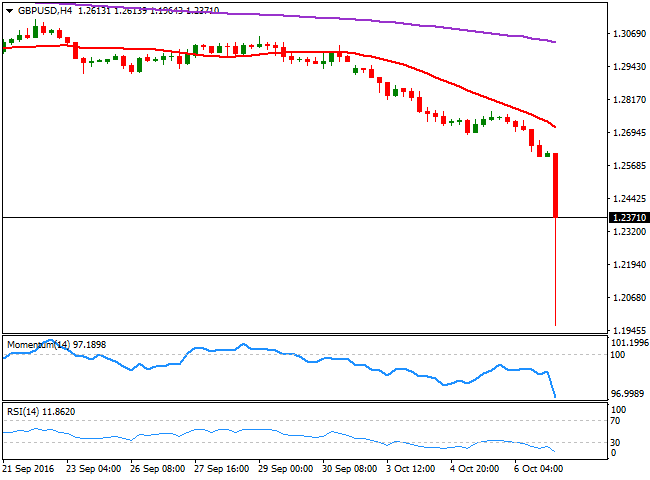
Pound's collapse continued this Thursday, with the GBP/USD pair sinking to fresh 31-year lows of 1.2601, and shedding additional 400 pips or a whopping 5% early Asia, in a matter of minutes. Ahead of the Nikkei opening, the pair is trading with a 10 pips spread of more, and with charts showing lows below 1.2000 but with no clear consensus over what triggered the slide, neither which was the actual low of such wild 5-minutes move. This kind of sharp moves in an extremely bearish, sentiment-driven market, are usually the beginning of the end of such dominant trend, but it may not be the case this time, given that political uncertainty and economic deterioration, will only worsen from here.
The FTSE 100 soared on a cheaper currency, as most of the listed companies get their incomes from abroad. What speculative interest forgot, is that those companies also have to buy their producer materials abroad, and are clearly more expensive. Easyjet was the first to lift a red flag, warning that the weak pound would cost the company £90m this financial year, with shares closing the day 6.93% lower.

The pair quickly bounced back to around 1.2400, and technical readings are currently extremely distorted by the sharp decline, as indicators in almost every intraday timeframe maintain sharp bearish slopes within extreme oversold levels. Still, as long as below 1.2500 the risk will remain towards the downside, whilst above this level, the pair can quickly recover up to 1.2600. More wild swings should be expected for the upcoming sessions, with investors now waiting for a positive US Payroll to resume selling at whatever level the pair stands by then.

Support levels: 1.2340 1.2290 1.2250

Resistance levels: 1.2420 1.2460 1.2510

View Live Chart for the GBP/USD

Author

Valeria Bednarik

Valeria Bednarik was born and lives in Buenos Aires, Argentina. Her passion for math and numbers pushed her into studying economics in her younger years.


More from Valeria Bednarik
Share:

Editor's Picks

Japanese Yen gains ground as traders await Fed rate decision

The USD/JPY pair loses ground to near 160.25 during the early European trading hours. Traders prefer to wait on the sidelines ahead of the US Federal Reserve interest rate decision under new Chair Kevin Warsh later on Wednesday.

AUD/USD stays pressured; holds above 0.7050 as traders await Fed decision

The AUD/USD pair struggles to capitalize on the previous day's hawkish Reserve Bank of Australia-inspired bounce and trades with a negative bias for the second consecutive day on Wednesday. Spot prices, however, hold above the 0.7050 level as traders opt to wait for the outcome of a two-day FOMC policy meeting before placing fresh directional bets.

Gold remains depressed but holds above $4,300 as traders seem hesitant ahead of Fed

Gold remains on the back foot heading into the European session, though it lacks follow-through selling and holds comfortably above the $4,300 mark. Traders now seem hesitant ahead of the highly anticipated FOMC policy decision, keeping the commodity below the weekly high.

DOGE near breakout, SHIB at its ceiling and PEPE leads meme coin recovery

Meme coins are approaching a key technical level, which could determine the next directional bias. Dogecoin struggles to overcome a major resistance level, and Shiba Inu recovery lost momentum near a crucial barrier. Meanwhile, Pepe extends its rally for a sixth straight day, raising the prospects of further upside if momentum persists.

The most important event will be the Fed meeting with Mr. Warsh now in charge

The most important event will be the Fed meeting on Wednesday, with Mr. Warsh now in charge. As more than one analyst points out, the case for holding rates the same is strengthened by the Iran deal and the prospect of the Strait re-opening, although nobody thinks Warsh can marshal enough doves to do a cut this time.

Why a hawkish RBA is no longer enough to lift the Australian Dollar

The Reserve Bank of Australia delivered more than what markets expected: a hawkish hold that should have supported the Aussie. But markets widely ignored it, focusing instead on slowing economic growth and proving that central bank messaging alone isn’t always enough to drive currencies.















