|

GBP/USD analysis: pressuring 1.3100, no light at the end of the Brexit tunnel

GBP/USD Current price: 1.3122

  • UK PM May wants future customs relationship with the EU to be in place by the end of 2020.
  • USD broad strength dominated the FX board, hurting further high-yielding Pound.
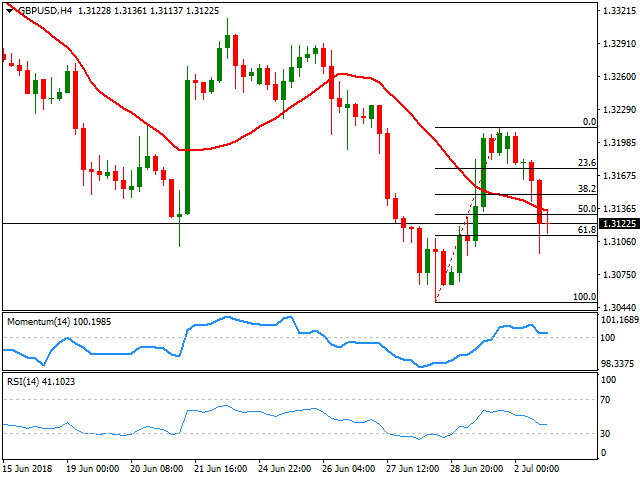
The GBP/USD pair fell to 1.3094 on the back of dollar's strength, and the lack of progress in Brexit negotiations. UK PM Theresa May was on the wires this Monday, saying that they want future customs relationship with the EU to be in place by the end of 2020 to ensure a backstop wouldn't be necessary, but the problem remains the same: she doesn't explain the "how." The UK Markit Manufacturing PMI came in at 54.4 for June, beating the expected 54.6, but the report did little to help the Pound. Meanwhile, MPC Haldane spoke, all of the sudden taking center stage after joining the hiking club in the latest BOE's meeting, saying that the EU exit is the biggest economic risk the central bank faces. The UK calendar has nothing to offer this Tuesday. The pair fell below the 50% retracement of its latest bullish run, and the 4 hours chart shows that is now finding sellers around a bearish 20 SMA, a few pips above the Fibonacci level, making of the 1.3140 area the immediate resistance. Technical indicators in the mentioned chart have retreated, turning flat in the US afternoon, with the Momentum still above its 100 level but the RSI at around 40, leaning the scale toward the downside.

Support levels: 1.3095 1.3050 1.3010  

Resistance levels: 1.3140 1.3185 1.3220

View Live Chart for the GBP/USD

Author

Valeria Bednarik

Valeria Bednarik was born and lives in Buenos Aires, Argentina. Her passion for math and numbers pushed her into studying economics in her younger years.


More from Valeria Bednarik
Share:

Editor's Picks

AUD/USD bulls regain control above 0.6950 amid USD retreat

AUD/USD regains traction and extends the previous day's bounce from the weekly low, aiming for 0.7000 in Asia on Friday. The overnight pullback in US bond yields keeps the US Dollar below an 18-month high, which in turn offers some support to the pair. Meanwhile, hawkish RBA expectations also keep the major underpinned.

USD/JPY holds gains near 158.00 after Japan's weak Household Spending data

USD/JPY clings to gains around 158.00 after data showed on Friday that Japan's Household Spending fell for the ninth straight month, undermining the Japanese Yen. Meanwhile, the US Dollar remains depressed as the overnight fall in US bond yields counters a hawkish Fed and geopolitical uncertainties, could cap any downside in the pair.

Gold remains range-bound below $4,200

Gold has given up some ground after an initial bullish attempt to reach weekly highs, returning to below the $4,200 mark per troy ounce on Friday. The US Dollar’s strong upside momentum, combined with rising US Treasury yields across the curve, seems to keep further gains in the yellow metal under scrutiny.

Has Bitcoin really escaped the macro forces it was built to fight?
Over 17 years ago, Satoshi Nakamoto designed Bitcoin (BTC) on the back of a global financial crisis as an alternative to the global monetary system outside the control of central banks, governments and traditional intermediaries. This raises a key question: has Bitcoin really become independent of the macroeconomic forces it was built to challenge?
The Euro is not the sick man of Europe. France's bond market is
EUR/USD remains under pressure, near the 17-month low of 1.1161 reached on Monday. The pair has lost more than 7% since its yearly peak, as concerns over France's public finances increasingly weigh on the single currency. But behind the weakness of the Euro (EUR), the problem does not necessarily lie with the European economy as a whole.
Has Bitcoin really escaped the macro forces it was built to fight?
Over 17 years ago, Satoshi Nakamoto designed Bitcoin (BTC) on the back of a global financial crisis as an alternative to the global monetary system outside the control of central banks, governments and traditional intermediaries. This raises a key question: has Bitcoin really become independent of the macroeconomic forces it was built to challenge?














